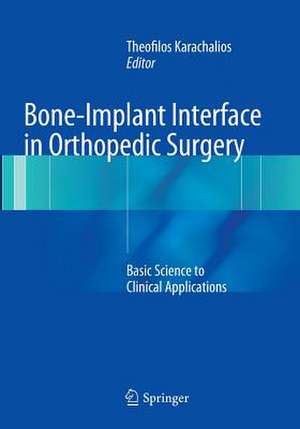
Bone-Implant Interface in Orthopedic Surgery
Editat de Theofilos Karachaliosen Limba Engleză Paperback – 23 aug 2016
Tabelele sintetice, figurile și imaginile clinice constituie fundamentul vizual al acestui volum, facilitând înțelegerea proceselor complexe de osteointegrare. În Bone-Implant Interface in Orthopedic Surgery, editorul Theofilos Karachalios abordează punctul critic al succesului pe termen lung în artroplastia totală: stabilitatea biologică și mecanică a zonei de contact dintre proteză și os. Considerăm că valoarea acestui tratat rezidă în capacitatea de a traduce limbajul tehnic al cercetătorilor în soluții pragmatice pentru sala de operație.
Structura volumului este riguros organizată, pornind de la o privire de ansamblu asupra designului suprafețelor de fixare în artroplastia de șold, continuând cu analiza detaliată a interfețelor specifice: de la acoperirile poroase cu titan sau cobalt-crom, până la tehnologiile de sablare (grit blasted) și straturile de hidroxiapatită. Clinicienii care folosesc Implant Bone Interface de John Older ca referință vor găsi aici o completare necesară privind noile materiale metalice trabeculare și mecanismele moleculare ale slăbirii aseptice. Subliniem relevanța capitolelor dedicate reviziilor de artroplastie, unde interfața ciment-os necesită o abordare distinctă față de intervențiile primare.
Apreciem continuitatea academică a editorului; dacă în lucrarea sa anterioară, Total Knee Arthroplasty, Theofilos Karachalios s-a concentrat pe designul optim și standardele de aur în reconstrucția genunchiului, volumul de față extinde perspectiva asupra bazelor biologice ale fixării aplicabile tuturor articulațiilor mari. Este o resursă care elimină discrepanța dintre datele de laborator și realitatea chirurgicală, oferind o analiză critică a metodelor de îmbunătățire a încorporării implantului.
Preț: 761.45 lei
Preț vechi: 801.52 lei
-5%
Carte tipărită la comandă
Livrare economică 08-22 iunie
Specificații
ISBN-10: 1447170946
Pagini: 356
Ilustrații: XI, 342 p. 117 illus., 51 illus. in color.
Dimensiuni: 178 x 254 x 20 mm
Greutate: 0.67 kg
Ediția:Softcover reprint of the original 1st edition 2014
Editura: Springer
Locul publicării:London, United Kingdom
V-ar putea interesa
-
 Misch's Contemporary Implant DentistryRandolph Resnik-32%Preț: 1216.17 lei1796.75 lei
 -
 Surgery of the Hip: Expert Consult - Online and PrintDaniel J. Berry-29%Preț: 1599.34 lei2247.55 lei
 -
 Evaluation and Management of Hip and Knee Arthritis in WomenClaudette M. Lajam-30%Preț: 1282.53 lei1825.27 lei
 -
 Atlas of Orthoses and Assistive DevicesDouglas P. Murphy-29%Preț: 1093.52 lei1542.40 leiRecomandat
 -
 -24%Preț: 1770.85 lei2325.88 lei
 -
 The Adult Hip (Two Volume Set): Hip Arthroplasty SurgeryDr. John J. Callaghan-22%Preț: 2761.07 lei3562.58 lei
 -
 Techniques in Revision Hip and Knee ArthroplastyGiles R Scuderi-33%Preț: 1041.89 lei1555.03 lei
 -
 Principles and Practice of Single Implant and RestorationMahmoud Torabinejad-26%Preț: 602.46 lei811.47 lei
 -
 Joint Replacement Arthroplasty: Basic Science, Hip, Knee, and AnkleBernard F. Morrey MD-26%Preț: 1923.35 lei2582.44 lei
 -
 Reverse Shoulder ArthroplastyDavid M Dines-5%Preț: 1205.92 lei1269.38 lei
 -
 -30%Preț: 1634.83 lei2330.88 lei
 -
 Essentials of Orthopedic SurgeryWilliam F. Postma-5%Preț: 442.50 lei465.79 lei
 -
 Complications after Primary Total Hip ArthroplastyMatthew P. Abdel-5%Preț: 824.19 lei867.56 lei
 -
 -5%Preț: 686.36 lei722.48 lei
 -
 -5%Preț: 355.28 lei373.98 lei
 -
 -5%Preț: 687.74 lei723.94 lei
 -
 -5%Preț: 1117.83 lei1176.66 lei
 -
 Biomechanics of Joints and ImplantsSanjay Gupta-5%Preț: 771.44 lei812.04 lei
 -
 Advances in Total Hip ArthroplastyYasuharu Nakashima-5%Preț: 1280.70 lei1348.10 lei
 -
 Hip ArthroplastyMrinal Sharma-5%Preț: 1277.03 lei1344.24 lei
De ce să citești această carte
Această lucrare se adresează chirurgilor ortopezi și cercetătorilor în biomateriale care doresc să înțeleagă de ce anumite implanturi eșuează în timp ce altele ating o supraviețuire pe termen lung. Cititorul câștigă o înțelegere profundă a interacțiunii dintre metal, ciment și țesut viu, esențială pentru optimizarea rezultatelor clinice și selectarea corectă a tipului de proteză în funcție de calitatea osoasă a pacientului.
Descriere scurtă
Cuprins
Recenzii
“This book provides a general overview of many of the aspects and concerns regarding the physical and chemical interactions that take place where an implant meets the bone, mainly with regard to total hip replacement. … the book will be best appreciated by surgeons, scientists, and engineers who have an interest in this very focused area.” (Samuel J. Chmell, Doody’s Book Reviews, February, 2014)
Textul de pe ultima copertă
What is the gold standard for the management of patients requiring implants?
Is there scope for improvement still further?
Huge efforts have been made both by research scientists in orthopedics and the implant industry to furthering the options available for arthroplasty without necessarily considering the cost-effectiveness of this research to clinical outcomes. It has also become apparent that theoretical and laboratory studies do not always match the results of long-term clinical studies of which there regretfully few of sufficient quality.
The Editor and his carefully chosen selection of contributors critically evaluate data from basic science, experimental in vivo and in vitro biological and mechanical models, autopsy specimens and long-term clinical studies to answer these questions.
Bone-Implant Interface in Orthopedic Surgery: Basic Science to Clinical Applications focuses on the bone-orthopedic implant interface in general and will be useful both for the novice who seeks a quick introduction to this specific topic and for more experienced surgeons who seek an in depth critical review of current practices.