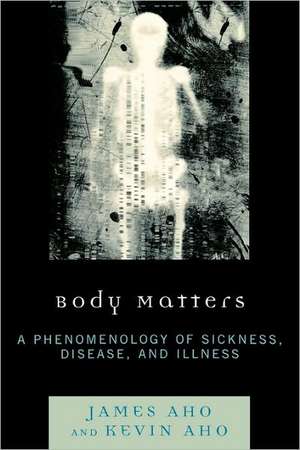
Body Matters
Autor James Aho, Kevin Ahoen Limba Engleză Hardback – iun 2008
Pregătirea pentru examenul de specialitate sau pentru certificările de board în domenii ce intersectează medicina cu științele socio-umane necesită o înțelegere profundă a modului în care percepem corpul uman. În lucrarea Body Matters, James Aho și Kevin Aho propun o analiză clinică și fenomenologică a afecțiunilor corporale, invitând la o întoarcere „la lucrurile în sine”. Găsim în această carte o deconstrucție riguroasă a presupunerilor implicite pe care profesioniștii din sănătate le au despre suferință, oferind în schimb un cadru conceptual care integrează dimensiunea istorică și socială a bolii. Reținem distincția fundamentală preluată din fenomenologia germană între Körper (corpul fizic, obiectiv) și Leib (corpul viu, trăit). Această dualitate este esențială pentru a înțelege de ce comunicarea dintre medic și pacient eșuează adesea. Structura cărții urmărește o progresie logică: după stabilirea bazelor teoretice în primele capitole, autorii explorează „corpul accelerat” și patologiile sale, culminând cu o viziune constructivă asupra terapiilor mai umane. Manual de referință comparabil cu The Meaning of Illness de S. Kay Toombs, dar actualizat pentru a răspunde provocărilor contemporane de bioetică și medicină narativă, volumul se distinge prin abordarea interdisciplinară. Poziționăm această lucrare în contextul operei lui James Aho, în special în relație cu Sociological Trespasses. Dacă în lucrările anterioare autorul explora violența colectivă sau rasismul ca probleme sociale, în Body Matters focalizarea se mută pe obsesia pentru corp și accelerarea vieții, privite nu ca probleme tehnice, ci ca fenomene ce necesită o abordare terapeutică „artistică” și umanistă. Recomandăm acest volum celor care doresc să depășească limitele rigide ale biomedicinei tehnologizate.
Preț: 704.73 lei
Preț vechi: 870.04 lei
-19%
Carte tipărită la comandă
Livrare economică 16-30 noiembrie
Specificații
ISBN-10: 0739126989
Pagini: 206
Dimensiuni: 157 x 235 x 17 mm
Greutate: 0.49 kg
Ediția:1
Editura: Bloomsbury Publishing
Locul publicării:New York, United States
V-ar putea interesa
-
 -20%Preț: 312.43 lei388.81 lei
 -
 Phenomenology of IllnessHavi Carel-22%Preț: 213.53 lei272.68 lei
 -
 Action and InteractionShaun GallagherPreț: 350.25 lei
 -
 Enactivist Interventions: Rethinking the MindShaun Gallagher-16%Preț: 218.46 lei259.15 lei
 -
 The Embodied Mind, revised editionEleanor Rosch-20%Preț: 225.75 lei283.16 lei
 -
 The Seminar of Jacques Lacan: Freud's Papers on TechniqueJacques Alain-MillerPreț: 146.21 lei
 -
 The Seminar of Jacques Lacan – Book IIIJacques LacanPreț: 157.81 lei
 -
 Preț: 157.94 lei
 -
 The Seminar of Jacques LacanJacques LacanPreț: 138.71 lei
 -
 On Feminine Sexuality, the Limits of Love and KnowledgeJacques LacanPreț: 118.38 lei
 -
 EcritsJacques LacanPreț: 245.40 lei
 -
 The Seminar of Jacques LacanJacques LacanPreț: 124.11 lei
 -
 Preț: 175.17 lei
 -
 Preț: 416.87 lei
 -
 The Object RelationJacques Lacan-19%Preț: 453.82 lei560.27 lei
 -
 Preț: 163.04 lei
 -
 The Enigma of Health: The Art of Healing in a Scientific AgeHans-Georg GadamerPreț: 152.37 lei
 -
 Illness: The cry of the fleshHavi CarelPreț: 312.59 lei
 -
 Desire and its InterpretationJacques LacanPreț: 171.46 lei
 -
 AnxietyJacques LacanPreț: 134.28 lei
 -
 The SinthomeJacques LacanPreț: 157.36 lei
 -
 Transference - The Seminar of Jacques Lacan, Book VIIIJacques LacanPreț: 160.94 lei
 -
 -26%Preț: 286.94 lei389.41 lei
 -
 Ethics of the RealAlenka ZupancicPreț: 141.09 lei
 -
 -19%Preț: 68.80 lei85.28 lei
De ce să citești această carte
Recomandăm această carte profesioniștilor din oncologie, psihoterapie și îngrijiri paliative care doresc să înțeleagă discrepanța dintre diagnosticul clinic și suferința resimțită de pacient. Cititorul câștigă un aparat critic valoros pentru a naviga relația medic-pacient, învățând să trateze nu doar „disease” (patologia), ci și „illness” (experiența trăită). Este o resursă esențială pentru oricine activează în domeniul medicinei umaniste.
Despre autor
James A. Aho este profesor de sociologie la Idaho State University, unde activează din 1969. Autor prolific, opera sa explorează sociologia inamicului, violența colectivă și fenomenele sociale marginale prin lucrări precum „Religious Mythology and the Art of War”. Kevin Aho este profesor de filozofie la Florida Gulf Coast University, specializat în fenomenologie și filozofia medicinei. Împreună, cei doi combină rigoarea sociologică cu profunzimea existențială pentru a analiza corpul uman, continuând temele de etică și sănătate explorate de Kevin în seria New Heidegger Research.
Descriere
To make their case, they draw on examples from a multiplicity of disciplines and cultures as well as a number of cases from Euro-American history. The intent is to unsettle taken-for-granted assumptions that readers may have about body troubles. These are assumptions widely held as well by medical and allied health professionals, in addition to many sociologists and philosophers of health and illness. To this end, Body Matters does not simply deconstruct prejudices of mainstream biomedicine; it also constructively envisions more humane and artful forms of therapy.
Cuprins
Recenzii
James and Kevin Aho have written an important book.
The Ahos accomplish a remarkable feat. Their writing is lively and engaging while their observations are deep and important. This is the most insightful study of today's experience of health matters I have yet seen.
The book is a great contribution to the critical literature on health and illnesses. It is unique in its attempt to apply Husserl and Heidegger to health and illness..It is elegantly written and filled with numerous examples illustrating the argumentation.
This book should be especially welcomed by those working within medical humanities, though not so much by philosophers and others interested in phenomenology...It brings together, even if in a much simplified way, a set of intuitions originating mainly in Edmund Husserl's phenomenology, neatly synthesizes and applies them to modern biomedicine with a critical intent. The outcome is comprehensive as far as the phenomenologically inspired divergent conceptualizations of pathological states of mind and body are concerned, and it is also often thought-provoking, well written and accessible to newcomers to the field.