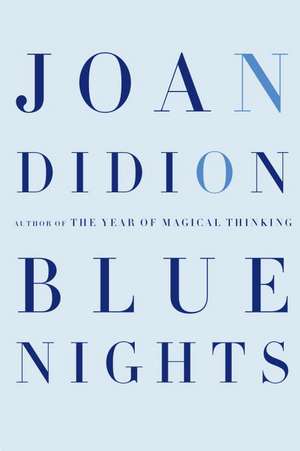
Blue Nights
Autor Joan Didionen Limba Engleză Hardback – noi 2011
Există momente în viață când lumina pare să zăbovească mai mult pe cer, un fenomen pe care Joan Didion îl numește „nopți albastre” — acele ore lungi de amurg care preced solstițiul de vară. Apreciem acest volum nu doar ca pe o cronică a durerii, ci ca pe o analiză lucidă a fragilității umane, scrisă în acele momente în care reflexia asupra trecutului devine inevitabilă. Cartea pornește de la o dată precisă, 26 iulie 2010, aniversarea nunții fiicei sale, eveniment care declanșează o serie de amintiri fragmentate din Malibu sau Brentwood, transformându-se rapid într-o meditație profundă despre pierderea lui Quintana Roo. Ca și The Year of Magical Thinking, acest volum pune accent pe procesarea pierderii și pe vulnerabilitatea extremă a individului, dar cu un stil propriu de o onestitate tăioasă, aproape clinică, îndreptată spre sine. Dacă în lucrările anterioare, precum Play It As It Lays, Didion diseca societatea americană cu o detașare cinică, în Blue Nights ea își întoarce bisturiul spre propriile temeri legate de bătrânețe și de rolul de mamă. Reținem interogațiile dureroase despre semnele ignorate în creșterea copilului și despre acea barieră de necunoscut care rămâne mereu între părinte și fiică. Ritmul este unul melancolic, dar precis, oferind o perspectivă rară asupra modului în care acceptăm (sau refuzăm să acceptăm) declinul fizic și emoțional.
Preț: 173.54 lei
Carte disponibilă
Livrare economică 17 noiembrie-01 decembrie
Specificații
ISBN-10: 0307267679
Pagini: 208
Dimensiuni: 141 x 207 x 25 mm
Greutate: 0.32 kg
Editura: Knopf Doubleday Publishing Group
Locul publicării:New York, NY
V-ar putea interesa
-
 The Year of Magical ThinkingJoan DidionPreț: 78.53 lei
 -
 Play It As It LaysJoan DidionPreț: 71.36 lei
 -
 Slouching Towards BethlehemJoan DidionPreț: 71.72 lei
 -
 Let Me Tell You What I MeanJoan DidionPreț: 78.57 lei
 -
 The Year of Magical ThinkingJoan DidionPreț: 71.60 lei
 -
 Notes to JohnJoan DidionPreț: 123.21 lei
 -
 The Wind's Twelve Quarters: StoriesUrsula K. Le GuinPreț: 95.88 lei
 -
 The Writing LifeAnnie DillardPreț: 88.30 lei
 -
 That's a Great Question, I'd Love to Tell YouElyse MyersPreț: 145.55 lei
 -
 We Tell Ourselves Stories in Order to LiveJoan DidionPreț: 290.74 lei
 -
 Special TasksPavel SudoplatovPreț: 179.49 lei
 -
 SanctuaryEmily Rapp BlackPreț: 151.27 lei
 -
 All Things ConsoledElizabeth HayPreț: 44.12 lei
 -
 The Evolutionary MindRupert SheldrakePreț: 103.71 lei
 -
 How to Lose Your MotherMolly Jong-Fast-33%Preț: 81.54 lei122.10 lei
 -
 The Year of Magical ThinkingJoan DidionPreț: 176.36 lei
 -
 World of Warcraft Chronicle, Volume 1Blizzard EntertainmentPreț: 328.35 lei
 -
 -18%Preț: 117.55 lei143.80 leiRecomandat
 -
 Homo Deus: A Brief History of TomorrowYuval Noah Harari-15%Preț: 81.21 lei96.07 lei
 -
 And the Walls Became the World All AroundJohanna EkstromPreț: 123.86 lei
 -
 The Writing LifeAnnie DillardPreț: 70.78 lei
 -
 I Write to Find Out What I am ThinkingJoan DidionPreț: 132.36 lei
De ce să citești această carte
Recomandăm această carte celor care caută o explorare onestă și lipsită de sentimentalism a doliului și a procesului de îmbătrânire. Cititorul câștigă o perspectivă profundă asupra complexității relației părinte-copil și a modului în care memoria ne modelează prezentul. Este un volum esențial pentru oricine apreciază proza de o claritate rară, care transformă experiența personală în literatură universală.
Despre autor
Joan Didion (1934–2021) a fost o figură emblematică a literaturii americane, renumită pentru eseurile sale care au definit contracultura anilor '60 și '70. Cariera sa a debutat la revista Vogue și a evoluat spre o analiză percutantă a retoricii sociale și politice. A fost distinsă cu National Book Award pentru The Year of Magical Thinking și a primit National Medal of Arts de la președintele Barack Obama în 2013. Opera sa, care include romane, scenarii și memorii, rămâne un etalon al stilului jurnalistic personal și al eleganței intelectuale.
Notă biografică
Extras
Blue nights are the opposite of the dying of the brightness, but they are also its warning.
Descriere scurtă
Blue Nights opens on July 26, 2010, as Didion thinks back to Quintana’s wedding in New York seven years before. Today would be her wedding anniversary. This fact triggers vivid snapshots of Quintana’s childhood—in Malibu, in Brentwood, at school in Holmby Hills. Reflecting on her daughter but also on her role as a parent, Didion asks the candid questions any parent might about how she feels she failed either because cues were not taken or perhaps displaced. “How could I have missed what was clearly there to be seen?” Finally, perhaps we all remain unknown to each other. Seamlessly woven in are incidents Didion sees as underscoring her own age, something she finds hard to acknowledge, much less accept.
Blue Nights—the long, light evening hours that signal the summer solstice, “the opposite of the dying of the brightness, but also its warning”—like The Year of Magical Thinking before it, is an iconic book of incisive and electric honesty, haunting and profoundly moving.
Recenzii
—Cathleen Schine, The New York Review of Books
“Blue Nights, though as elegantly written as one would expect, is rawer than its predecessor, the ‘impenetrable polish’ of former, better days now chipped and scratched. The author as she presents herself here, aging and baffled, is defenseless against the pain of loss, not only the loss of loved ones but the loss that is yet to come: the loss, that is, of selfhood. The book will be another huge success . . . Certainly as a testament of suffering nobly borne, which is what it will be generally taken for, it is exemplary. However, it is most profound, and most provocative, at another level, the level at which the author comes fully to realize, and to face squarely, the dismaying fact that against life’s worst onslaughts nothing avails, not even art; especially not art.”
—John Banville, The New York Times Book Review
"The marvel of Blue Nights is that its 76-year-old, matchstick-frail author has found the strength to articulate her deepest fears—which are fears we can all relate to."
—Heller McAlpin, The Wasthington Post
The Week magazine's 5 Best Non-Fiction Books of 2011
“The master of American prose turns her sharp eye on her own family once again in this breathtaking follow-up to The Year of Magical Thinking. With harrowing honesty and mesmerizing style, Didion chronicles the tragic death of her daughter, Quintana, interwoven with memories of their happier days together and Didion’s own meditations on aging.”
—Malcolm Jones and Lucas Wittmann, Newsweek
“A searing memoir”
—People
“Darkly riveting . . . The cumulative effect of watching her finger her recollections like beads on a rosary is unexpectedly instructive. None of us can escape death, but Blue Nights shows how Didion has, with the devastating force of her penetrating mind, learned to simply abide.”
—Louisa Kamps, Elle
“A scalpel-sharp memoir of motherhood and loss . . . Now coping with not only grief and regret but also illness and age, Didion is courageous in both her candor and artistry, ensuring that this infinitely sad yet beguiling book of distilled reflections and remembrance is graceful and illuminating in its blue musings.”
—Donna Seaman, Booklist
"Brilliant...Nothing Didion has written since Play It As It Lays seems to me as right and true as Blue Nights. Nothing she has written seems as purposeful and urgent to be told."
—Joe Woodward, Huffington Post
“[Didion] often finds captivating, unparalleled grooves. Her expansive thinking…is particularly striking.”
—The A. V. Club
“The reader only senses how intimately she understands her instrument. Her sentences are unquestionably taut, rhythmic and precise.”
—Time Out NY
"A searing, incisive look at grief and loss by one of the most celebrated memoirists of our time."
—Relevant Magazine
"Both Fascinating and heartbreaking."
—Marie Claire
Descriere
From one of our most powerful writers, a work of stunning frankness about losing a daughter.