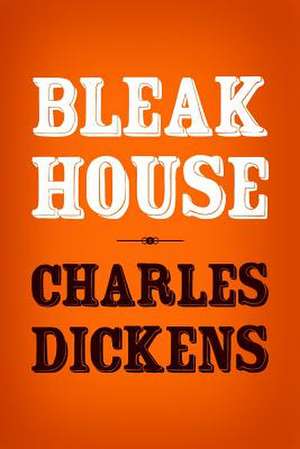
Bleak House
Autor Charles Dickensen Limba Engleză Paperback
O ceață densă se așterne peste Londra, infiltrându-se în fiecare colț al curții de justiție și în viețile celor prinși în labirintul procesului Jarndyce v Jarndyce. Astfel se deschide Bleak House, un text monumental în care Charles Dickens își demonstrează măiestria de a țese destine individuale în pânza coruptă a sistemului juridic victorian. Observăm o inovație structurală fascinantă: povestea se desfășoară pendulând între vocea intimă, la persoana întâi, a tinerei Esther Summerson și perspectiva detașată, uneori ironică, a unui narator omniscient. Această dualitate ne oferă atât căldura unei confesiuni personale, cât și o panoramă socială vastă.
Ritmul narativ amintește de densitatea din Great Expectations, dar structura este mult mai ambițioasă, fiind considerată de mulți critici drept cea mai complexă construcție a autorului. Dacă în A Tale of Two Cities Dickens explora tumultul istoric al Revoluției Franceze, aici el se apleacă asupra unei revoluții necesare în interiorul instituțiilor britanice. Găsim în acest volum o întreagă galerie de personaje memorabile, de la avocatul amenințător Tulkinghorn până la Inspectorul Bucket, a cărui prezență marchează nașterea genului polițist modern în literatura engleză. Ediția de față, publicată de WORDSWORTH EDITIONS LTD, este îmbogățită cu notele de lucru ale autorului și extrase din receptarea critică a vremii, oferind o perspectivă completă asupra modului în care ficțiunea a reușit să grăbească reformele legale reale din secolul al XIX-lea.
Preț: 174.56 lei
Carte disponibilă
Livrare economică 09-23 noiembrie
Specificații
ISBN-10: 149959027X
Pagini: 692
Dimensiuni: 152 x 229 x 39 mm
Greutate: 1 kg
Editura: CREATESPACE
V-ar putea interesa
-
 Wuthering HeightsEmily BrontëPreț: 28.01 lei
 -
 The Hobbit: Special collector's film tie-in editionJ. R. R. TolkienPreț: 122.91 lei
 -
 David CopperfieldCharles Dickens-15%Preț: 64.42 lei75.67 lei
 -
 Sir Gawain and The Green KnightKeith Harrison-20%Preț: 51.23 lei63.87 lei
 -
 Tyger, TygerWilliam Blake-39%Preț: 17.30 lei28.43 lei
 -
 The SilmarillionJ. R. R. TolkienPreț: 65.60 lei
 -
 The Lord of the RingsJ. R. R. TolkienPreț: 325.69 lei
 -
 The HobbitJ. R. R. TolkienPreț: 273.09 lei
 -
 Perspective for ArtistsRex Vicat Cole-46%Preț: 66.28 lei121.90 lei
 -
 SnowOrhan PamukPreț: 80.80 lei
 -
 Dynamic AnatomyB. HogarthPreț: 195.45 lei
 -
 Snow Falling on Cedars: The multi-million copy bestsellerDavid Guterson-26%Preț: 69.94 lei94.06 lei
 -
 Atlas of Astronomical DiscoveriesGovert SchillingPreț: 368.43 lei
 -
 -19%Preț: 46.26 lei56.88 lei
 -
 -21%Preț: 66.66 lei84.02 lei
 -
 The Forsyte SagaJohn GalsworthyPreț: 39.80 lei
 -
 Collected Ghost StoriesM. R. JamesPreț: 31.75 lei
 -
 Vanity FairWilliam Makepeace ThackerayPreț: 40.63 lei
 -
 Three Men in a Boat & Three Men on the BummelJerome K. JeromePreț: 36.87 lei
 -
 Far from the Madding CrowdThomas HardyPreț: 28.01 lei
 -
 Mayor of CasterbridgeThomas HardyPreț: 28.01 lei
 -
 Our Mutual FriendCharles DickensPreț: 28.01 lei
 -
 IvanhoeWalter ScottPreț: 38.49 lei
 -
 MiddlemarchGeorge EliotPreț: 28.01 lei
 -
 Old Curiosity ShopCharles DickensPreț: 40.15 lei
 -
 Jude the ObscureThomas HardyPreț: 28.01 lei
De ce să citești această carte
Recomandăm această ediție cititorilor care doresc să descopere apogeul geniului lui Dickens într-o formă academică accesibilă. Veți câștiga nu doar plăcerea unei lecturi clasice, ci și o înțelegere profundă a contextului social victorian prin apendicele incluse. Este o carte esențială pentru cei care au apreciat Jude the Obscure de Thomas Hardy și caută o critică socială la fel de tăioasă, dar servită cu umorul și compasiunea specifice lui Dickens.
Despre autor
Charles John Huffam Dickens (1812–1870) este recunoscut drept cel mai important romancier al epocii victoriene. Experiența sa timpurie de lucru într-o fabrică de cremă de ghete, în timp ce tatăl său era închis pentru datorii, i-a marcat profund opera, transformându-l într-un critic acerb al nedreptăților sociale. De la succesul fulminant cu Pickwick Papers până la maturitatea artistică din Bleak House, Dickens a folosit formatul publicării în foileton pentru a crea o legătură unică cu publicul său. Jurnalist, editor și activist, el a militat neîncetat pentru drepturile copiilor și reforma educației, lăsând în urmă 15 romane ce rămân puncte de referință în literatura universală.
Descriere scurtă
"This edition contains the original and unabridged text of Bleak House by Charles Dickens."
Bleak House by Charles Dickens is held to be one of Dickens's finest novels, containing one of the most vast, complex and engaging arrays of minor characters and sub-plots in his entire canon. The story is told partly by the novel's heroine, Esther Summerson, and partly by a mostly omniscient narrator. Memorable characters include the menacing lawyer Tulkinghorn, the friendly but depressive John Jarndyce, and the childish and disingenuous Harold Skimpole, as well as the likeable but imprudent Richard Carstone.
At the novel's core is long-running litigation in England's Court of Chancery, Jarndyce v Jarndyce, which has far-reaching consequences for all involved. This case revolves around a testator who apparently made several wills. The litigation, which already has taken many years and consumed between 60,000 and 70,000 in court costs, is emblematic of the failure of Chancery. Dickens's assault on the flaws of the British judicial system is based in part on his own experiences as a law clerk, and in part on his experiences as a Chancery litigant seeking to enforce copyright on his earlier books. His harsh characterisation of the slow, arcane Chancery law process gave memorable form to pre-existing widespread frustration with the system. Though Chancery lawyers and judges criticised Dickens's portrait of Chancery as exaggerated and unmerited, his novel helped to spur an ongoing movement that culminated in the enactment of legal reform in the 1870s."
Descriere
Bleak House, Dickens's most daring experiment in the narration of a complex plot, challenges the reader to make connections - -between the fashionable and the outcast, the beautiful and the ugly, the powerful and the victims. Nowhere in Dickens's later novels is his attack on an uncaring society more imaginatively embodied, but nowhere either is the mixture of comedy and angry satire more deftly managed. Bleak House defies a single description. It is a mystery story, in which Esther Summerson discovers the truth about her birth and her unknown mother's tragic life. It is a murder story, which comes to a climax in a thrilling chase, led by one of the earliest detectives in English fiction, Inspector Bucket. And it is a fable about redemption, in which a bleak house is transformed by the resilience of human love. ABOUT THE SERIES: For over 100 years Oxford World's Classics has made available the widest range of literature from around the globe. Each affordable volume reflects Oxford's commitment to scholarship, providing the most accurate text plus a wealth of other valuable features, including expert introductions by leading authorities, helpful notes to clarify the text, up-to-date bibliographies for further study, and much more.
Recenzii
The critical introduction and extensive appendices to this edition focus on the novel’s social context and reception, Dickens’s treatment of his women characters and the working class, and the inequalities of the Victorian legal system.
“Patricia Ingham’s edition of Bleak House is a model of clear thinking, scrupulous editing, and critical acumen. The contextual documents have been selected with a keen eye for what modern readers need to know if they are to appreciate this wonderful novel in all its complexity. The edition will be an invaluable resource for those studying or teaching Dickens, but in addition will stimulate new thinking even among established Dickens scholars. It is an excellent addition to the Broadview list.” — Penny Boumelha, Victoria University of Wellington
“In this splendid new edition of Charles Dickens’s Bleak House, Patricia Ingham brings her fine critical intelligence to bear on a novel that treats the city of London as a historical reality and as a haunting metaphor. Professor Ingham’s wide-ranging erudition—her expertise as a linguist, social historian, editor, and literary theorist—allows her to provide a framework that does full justice to Dickens’s multi-layered narrative. Her introduction contextualizes the novel in pertinent ways, the notes are helpful, and rich appendices provide a wide array of nineteenth-century documents necessary to grasp how the novel is both representative and highly original.” — Linda M. Shires, Yeshiva University
Notă biografică
Extras
In Chancery
London. Michaelmas Term lately over, and the Lord Chancellor sitting in Lincoln's Inn Hall. Implacable November weather. As much mud in the streets, as if the waters had but newly retired from the face of the earth, and it would not be wonderful to meet a Megalosaurus,forty feet long or so, waddling like an elephantine lizard up Holborn-hill. Smoke lowering down from chimney-pots, making a soft black drizzle, with flakes of soot in it as big as full-grown snow-flakes-gone into mourning, one might imagine, for the death of the sun. Dogs, undistinguishable in mire. Horses, scarcely better; splashed to their very blinkers. Foot passengers, jostling one another's umbrellas, in a general infection of ill-temper, and losing their foot-hold at street corners, where tens of thousands of other foot passengers have been slipping and sliding since the day broke (if the day ever broke), adding new deposits to the crust upon crust of mud, sticking at those points tenaciously to the pavement, and accumulating at compound interest.
Fog everywhere. Fog up the river, where it flows among green aits and meadows; fog down the river, where it rolls defiled among the tiers of shipping, and the waterside pollutions of a great (and dirty) city. Fog on the Essex marshes, fog on the Kentish heights. Fog creeping into the cabooses of collier-brigs; fog lying out on the yards, and hovering in the rigging of great ships; fog drooping on the gunwales
of barges and small boats. Fog in the eyes and throats of ancient Greenwich pensioners, wheezing by the firesides of their wards; fog in the stem and bowl of the afternoon pipe of the wrathful skipper, down in his close cabin; fog cruelly pinching the toes and fingers of his shivering little 'prentice boy on deck. Chance people on the bridges peeping over the parapets into a nether sky of fog, with fog all round them, as if they were up in a balloon, and hanging in the misty clouds.
Gas looming through the fog in divers places in the streets, much as the sun may, from the spongey fields, be seen to loom by husbandman and ploughboy. Most of the shops lighted two hours before their time-as the gas seems to know, for it has a haggard and unwilling look.
The raw afternoon is rawest, and the dense fog is densest, and the muddy streets are muddiest, near that leaden-headed old obstruction, appropriate ornament for the threshold of a leaden-headed old corporation: Temple Bar. And hard by Temple Bar, in Lincoln's Inn Hall, at the very heart of the fog, sits the Lord High Chancellor in his High Court of Chancery.
Never can there come fog too thick, never can there come mud and mire too deep, to assort with the groping and floundering condition which this High Court of Chancery, most pestilent of hoary sinners, holds, this day, in the sight of heaven and earth.
On such an afternoon, if ever, the Lord High Chancellor ought to be sitting here-as here he is-with a foggy glory round his head, softly fenced in with crimson cloth and curtains, addressed by a large advocate with great whiskers, a little voice, and an interminable brief, and outwardly directing his contemplation to the lantern in the roof, where he can see nothing but fog. On such an afternoon, some score of members of the High Court of Chancery bar ought to be-as here they are-mistily engaged in one of the ten thousand stages of an endless cause, tripping one another up on slippery precedents, groping knee-deep in technicalities, running their goat-hair and horse-hair warded heads against walls of words, and making a pretence of equity with serious faces, as players might. On such an afternoon, the various solicitors in the cause, some two or three of whom have inherited it from their fathers, who made a fortune by it, ought to be-as are they not?-ranged in a line, in a long matted well (but you might look in vain for Truth at the bottom of it), between the registrar's red table and the silk gowns, with bills, cross-bills, answers, rejoinders, injunctions, affidavits, issues, references to masters, masters' reports, mountains of costly nonsense, piled before them. Well may the court be dim, with wasting candles here and there; well may the fog hang heavy in it, as if it would never get out; well may the stained glass windows lose their color, and admit no light of day into the place; well may the uninitiated from the streets, who peep in through the glass panes in the door, be deterred from entrance by its owlish aspect, and by the drawl languidly echoing to the roof from the padded dais where the Lord High Chancellor looks into the lantern that has no light in it, and where the attendant wigs are all stuck in a fog-bank! This is the Court of Chancery; which has its decaying houses and its blighted lands in every shire; which has its worn-out lunatic in every madhouse, and its dead in every churchyard; which has its ruined suitor, with his slipshod heels and threadbare dress, borrowing and begging through the round of every man's acquaintance; which gives to monied might the means abundantly of wearying out the right; which so exhausts finances, patience, courage, hope; so overthrows the brain and breaks the heart; that there is not an honorable man among its practitioners who would not give-who does not often give-the warning, "Suffer any wrong that can be done you, rather than come here!"
Who happen to be in the Lord Chancellor's court this murky afternoon besides the Lord Chancellor, the counsel in the cause, two or three counsel who are never in any cause, and the well of solicitors before mentioned? There is the registrar below the Judge, in wig and gown; and there are two or three maces, or petty-bags, or privy-purses, or whatever they may be, in legal court suits. These are all yawning; for no crumb of amusement ever falls from Jarndyce and Jarndyce (the cause in hand), which was squeezed dry years upon years ago. The short-hand writers, the reporters of the court, and the reporters of the newspapers, invariably decamp with the rest of the regulars when Jarndyce and Jarndyce comes on. Their places are a blank. Standing on a seat at the side of the hall, the better to peer into the curtained sanctuary, is a little mad old woman in a squeezed bonnet, who is always in court, from its sitting to its rising, and always expecting some incomprehensible judgment to be given in her favor. Some say she really is, or was, a party to a suit; but no one knows for certain, because no one cares. She carries some small litter in a reti-cule which she calls her documents; principally consisting of paper matches and dry lavender. A sallow prisoner has come up, in custody, for the half-dozenth time, to make a personal application "to purge himself of his contempt;" which, being a solitary surviving executor who has fallen into a state of conglomeration about accounts of which it is not pretended that he had ever any knowledge, he is not at all likely ever to do. In the meantime his prospects in life are ended. Another ruined suitor, who periodically appears from Shropshire, and breaks out into efforts to address the Chancellor at the close of the day's business, and who can by no means be made to understand that the Chancellor is legally ignorant of his existence after making it desolate for a quarter of a century, plants himself in a good place and keeps an eye on the Judge, ready to call out "My lord!" in a voice of sonorous complaint, on the instant of his rising. A few lawyers' clerks and others who know this suitor by sight, linger, on the chance of his furnishing some fun, and enlivening the dismal weather a little.
Jarndyce and Jarndyce drones on. This scarecrow of a suit has, in course of time, become so complicated, that no man alive knows what it means. The parties to it understand it least; but it has been observed that no two Chancery lawyers can talk about it for five minutes, without coming to a total disagreement as to all the premises. Innumerable children have been born into the cause; innumerable young people have married into it; innumerable old people have died out of it. Scores of persons have deliriously found themselves made parties in Jarndyce and Jarndyce, without knowing how or why; whole families have inherited legendary hatreds with the suit. The little plaintiff or defendant, who was promised a new rocking-horse when Jarndyce and Jarndyce should be settled, has grown up, possessed himself of a real horse, and trotted away into the other world. Fair wards of court have faded into mothers and grandmothers; a long procession of Chancellors has come in and gone out; the legion of bills in the suit have been transformed into mere bills of mortality; there are not three Jarndyces left upon the earth perhaps, since old Tom Jarndyce in despair blew his brains out at a coffee-house in Chancery-lane; but Jarndyce and Jarndyce still drags its dreary length before the Court, perennially hopeless.
Jarndyce and Jarndyce has passed into a joke. That is the only good that has ever come of it. It has been death to many, but it is a joke in the profession. Every master in Chancery has had a reference out of it. Every Chancellor was "in it," for somebody or other, when he was counsel at the bar. Good things have been said about it by blue-nosed, bulbous-shoed old benchers, in select port-wine committee after dinner in hall. Articled clerks have been in the habit of fleshing their legal wit upon it. The last Lord Chancellor handled it neatly, when, correcting Mr. Blowers the eminent silk gown who said that such a thing might happen when the sky rained potatoes, he observed, "or when we get through Jarndyce and Jarndyce, Mr. Blowers;"-a pleasantry that particularly tickled the maces, bags, and purses.
How many people out of the suit, Jarndyce and Jarndyce has stretched forth its unwholesome hand to spoil and corrupt, would be a very wide question. From the master, upon whose impaling files reams of dusty warrants in Jarndyce and Jarndyce have grimly writhed into many shapes; down to the copying clerk in the Six Clerks' Office, who has copied his tens of thousands of Chancery-folio-pages under that eternal heading; no man's nature has been made the better by it. In trickery, evasion, procrastination, spoliation, botheration, under false pretences of all sorts, there are influences that can never come to good. The very solicitors' boys who have kept the wretched suitors at bay, by protesting time out of mind that Mr. Chizzle, Mizzle, or otherwise, was particularly engaged and had appointments until dinner, may have got an extra moral twist and shuffle into themselves out of Jarndyce and Jarndyce. The receiver in the cause has acquired a goodly sum of money by it, but has acquired too a distrust of his own mother, and a contempt for his own kind. Chizzle, Mizzle, and otherwise, have lapsed into a habit of vaguely promising themselves that they will look into that outstanding little matter, and see what can be done for Drizzle-who was not well used-when Jarndyce and Jarndyce shall be got out of the office. Shirking and sharking, in all their many varieties, have been sown broadcast by the ill-fated cause; and even those who have contemplated its history from the outermost circle of such evil, have been insensibly tempted into a loose way of letting bad things alone to take their own bad course, and a loose belief that if the world go wrong, it was, in some off-hand manner, never meant to go right.
Thus, in the midst of the mud and at the heart of the fog, sits the Lord High Chancellor in his High Court of Chancery.
Cuprins
Introduction
Charles Dickens: A Brief Chronology
A Note on the Text
Bleak House
Appendix A: Dickens’s Working Notes for Bleak House
Appendix B: The Reception of Bleak House
- From The Spectator (September 1853)
- From The Illustrated London News (24 September 1853)
- From The Athenaeum (17 September 1853)
- From The Eclectic Review (December 1853)
- From Bentley’s Miscellany (8 October 1853)
- From The Examiner (8 October 1853)
- From The Rambler (January 1854)
- From Charlotte Brontë, Letter to George Smith (11 March 1852)
- From J.S. Mill, Letter to Harriet Taylor (20 March 1854)
- From G.H. Lewes, Letters to Dickens (1852)
- Marriage and the Law: From William Blackstone, Commentaries on the Laws of England (1765–69)
- Support for Conventional Views
- From Charles Dickens, “Sucking Pigs,” Household Words (November 1851)
- From “The Laws Concerning Women,” Blackwood’s Edinburgh Magazine (April 1856)
- From Margaret Oliphant, “The Condition of Women,” Blackwood’s Edinburgh Magazine (February 1858)
- Opposition to Conventional Views
- From the Review in Foreign Quarterly Review of The Education of Mothers of Families (1842)
- From Harriet Taylor, “The Enfranchisement of Women,” The Westminster and Foreign Quarterly Review (1851)
- From Jessie Boucherett, Endowed Schools (1862)
- Personal Testimonies from Women
- From Jane Welsh Carlyle, Letter to John Forster (c. February 1844)
- From Elizabeth Gaskell, Letter to Eliza Fox (12 February 1850)
- From Mary Taylor, Letter to Charlotte Brontë (April 1850)
- From Charlotte Brontë, Letter to Elizabeth Gaskell (20 September 1851)
- From Florence Nightingale, Cassandra (1860)
- Women in Contemporary Fiction
- From Charlotte Brontë, Jane Eyre (1848)
- From Geraldine Jewsbury, The Half Sisters (1848)
- From Frances Trollope, The Young Countess or Love and Jealousy (1848)
- From “Reform in the Court of Chancery,” The Times (1 April 1850)
- From “Delays in Chancery,” The Times (8 August 1850)
- From “Court of Chancery,” The Times (25 December 1850)
- Leading Article, The Times (1 January 1851)
- From Alfred Cole and W.H. Wills, “The Martyrs of Chancery,” Household Words
- December 1850
- February 1851
- From Edward B. Sugden, “Prisoners for Contempt of the Court of Chancery,” The Times (7 January 1851)
- From “A Chancery Bone of Contention,” Punch (June 1852)
- From Charles Dickens, “Whole Hogs,” Household Words (August 1851)
- From Clare Lucas Balfour, “Stopping Half Way,” The Temperance Offering (1852)
- Charles Dickens, Letter to the Reverend H. Christopherson (9 July 1852)
- From R.W. Vanderkiste, Notes and Narratives of a Six Years’ Mission Principally among the Dens of London (1852)
- From the London Quarterly Review (January 1871)
- From Thomas Carlyle, Chartism (1839)
- From Arthur Helps, The Claims of Labour (1844)
- From Jessie Boucherett, “Endowed Schools” (1852)
- From J.S. Mill, Principles of Political Economy (1859)
- Living Conditions as Described in Dickens’s Household Words
- From “A December Vision” (December 1850)
- From “A Walk in a Workhouse” (May 1850)
- From “A Nightly Scene in London” (January 1856)
- Burial Grounds
- From “Spa-Fields Burial Grounds,” The Times (5 March 1845)
- From “Heathen and Christian Burial,” Household Words (April 1850)
- Disease
- From Thomas Carlyle, Past and Present (1843)
- From “How Cholera is Spread,” The Lancet (13 October 1849)
- [Mortality Among the Working Classes], from The Times (4 September 1851)
- Epidemics and Sanitation
- From Edwin Chadwick, Report on the Sanitary Conditions of the Labouring Population (1842)
- [Sanitary Conditions of the city], from The Times (2 January 1851)
- From a Speech by Dickens to the Metropolitan Sanitary Association (10 May 1851)