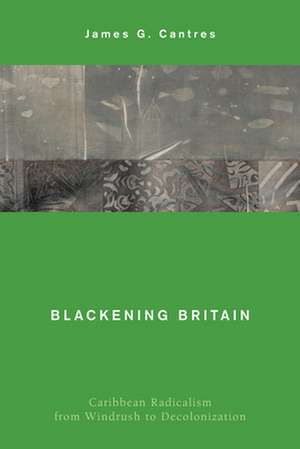
Blackening Britain: Caribbean Radicalism from Windrush to Decolonization: Global Critical Caribbean Thought
Autor James G. Cantresen Limba Engleză Hardback – 10 dec 2020
This book also interrogates the ways in which prominent West Indian activists, intellectuals, political actors, and artists conceived of their relationship to Britain. Ultimately, this work shows a move away from British identity and a radical, revolutionary consciousness rooted in the West Indian background and forged in the contentious space of metropolitan Britain.










Preț: 697.78 lei
Preț vechi: 1005.30 lei
-31%
Puncte Express: 1047
Carte tipărită la comandă
Livrare economică 18 noiembrie-02 decembrie
Livrare prin curier în România Termenul estimat este afișat lângă disponibilitate.
Transport gratuit pentru acest produs Plată online sau ramburs, în funcție de opțiunile comenzii.
Retur gratuit în 14 zile Comandă securizată și suport în română.
Specificații
ISBN-13: 9781538143544
ISBN-10: 1538143542
Pagini: 270
Dimensiuni: 163 x 238 x 22 mm
Greutate: 0.57 kg
Editura: Bloomsbury Publishing
Colecția Rowman & Littlefield
Seria Global Critical Caribbean Thought
Locul publicării:New York, United States
ISBN-10: 1538143542
Pagini: 270
Dimensiuni: 163 x 238 x 22 mm
Greutate: 0.57 kg
Editura: Bloomsbury Publishing
Colecția Rowman & Littlefield
Seria Global Critical Caribbean Thought
Locul publicării:New York, United States
Cuprins
Introduction More English than the English?
Claims-making and Contestations in Britain and Across Empire
Chapter 1. From Small Islands to a Small Island
The Caribbean Background and the Interwar Migrants
Chapter 2. The 5th Pan-African Congress, Manchester 1945
Black Internationalism in the Context of Britain
Chapter 3. Existentialists Abroad
Legacies of Caribbean Intellectuals in Britain
After 1948: The British Nationality Act and the Multilayered Nature of Caribbean Migration
British Social Science Responses and Student Negotiations
Chapter 4. "We're here, and we're here in a big way": West Indians Respond to the Notting Hill Race Riots
Racial Violence in the Metropole and the Surge of Political Blackness
Chapter 5. Diasporic Artist-Activists and Imperial Reckoning
Academic and Grassroots Responses to Notting Hill
Chapter 6. British Caribbean Independence and The 1962 Commonwealth Immigration Act
Caribbean Migrants and the Making of a New Britain
Chapter 7. Black Publishers and Revolutionary Epistemologies
Radical Racial Epistemology and Black Post-Nationalism
Conclusion
"Rivers of Blood" and Black Liberation Dreams
Coda [crisis]: Windrush at 70 and the Hostile Environment
Claims-making and Contestations in Britain and Across Empire
Chapter 1. From Small Islands to a Small Island
The Caribbean Background and the Interwar Migrants
Chapter 2. The 5th Pan-African Congress, Manchester 1945
Black Internationalism in the Context of Britain
Chapter 3. Existentialists Abroad
Legacies of Caribbean Intellectuals in Britain
After 1948: The British Nationality Act and the Multilayered Nature of Caribbean Migration
British Social Science Responses and Student Negotiations
Chapter 4. "We're here, and we're here in a big way": West Indians Respond to the Notting Hill Race Riots
Racial Violence in the Metropole and the Surge of Political Blackness
Chapter 5. Diasporic Artist-Activists and Imperial Reckoning
Academic and Grassroots Responses to Notting Hill
Chapter 6. British Caribbean Independence and The 1962 Commonwealth Immigration Act
Caribbean Migrants and the Making of a New Britain
Chapter 7. Black Publishers and Revolutionary Epistemologies
Radical Racial Epistemology and Black Post-Nationalism
Conclusion
"Rivers of Blood" and Black Liberation Dreams
Coda [crisis]: Windrush at 70 and the Hostile Environment
Recenzii
Cantres traces the emergence and consolidation of a radical consciousness among West Indians in mid-20th-century Britain. Drawing on a broad range of primary sources and secondary materials, Cantres begins by looking at the Caribbean situation before and immediately after WW II, including the fifth Pan-African Congress convened in Manchester, UK, in 1945. He describes the initial responses of uprooted intellectuals to living at the geographical center of a declining colonial power. He details the response of both activists and ordinary émigrés to the Notting Hill race riots of 1958, and he explains how such organizations as the West Indian Student Centre accommodated young aspirants to the challenging realities of the British education system. The restrictions of the Commonwealth Immigrants Act of 1962 helped provoke the emergence of a Black Power movement in the wake of the inflammatory rhetoric of Enoch Powell. The Caribbean Artists Movement organized a conference in 1968 that contested passive assimilation, and groups such as the Black Eagles, led by Michael X, embodied a revolutionary consciousness. The author argues that by the 1970s Black thinkers had created a blueprint for political resistance and autonomy. Recommended.
A significant contribution to the growing literature on Caribbean organisations, activists and writers in the post-war period, from the Manchester Pan-African Congress to the Black Power Movement and beyond.
Blackening Britain begins with the taller trees, such as Harold Moody, in the urban forests of 1950s British race relations. From these heights, this comprehensive text plunges its readers into the thick and violent undergrowth, where the struggles of Black immigrants to survive remained for decades at the level of life and death. It closes with Black political and intellectual responses to these bitter racial struggles. Most definitely an informative and engaging read.
In Blackening Britain, James Cantres argues that West Indians in Britain did much more than pursue British identity and citizenship. Grounded in a racialized consciousness and pulling from transnational political imaginaries, they rejected the British state as the arbiter of identity construction and cultivated a more radical "post-nationalist perspective." An important contribution to the growing body of work on Black Britain.
A significant contribution to the growing literature on Caribbean organisations, activists and writers in the post-war period, from the Manchester Pan-African Congress to the Black Power Movement and beyond.
Blackening Britain begins with the taller trees, such as Harold Moody, in the urban forests of 1950s British race relations. From these heights, this comprehensive text plunges its readers into the thick and violent undergrowth, where the struggles of Black immigrants to survive remained for decades at the level of life and death. It closes with Black political and intellectual responses to these bitter racial struggles. Most definitely an informative and engaging read.
In Blackening Britain, James Cantres argues that West Indians in Britain did much more than pursue British identity and citizenship. Grounded in a racialized consciousness and pulling from transnational political imaginaries, they rejected the British state as the arbiter of identity construction and cultivated a more radical "post-nationalist perspective." An important contribution to the growing body of work on Black Britain.