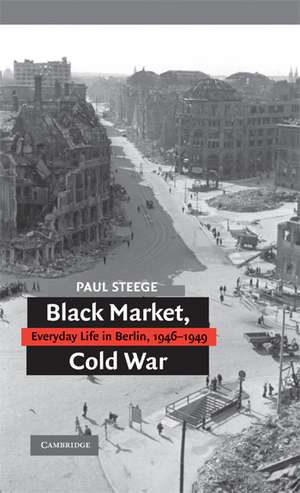
Black Market, Cold War
Autor Paul Steegeen Limba Engleză Paperback – oct 2008
Preț: 448.11 lei
Puncte Express: 672
Carte tipărită la comandă
Livrare economică 27 noiembrie-11 decembrie
Livrare prin curier în România Termenul estimat este afișat lângă disponibilitate.
Transport gratuit pentru acest produs Plată online sau ramburs, în funcție de opțiunile comenzii.
Retur gratuit în 14 zile Comandă securizată și suport în română.
Specificații
ISBN-13: 9780521745178
ISBN-10: 0521745179
Pagini: 374
Ilustrații: 1
Dimensiuni: 156 x 234 x 20 mm
Greutate: 0.57 kg
Editura: Cambridge University Press
Locul publicării:New York, United States
ISBN-10: 0521745179
Pagini: 374
Ilustrații: 1
Dimensiuni: 156 x 234 x 20 mm
Greutate: 0.57 kg
Editura: Cambridge University Press
Locul publicării:New York, United States
V-ar putea interesa
-
 The Lighthouse StevensonsBella BathurstPreț: 93.17 lei
 -
 -31%Preț: 741.35 lei1076.72 lei
 -
 -15%Preț: 226.10 lei265.08 lei
 -
 Elemental GermansChristoph LauchtPreț: 404.72 lei
 -
 Boys in ZincSvetlana AlexiévichPreț: 79.22 lei
 -
 The Cambridge History of the Cold War 3 Volume SetMelvyn P. Leffler-20%Preț: 667.89 lei836.25 lei
 -
 Soviet Cold War Weaponry: Aircraft, Warships and MissilesAnthony Tucker-JonesPreț: 108.05 lei
 -
 The Cold War: A Military HistoryJeremy Black-15%Preț: 258.32 lei305.19 lei
 -
 Warsaw Pact BadgesRichard HollingdalePreț: 105.24 lei
 -
 -21%Preț: 174.47 lei221.64 lei
 -
 The Cold War Spy Pocket ManualPhilip ParkerPreț: 71.85 lei
Cuprins
1. Postwar Berlin: the continuities of scarcity; 2. October 1946: rolling back Soviet power; 3. June 1947: Berlin politics in the shadow of the black market; 4. March 1948: Berlin and the struggle for the Soviet Zone; 5. August 1948: battle lines on the Potsdamer Platz; 6. June 1949: ending the blockade.
Recenzii
'Steege's fascinating book is a superb example of 'history from below'. He is not the first historian to have examined the lives of the people of Berlin in this period, but no one has illuminated the interaction between daily life and global politics as effectively as he does.' Journal of European Studies
Descriere
This book explains how and why Berlin became the symbolic capital of the Cold War.