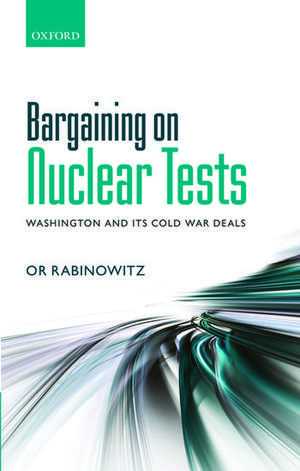
Bargaining on Nuclear Tests: Washington and its Cold War Deals
Autor Or Rabinowitzen Limba Engleză Hardback – mai 2014
Preț: 766.36 lei
Preț vechi: 1095.75 lei
-30%
Puncte Express: 1150
Carte tipărită la comandă
Livrare economică 10-15 decembrie
Livrare prin curier în România Termenul estimat este afișat lângă disponibilitate.
Transport gratuit pentru acest produs Plată online sau ramburs, în funcție de opțiunile comenzii.
Retur gratuit în 14 zile Comandă securizată și suport în română.
Specificații
ISBN-13: 9780198702931
ISBN-10: 0198702930
Pagini: 246
Dimensiuni: 163 x 239 x 22 mm
Greutate: 0.53 kg
Editura: OUP OXFORD
Colecția OUP Oxford
Locul publicării:Oxford, United Kingdom
ISBN-10: 0198702930
Pagini: 246
Dimensiuni: 163 x 239 x 22 mm
Greutate: 0.53 kg
Editura: OUP OXFORD
Colecția OUP Oxford
Locul publicării:Oxford, United Kingdom
V-ar putea interesa
-
 -15%Preț: 226.10 lei265.08 lei
 -
 Elemental GermansChristoph LauchtPreț: 404.72 lei
 -
 Boys in ZincSvetlana AlexiévichPreț: 79.22 lei
 -
 The Cambridge History of the Cold War 3 Volume SetMelvyn P. Leffler-20%Preț: 667.89 lei836.25 lei
 -
 Soviet Cold War Weaponry: Aircraft, Warships and MissilesAnthony Tucker-JonesPreț: 109.97 lei
 -
 The Cold War: A Military HistoryJeremy Black-15%Preț: 258.32 lei305.19 lei
 -
 Warsaw Pact BadgesRichard HollingdalePreț: 105.24 lei
 -
 -21%Preț: 174.47 lei221.64 lei
 -
 The Cold War Spy Pocket ManualPhilip ParkerPreț: 71.85 lei
Recenzii
Or Rabinowitz provides a fascinating glimpse inside the hidden history of American efforts to persuade Israel, India, South Africa and Pakistan not to test nuclear weapons.
Bargaining on Nuclear Tests is a fascinating study of a little-known aspect of how the Cold-War rivalry that played itself out in a number of different locales - Israel, Pakistan and South Africa. Central to the narrative is the U.S.-Israeli dance over Israel's nuclear program. Realizing that Israel had already developed a nuclear weapon, President Nixon, urged on by his National Security adviser Henry Kissinger, apparently agreed in private with Israeli Prime Minister Golda Meir in 1969 that the United States would look the other way as long as Israel did not openly test a weapon. Or Rabinowitz sifts through the still-ambiguous evidence to tell a convincing and important story.
Rabinowitz makes a strong case that the United States, as a last resort in dealing with nuclear proliferation, sought to bargain with Israel, Pakistan and South Africa to convince them not to test a nuclear weapon in response for backing off efforts to stop and roll back their nuclear programs. She provides some interesting information on the development of these three and the Indian nuclear effort and raises questions about whether and how the bargains were kept or broken on each side. An interesting read, especially for nuclear policy buffs.
[an] important contribution ... to the study of nuclear non-proliferation during the late Cold War and into the post-Cold War period. Rabinowitz offers a valuable work that draws together quite disparate threads and addresses the 'no testing' element of non-proliferation policy. By analysing this previously neglected component of US nuclear policy, Bargaining on Nuclear Tests provides a significant theoretical and analytical foundation for continued work on this fascinating subject.
Bargaining on Nuclear Tests is a fascinating study of a little-known aspect of how the Cold-War rivalry that played itself out in a number of different locales - Israel, Pakistan and South Africa. Central to the narrative is the U.S.-Israeli dance over Israel's nuclear program. Realizing that Israel had already developed a nuclear weapon, President Nixon, urged on by his National Security adviser Henry Kissinger, apparently agreed in private with Israeli Prime Minister Golda Meir in 1969 that the United States would look the other way as long as Israel did not openly test a weapon. Or Rabinowitz sifts through the still-ambiguous evidence to tell a convincing and important story.
Rabinowitz makes a strong case that the United States, as a last resort in dealing with nuclear proliferation, sought to bargain with Israel, Pakistan and South Africa to convince them not to test a nuclear weapon in response for backing off efforts to stop and roll back their nuclear programs. She provides some interesting information on the development of these three and the Indian nuclear effort and raises questions about whether and how the bargains were kept or broken on each side. An interesting read, especially for nuclear policy buffs.
[an] important contribution ... to the study of nuclear non-proliferation during the late Cold War and into the post-Cold War period. Rabinowitz offers a valuable work that draws together quite disparate threads and addresses the 'no testing' element of non-proliferation policy. By analysing this previously neglected component of US nuclear policy, Bargaining on Nuclear Tests provides a significant theoretical and analytical foundation for continued work on this fascinating subject.
Notă biografică
Or (Ori) Rabinowitz, an Israeli Chevening Scholar, is a research associate at the Centre for Science and Security Studies, King's College London (KCL). She holds a PhD degree awarded by the War Studies Department of KCL, an MA degree in Security Studies and an LLB degree in Law, both from Tel-Aviv University. Dr Rabinowitz has worked as a news desk editor on Israel's 'Channel 10' news, Ma'ariv newspaper and the IDF radio station 'Galey Zahal', and at the press office of the Israeli embassy in London.