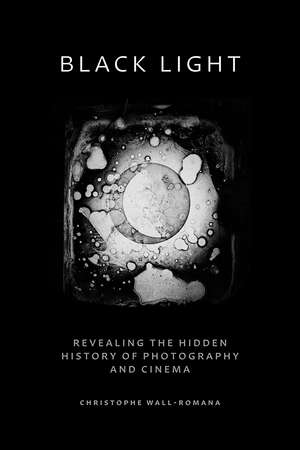
Black Light: Revealing the Hidden History of Photography and Cinema
Autor Christophe Wall-Romanaen Limba Engleză Paperback – 10 feb 2026
Conventional histories have long traced the origins of photography and cinema to the goal of reproducing the visible world. Black Light offers a radical counter to this understanding. Investigating the optical, cosmological, and racial thought that surrounded their conception, Christophe Wall-Romana argues that these media developed out of a desire to visualize what cannot be seen.
Taking as its starting point the concurrent invention of the telescope and industrialization of the transatlantic slave trade, Black Light shows how photography and cinema are entangled with two key preoccupations of the Enlightenment: visualizing the mysteries of the cosmos and managing Blackness. Wall-Romana uses literary and technological sources to demonstrate how racial and astronomical thinking interwove throughout the long development of our modern visual media. Retracing the impulses behind nonmimetic photoimaging and dynamic modeling, he exposes the racial underpinnings of research on photosensitive compounds such as silver nitrate and the racist lenses applied in post-Copernican cosmology.
Black Light charts the pivotal period from the seventeenth through the nineteenth century when Europeans were reckoning with “multiple worlds” and natural philosophy was giving way to “mechanical objectivity.” Wall-Romana shows how engagement with the nature of light was always entangled with racist discourses on Blackness—especially after the 1801 discovery of the invisible spectrum and its paradox of “black light.” Deprovincializing media archaeology, this book presents a groundbreaking historical framework with which to reenvision our dominant modes of seeing and understanding the world.
Retail e-book files for this title are screen-reader friendly with images accompanied by short alt text and/or extended descriptions.
Preț: 189.21 lei
Puncte Express: 284
Carte disponibilă
Livrare economică 31 octombrie-14 noiembrie
Livrare express 17-23 octombrie pentru 35.85 lei
Livrare prin curier în România Termenul estimat este afișat lângă disponibilitate.
Transport gratuit de la 400.00 lei Plată online sau ramburs, în funcție de opțiunile comenzii.
Retur gratuit în 14 zile Comandă securizată și suport în română.
Specificații
ISBN-13: 9781517917760
ISBN-10: 151791776X
Pagini: 328
Ilustrații: 80 black and white illustrations
Dimensiuni: 152 x 229 x 20 mm
Greutate: 0.56 kg
Editura: University of Minnesota Press
Colecția Univ Of Minnesota Press
ISBN-10: 151791776X
Pagini: 328
Ilustrații: 80 black and white illustrations
Dimensiuni: 152 x 229 x 20 mm
Greutate: 0.56 kg
Editura: University of Minnesota Press
Colecția Univ Of Minnesota Press
V-ar putea interesa
-
 Camera Lucida: Reflections on PhotographyRoland Barthes-20%Preț: 62.50 lei78.02 lei
 -
 -13%Preț: 153.51 lei177.14 lei
 -
 A Dirty History of Photography: Chemistry, Fog, and EmpireMichelle HenningPreț: 285.58 lei
 -
 MortevivumKimberly Juanita Brown-17%Preț: 96.81 lei116.13 lei
 -
 The Image of the Black in Western Art, Volume IVDavid Bindman-19%Preț: 610.58 lei753.80 lei
 -
 The Unseen TruthSarah LewisPreț: 230.27 lei
 -
 Who's Black and Why?Andrew S. CurranPreț: 229.37 lei
 -
 Sun and MoonMark Holborn-16%Preț: 440.51 lei526.36 lei
 -
 Preț: 416.73 lei
 -
 Four Arts of PhotographyDominic Mciver Lopes-23%Preț: 614.78 lei798.42 lei
 -
 -32%Preț: 552.03 lei817.57 lei
 -
 Multi Multi - Photoworks Annual #31Diane Smyth-21%Preț: 245.68 lei311.09 lei
 -
 Forms of the VisiblePhilippe DescolaPreț: 290.05 lei
 -
 Reframing BlacknessAlayo AkinkugbePreț: 142.73 lei
 -
 The Lives of Images, Vol. 2: Analogy, Attunement, and AttentionStanley Wolukau-WanambwaPreț: 134.81 lei
 -
 Ideas of AfricaOluremi C. Onabanjo-18%Preț: 256.93 lei313.61 lei
 -
 Civil ImaginationAriella Aïsha AzoulayPreț: 146.04 lei
 -
 Preț: 173.29 lei
 -
 Towards a Philosophy of PhotographyVilém Flusser-32%Preț: 110.50 lei161.69 lei
 -
 -25%Preț: 86.00 lei114.62 leiRecomandat
Notă biografică
Christophe Wall-Romana is professor of French in the Department of French and Italian at the University of Minnesota. He is author of Cinepoetry: Imaginary Cinemas in French Poetry and Jean Epstein: Corporeal Cinema and Film Philosophy and translator of Jean Epstein’s The Intelligence of a Machine as well as Gilbert Simondon’s Imagination and Invention, both published by the University of Minnesota Press.
Cuprins
Contents
Acknowledgments
Introduction: The Matrix of Photography and Cinema
1. Photosophia: Visualizing the Racialized Cosmos in the Seventeenth Century
2. Kinemorphosis: Cosmological Animation and History’s Whiteness
3. Photoimaging Hieroglyphs: Blackening, Anti-Blackness, and Proto-Photography
4. Photology: Black Light, the Wave Theory of Light, and Pre-Photography
5. Selenography: The Moon, Slavery, and the Dark Side of Photography
6. The Graphic Method: Time-Tracing, Colonial Supremacy, and Astrophotography
7. Flammarion’s Telechronoscope: The End of Natural History and the Beginning of Cinema
Conclusion: The Matrix of Photocinema and the Moral Universe
Notes
Index
Acknowledgments
Introduction: The Matrix of Photography and Cinema
1. Photosophia: Visualizing the Racialized Cosmos in the Seventeenth Century
2. Kinemorphosis: Cosmological Animation and History’s Whiteness
3. Photoimaging Hieroglyphs: Blackening, Anti-Blackness, and Proto-Photography
4. Photology: Black Light, the Wave Theory of Light, and Pre-Photography
5. Selenography: The Moon, Slavery, and the Dark Side of Photography
6. The Graphic Method: Time-Tracing, Colonial Supremacy, and Astrophotography
7. Flammarion’s Telechronoscope: The End of Natural History and the Beginning of Cinema
Conclusion: The Matrix of Photocinema and the Moral Universe
Notes
Index
Recenzii
"Black Light is an erudite and richly illustrated study of the enduring intersections of race and visuality. Reflecting on the telescope, animated visualization, the graphic method, heliography, the chromo-megascope, the telechronoscope, silhouettes, wave theory, black light, and so much more, this book promises to catalyze robust conversations at the intersection of science and technology studies, media archaeology, and black studies, conversations that will in turn inflect histories and theories of photography and cinema."—Karen Redrobe, author of Undead: (Inter)(in)animation, Feminisms, and the Art of War
"Black Light is a groundbreaking work that implicates developments in photography and cinema with scientific racism. Historicizing cosmic origins and racial difference, Christophe Wall-Romana challenges foundational myths connected to these visual media, arguing that the very idea of objective imaging was co-formed with ideologies of white supremacy. A radical reassessment of the modern image." —Omar W. Nasim, author of The Astronomer's Chair: A Visual and Cultural History
"Black Light boldly disrupts, revises, and reanimates debates about everything we understand about visualization—its historical technologies, cultures, and practices, as well as their philosophical contexts. Christophe Wall-Romana’s magisterial, deeply interdisciplinary research illuminates what has gone unnoticed in media archaeology for far too long, daring his readers to abandon long-held assumptions about how and why images were made in the first place. Black Light inaugurates a new era in the study of visuality and the ‘prehistory’ of film and photography. Do not be left behind." —Jennifer Wild, author of The Parisian Avant-Garde in the Age of Cinema, 1900–1923
"Deprovincializing media archaeology, Black Light presents a groundbreaking historical framework with which to reenvision our dominant modes of seeing and understanding the world." —New Books
"Black Light is a groundbreaking work that implicates developments in photography and cinema with scientific racism. Historicizing cosmic origins and racial difference, Christophe Wall-Romana challenges foundational myths connected to these visual media, arguing that the very idea of objective imaging was co-formed with ideologies of white supremacy. A radical reassessment of the modern image." —Omar W. Nasim, author of The Astronomer's Chair: A Visual and Cultural History
"Black Light boldly disrupts, revises, and reanimates debates about everything we understand about visualization—its historical technologies, cultures, and practices, as well as their philosophical contexts. Christophe Wall-Romana’s magisterial, deeply interdisciplinary research illuminates what has gone unnoticed in media archaeology for far too long, daring his readers to abandon long-held assumptions about how and why images were made in the first place. Black Light inaugurates a new era in the study of visuality and the ‘prehistory’ of film and photography. Do not be left behind." —Jennifer Wild, author of The Parisian Avant-Garde in the Age of Cinema, 1900–1923
"Deprovincializing media archaeology, Black Light presents a groundbreaking historical framework with which to reenvision our dominant modes of seeing and understanding the world." —New Books