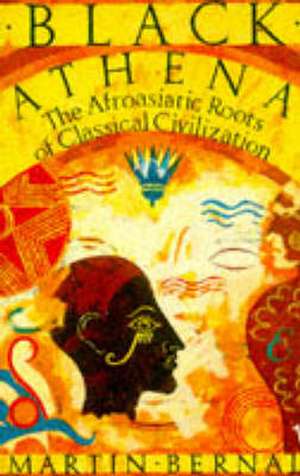
Black Athena
Autor Martin Bernalen Limba Engleză Paperback – 21 noi 1991
Descoperim aici o analiză riguroasă a fundamentelor lingvistice ale civilizației occidentale, în ceea ce reprezintă volumul final al trilogiei Black Athena. Ne-a atras atenția în mod deosebit modul în care Martin Bernal utilizează etimologia pentru a demonstra că aproximativ 40% din lexicul limbii grecești își are rădăcinile în limbi afro-asiatice, precum egipteana veche și semitica de vest. Autorul nu se limitează la termeni uzuali, ci extinde cercetarea asupra conceptelor fundamentale din politică, religie și filosofie, sugerând o dominanță culturală profundă exercitată de civilizațiile din Africa și Orientul Apropiat asupra populațiilor indo-europene. Structura lucrării este una academică și metodică, debutând cu tabele cronologice și o secțiune dedicată foneticii și transcrierii, elemente esențiale pentru parcurgerea demonstrațiilor lingvistice ulterioare. Observăm o progresie clară de la fundamentele teoretice ale „Modelului Antic Revizuit” către studii de caz specifice, cum este analiza Cretei din perioada pre-palatinală. Cartea este comparabilă cu Black Athena Revisited de Mary R. Lefkowitz în rigoarea documentării, dar oferă o perspectivă opusă, fiind esențială pentru înțelegerea polemicilor actuale din studiile culturale. În contextul operei sale, acest volum completează viziunea din Black Athena: The Fabrication of Ancient Greece, unde Bernal demonta construcția istoriografică europeană din secolele XVIII-XIX. Dacă primele volume se concentrau pe arheologie și documente istorice, lucrarea de față ancorează întreaga teză în realitatea concretă a limbajului, oferind închiderea necesară uneia dintre cele mai controversate serii din istoriografia modernă.
Preț: 91.12 lei
Preț vechi: 109.90 lei
-17%
Carte disponibilă
Livrare economică 05-11 noiembrie
Livrare express 16-22 octombrie pentru 50.04 lei
Specificații
ISBN-10: 0099887800
Pagini: 608
Ilustrații: Illustrations, maps
Dimensiuni: 131 x 199 x 60 mm
Greutate: 0.45 kg
Editura: Vintage Publishing
Locul publicării:United Kingdom
V-ar putea interesa
-
 The Brothers GrimmJ. ZipesPreț: 433.93 lei
 -
 Preț: 132.28 lei
 -
 The Global Cold WarOdd Arne WestadPreț: 232.67 lei
 -
 The Unthinkable Revolution in IranCharles KurzmanPreț: 247.63 lei
 -
 Ancient EncountersJames C. ChattersPreț: 126.42 lei
 -
 The Birth of Fascist IdeologyZeev SternhellPreț: 438.61 lei
 -
 Mussolini's IntellectualsA. James GregorPreț: 356.51 lei
 -
 The Secret Order of AssassinsMarshall G S HodgsonPreț: 203.74 lei
 -
 Celestial Key to the VedasB. G. SidharthPreț: 129.89 lei
 -
 Preț: 158.83 lei
 -
 1491 (Second Edition)Charles C. MannPreț: 128.96 lei
 -
 The Anatomy of FascismRobert O. PaxtonPreț: 105.22 lei
 -
 -17%Preț: 89.95 lei108.97 lei
 -
 The Dream Culture of the NeanderthalsStan GoochPreț: 96.26 lei
 -
 The Kingdom of Agarttha: A Journey into the Hollow EarthMarquis Alexandre Saint-Yves d'AlveydrePreț: 63.00 lei
 -
 Preț: 272.43 lei
 -
 The Field Guide to Bigfoot and Other Mystery PrimatesLoren ColemanPreț: 117.34 lei
 -
 Preț: 125.71 lei
 -
 The Enigma of Cranial DeformationDavid Hatcher ChildressPreț: 116.57 lei
De ce să citești această carte
Această lucrare este indispensabilă pentru studenții și cercetătorii din domeniile istoriei antice, lingvisticii și studiilor culturale. Cititorul câștigă o perspectivă nouă asupra originilor Europei, înțelegând cum influențele afro-asiatice au modelat gândirea greacă. Este o invitație la reevaluarea critică a istoriei civilizației occidentale, oferind argumente lingvistice solide care depășesc barierele eurocentrismului tradițional, fiind utilă oricui dorește să exploreze rădăcinile profunde ale filosofiei și religiei elene.
Despre autor
Martin Bernal a fost profesor emerit de guvernare și studii ale Orientului Apropiat la Universitatea Cornell. Cariera sa academică a fost marcată de o vastă deschidere interdisciplinară, trecând de la studiul istoriei intelectuale chineze la reevaluarea fundamentelor civilizației clasice. Lucrarea sa monumentală, Black Athena, a fost tradusă în numeroase limbi, inclusiv germană, italiană și franceză, generând dezbateri aprinse în mediul universitar global. Prin scrierile sale, precum Black Athena Writes Back, Bernal a rămas o voce centrală în dialogul despre rasismul sistemic în mediul academic și nevoia de a recunoaște contribuțiile Afro-Asiei la cultura mondială.
Descriere
Notă biografică
Cuprins
Transcription and Phonetics
Chronological Tables
Introduction
Intrinsic reasons for preferring the Revised Ancient Model to the Aryan one
Some theoretical considerations
A summary of the argument
Chapter I Crete before the palaces, 7000–2100 bc
The ‘diffusionist’ and ‘isolationist’ debate
Crete before the 21st century bc
Cretan religion in the Early Bronze Age
Conclusion
Chapter II Egypt’s influence on Boiotia and the
peloponnese in the 3rd millennium, I
The cultic, mythical and legendary evidence
Semelē and Alkmēnē
Athena and Athens in Boiotia: The cults of Athena
Itōnia and Athena Alalkomena
Nēit, the controller of water
The battles between Nēit and Seth, Athena and Poseidon
Poseidon / Seth
Nēit / Athena and Nephthys / Erinys
Herakles
Conclusion
Chapter III Egypt’s influence on Boiotia and the
peloponnese in the 3rd millennium, II
The archaeological evidence
Spartan archaeology: the tomb of Alkmēnē
The tomb of Amphion and Zēthos
The draining of the Kopais
Granaries
Irrigation and settlement in the Argolid
Drainage and irrigation in Arkadia
Parallels between Boiotian and Arkadian place names
Social and political structures in Early Helladic Greece
Other archaeological traces of Old Kingdom Egypt in
the Aegean
The end of Early Bronze Age ‘high’ civilization
Conclusion
Chapter IV The Old Palace Period in Crete and the
Egyptian Middle Kingdom, 2100 to 1730 bc
Early Minoan III – the Prepalatial Period
Lead and spirals
The Cretan palaces
Crètan writing systems
Cultic symbols in Early Palatial Crete
Possible Anatolian origins of the bull cult
Thunder and sex: Min, Pan and Bwäzä
Min and Minos
The case against Egyptian influence
Mont and Rhadamanthys
The survival of the bull cult — Cretan conservatism
Conclusion
Chapter V Sesōstris, I
The archaeological and documentary evidence for the
Greek accounts of his conquest
The discovery of the Mit Rahina inscription
The significance of the inscription as evidence for an
Egyptian empire in Asia during the Middle Kingdom
Senwosre and Sesōstris
The real and the fantastic in the Sesōstris stories
Middle Kingdom Egypt’s military capability
The background
Archaeological evidence for the campaigns
Was Sesōstris the destroyer?
Sesōstris in Thrace and Scythia?
Sesōstris in Colchis?
The evidence for Sesōstris’ ‘conquests’ from the Mit Rahina inscription
Conclusion
Chapter VI Sesōstris, II
The cultic, mythical and legendary evidence
The Egyptian tradition
The traditions of the Levant and Anatolia
Thrace and Scythia
Colchis: an Egyptian colony?
Mesopotamia and Iran
The Greek legends of Memnōn and his conquests of Anatolia
The case for an Egyptian conquest of Troy c. 1900 bc
Sesōstris / Senwosre and Amenemḥ’s conquests:
a summary of the evidence
Chapter VII The Thera eruption: from the Aegean to China
The controversy over dating
The eruption re-dated
The implications of the re-dating
Thera and Kalliste
Volcanic allusions in the Exodus story
Membliaros and the pall of darkness
The myth of Atlantis
The Hekla eruption in Iceland
China: the historiographical impact
The world-wide impact of the Thera eruption
Conclusion
Chapter VIII The Hyksos
The chronology of the 13th Dynasty: chaos in Egypt
The chronology of the 15th Dynasty: the beginnings of Hyksos rule
The Hyksos capital at Tell el Daba’a
The 400-year stela and the Temple of Seth
A chronological summary
Who were the Hyksos?
Different views on the origin and the arrival of the Hyksos
The Hyksos as a multinational corporation
Horses and chariots: Hurrians and Aryans
Hurrians and Hyksos
Hyksos material culture
The Hyksos and the biblical captivity or sojourn in Egypt
Conclusion
Chapter IX Crete, Thera and the birth of Mycenaean
culture in the i8th and 17th centuries bc
A Hyksos invasion?
The Cretan new palaces
The weapons of Crete in MMIII
The flying gallop, the sphinx and the griffin
Was there a Hyksos invasion of Crete c. 1730 bc?
The Hyksos in Thera?
The origins of Mycenaean civilization
The Aryanist Model of invasion
Between Aryan and Ancient: Frank Stubbings
Conclusion: a revision of the Ancient Model
Chapter X Egyptian, Mesopotamian and Levantine contacts with the Aegean
The documentary evidence
Egyptian place names referring to the Aegean
The etymology of Danaan
Documentary evidence for Egyptian relations with the Aegean in the Late Bronze Age
Accuracy and hybridism in Egyptian inscriptions and tomb paintings
Why did Cretan princes bring tribute to Egypt?
Dating the Mycenaean domination of Crete
Crete and Mycenaean missions to Egypt
The statue base of Amenōphis III
Contacts between Egypt and the Aegean in the late 18th and 19th Dynasties
A summary of the evidence from Egyptian documents and paintings
Mesopotamian and Ugaritic documents
Aegean documents
Conclusion
Chapter XI Egyptian and Levantine contacts with the Aegean, 1550–1250 bc
The archaeological evidence
Late Mycenaean Greece
The relative isolation of the Aegean 1550–1470 bc
Egyptian expansion from c. 1520 to 1420
Pelops and the Achaians: evidence from Anatolia
Pelops ‘the crown prince’?
The Achaians and the Danaans
Archaeological traces of the Achaians
Mycenaeans and Hittites
Ugarit and Cyprus
Mycenaean expansion and the conquests of Tuthmōsis III
The merchants of the Mediterranean in the Late Bronze Age?
The Kaş shipwreck: the sailors
The Egyptian Thebes and Mycenae, 1420–1370 bc
The foundation deposit plaques
The vocabulary of trade
The decline of Egyptian influence on the Aegean 1370–1220 bc
Phi and Psi figurines and smiting gods
Canaanite jars
Ivory
Conclusion
Chapter XII The heroic end to the heroic age
The fall of Thebes, Troy and Mycenae 1250–1150 bc
Cylinder seals
The Boiotian Thebes and the Phoenicians’ arrival
Ancient chronographies
Kadmos and the alphabet
Kadmos and Danaos: Hyksos rulers
Problems in the writing of Linear B
The treasure of the Kadmeion
The Kassite connection
The destruction of Thebes
A brief survey of Trojan history
The date of the Trojan War
Thebes and Troy
The collapse of Mycenaean civilization
Conclusion
Conclusion
Maps and Charts
Notes
Glossary
Bibliography
Index