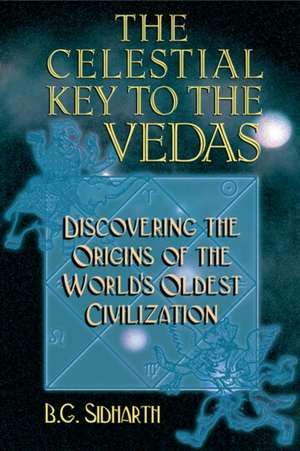
The Celestial Key to the Vedas
Autor B G Sidharthen Limba Engleză Paperback – oct 1999
Analizând dovezile interne din Rig Veda prin prisma astronomiei moderne, The Celestial Key to the Vedas propune o recalibrare radicală a cronologiei civilizației indice. Remarcăm modul în care B G Sidharth folosește datele despre eclipse, aliniamente stelare și precesia echinocțiilor pentru a contesta estimarea convențională de 1500 î.Hr., împingând originile acestor texte până în mileniul al X-lea î.Hr. Autorul argumentează că ceea ce cercetătorii occidentali au interpretat timp de un secol ca fiind simple mituri reprezintă, în realitate, un sistem sofisticat de marcare a timpului și o înțelegere profundă a fenomenelor cerești.
Subliniem rigoarea cu care Sidharth decodează simbolismul zeităților hinduse, revelând cunoștințe despre heliocentrism și ciclurile eclipselor care preced cu milenii descoperirile similare din Grecia sau Egipt. Această lucrare extinde cadrul propus de Time Keepers of the Vedas de Prabhakar Gondhalekar cu date noi extrase din analiza matematică a asterismelor lunare și a calendarului antic. În timp ce A Historical View of the Hindu Astronomy de John Bentley încerca încă din secolul al XIX-lea să elimine stratul mitic, Sidharth demonstrează că mitul este vehiculul precis al datelor științifice. Volumul se aliniază preocupărilor autorului din Best of Indian Physics, unde explorează tradiția excelenței științifice în India, oferind aici fundamentul arhaic al acestei tradiții. Structura argumentației este tehnică, dar accesibilă, transformând lectura într-o investigație detectivistică în istoria profundă a umanității.
Preț: 125.67 lei
Carte disponibilă
Livrare economică 20 mai-03 iunie
Livrare express 06-12 mai pentru 22.12 lei
Specificații
ISBN-10: 0892817534
Pagini: 176
Dimensiuni: 151 x 229 x 14 mm
Greutate: 0.27 kg
Ediția:Original edition
Editura: Inner Traditions/Bear & Company
V-ar putea interesa
-
 Black AthenaMartin Bernal-19%Preț: 84.70 lei104.55 lei
 -
 The Brothers GrimmJ. ZipesPreț: 405.96 lei
 -
 Preț: 132.28 lei
 -
 Preț: 207.89 lei
 -
 The Unthinkable Revolution in IranCharles KurzmanPreț: 247.63 lei
 -
 Ancient EncountersJames C. ChattersPreț: 115.04 lei
 -
 Preț: 414.10 lei
 -
 Mussolini's IntellectualsA. James GregorPreț: 328.99 lei
 -
 The Secret Order of AssassinsMarshall G S HodgsonPreț: 190.63 lei
 -
 Preț: 158.83 lei
 -
 1491 (Second Edition)Charles C. MannPreț: 121.94 lei
 -
 The Anatomy of FascismRobert O. PaxtonPreț: 96.51 lei
 -
 -18%Preț: 86.12 lei105.25 lei
 -
 The Dream Culture of the NeanderthalsStan GoochPreț: 91.71 lei
 -
 The Kingdom of Agarttha: A Journey into the Hollow EarthMarquis Alexandre Saint-Yves d'AlveydrePreț: 60.92 lei
 -
 Preț: 253.79 lei
 -
 The Field Guide to Bigfoot and Other Mystery PrimatesLoren ColemanPreț: 107.95 lei
 -
 Preț: 121.78 lei
 -
 The Enigma of Cranial DeformationDavid Hatcher ChildressPreț: 111.30 lei
De ce să citești această carte
Această carte este esențială pentru cei interesați de arheoastronomie și istoria comparată a religiilor. Cititorul va descoperi cum textele sacre ale Indiei funcționează ca arhive astronomice precise, oferind o perspectivă nouă asupra vechimii civilizației vedice. Este o lectură care validează intuițiile antice prin calcule matematice riguroase, fiind ideală pentru cei care doresc să înțeleagă conexiunea dintre cosmologie și spiritualitate.
Despre autor
B G Sidharth este un astronom de renume internațional și director fondator al Centrului Științific Birla din Hyderabad, India. Cu o carieră dedicată fizicii și cercetării fundamentale, el a organizat conferințe de prestigiu documentate în volume precum A Century of Ideas. Expertiza sa în astrofizică îi permite să abordeze textele antice precum Rig Veda nu doar ca editor literar, ci ca om de știință, căutând dovezi empirice în descrierile cerești ale antichității. Lucrările sale pun în valoare contribuția istorică a Indiei la știința universală.
Descriere scurtă
A leading astronomer proves that India had a thriving civilization capable of sophisticated astronomy long before Greece, Egypt, or any other world culture.
• Provides conclusive evidence that the Rig Veda is 12,000 years old.
• Establishes actual dates and places for many of the events in the Hindu epics.
For more than a century scholars have debated the antiquity of the Vedas and their related literature, the Brahmanas and Puranas. Relying upon a host of assumptions from linguistic theory, anthropology, and archaeology, they have agreed upon 1500 b.c. as the earliest possible date for the Rig Veda, itself the oldest extant example of Indo-European literature. But in this groundbreaking book, astronomer B. G. Sidharth proves conclusively that the earliest portions of the Rig Veda can be dated as far back as 10,000 b.c.
By deciphering the astronomical events and alignments contained in mythical and symbolic form in these ancient texts, Sidharth calls into question many if not all of the assumptions governing Indo-European prehistory. He explores such subjects as the astronomical significance of many Hindu deities and myths, the system of lunar asterisms used to mark time, the identity of the Asvins, and the sophisticated calendar of the ancients that harmonized solar and lunar cycles. Sidharth provides incontrovertible evidence that such "advanced" astronomical concepts as precession, heliocentrism, and the eclipse cycle are encoded in these ancient texts, passages of which make perfect sense only if these astronomical keys are known. Based on internal evidence in the Mahabharata and Ramayana, he also becomes the first to establish likely dates--and even places--for the events described in these famous epics. The Celestial Key to the Vedas is sure to astonish anyone concerned with astronomy, India, or the roots of civilization.