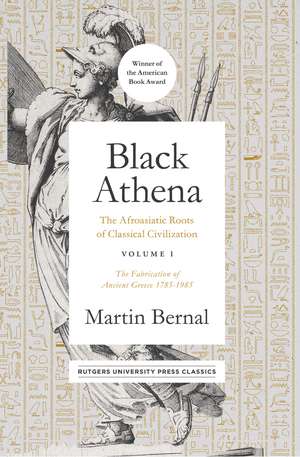
Black Athena
Autor Martin Bernalen Limba Engleză Paperback – 14 feb 2020
Descoperim aici o analiză riguroasă a fundamentelor lingvistice ale civilizației occidentale, în ceea ce reprezintă volumul final al trilogiei Black Athena. Ne-a atras atenția în mod deosebit modul în care Martin Bernal utilizează etimologia pentru a demonstra că aproximativ 40% din lexicul limbii grecești își are rădăcinile în limbi afro-asiatice, precum egipteana veche și semitica de vest. Autorul nu se limitează la termeni uzuali, ci extinde cercetarea asupra conceptelor fundamentale din politică, religie și filosofie, sugerând o dominanță culturală profundă exercitată de civilizațiile din Africa și Orientul Apropiat asupra populațiilor indo-europene. Structura lucrării este una academică și metodică, debutând cu tabele cronologice și o secțiune dedicată foneticii și transcrierii, elemente esențiale pentru parcurgerea demonstrațiilor lingvistice ulterioare. Observăm o progresie clară de la fundamentele teoretice ale „Modelului Antic Revizuit” către studii de caz specifice, cum este analiza Cretei din perioada pre-palatinală. Cartea este comparabilă cu Black Athena Revisited de Mary R. Lefkowitz în rigoarea documentării, dar oferă o perspectivă opusă, fiind esențială pentru înțelegerea polemicilor actuale din studiile culturale. În contextul operei sale, acest volum completează viziunea din Black Athena: The Fabrication of Ancient Greece, unde Bernal demonta construcția istoriografică europeană din secolele XVIII-XIX. Dacă primele volume se concentrau pe arheologie și documente istorice, lucrarea de față ancorează întreaga teză în realitatea concretă a limbajului, oferind închiderea necesară uneia dintre cele mai controversate serii din istoriografia modernă.
Preț: 318.79 lei
Carte disponibilă
Livrare economică 02-16 noiembrie
Specificații
ISBN-10: 1978804261
Pagini: 669
Dimensiuni: 129 x 200 x 41 mm
Greutate: 0.7 kg
Ediția:None
Editura: Rutgers University Press
V-ar putea interesa
-
 The Brothers GrimmJ. ZipesPreț: 433.93 lei
 -
 Preț: 132.28 lei
 -
 The Global Cold WarOdd Arne WestadPreț: 232.67 lei
 -
 The Unthinkable Revolution in IranCharles KurzmanPreț: 247.63 lei
 -
 Ancient EncountersJames C. ChattersPreț: 126.42 lei
 -
 The Birth of Fascist IdeologyZeev SternhellPreț: 438.61 lei
 -
 Mussolini's IntellectualsA. James GregorPreț: 356.51 lei
 -
 The Secret Order of AssassinsMarshall G S HodgsonPreț: 203.74 lei
 -
 Celestial Key to the VedasB. G. SidharthPreț: 129.89 lei
 -
 Preț: 158.83 lei
 -
 1491 (Second Edition)Charles C. MannPreț: 128.96 lei
 -
 The Anatomy of FascismRobert O. PaxtonPreț: 105.22 lei
 -
 -17%Preț: 89.95 lei108.97 lei
 -
 The Dream Culture of the NeanderthalsStan GoochPreț: 96.26 lei
 -
 The Kingdom of Agarttha: A Journey into the Hollow EarthMarquis Alexandre Saint-Yves d'AlveydrePreț: 63.00 lei
 -
 Preț: 272.43 lei
 -
 The Field Guide to Bigfoot and Other Mystery PrimatesLoren ColemanPreț: 117.34 lei
 -
 Preț: 125.71 lei
 -
 The Enigma of Cranial DeformationDavid Hatcher ChildressPreț: 116.57 lei
De ce să citești această carte
Această lucrare este indispensabilă pentru studenții și cercetătorii din domeniile istoriei antice, lingvisticii și studiilor culturale. Cititorul câștigă o perspectivă nouă asupra originilor Europei, înțelegând cum influențele afro-asiatice au modelat gândirea greacă. Este o invitație la reevaluarea critică a istoriei civilizației occidentale, oferind argumente lingvistice solide care depășesc barierele eurocentrismului tradițional, fiind utilă oricui dorește să exploreze rădăcinile profunde ale filosofiei și religiei elene.
Despre autor
Martin Bernal a fost profesor emerit de guvernare și studii ale Orientului Apropiat la Universitatea Cornell. Cariera sa academică a fost marcată de o vastă deschidere interdisciplinară, trecând de la studiul istoriei intelectuale chineze la reevaluarea fundamentelor civilizației clasice. Lucrarea sa monumentală, Black Athena, a fost tradusă în numeroase limbi, inclusiv germană, italiană și franceză, generând dezbateri aprinse în mediul universitar global. Prin scrierile sale, precum Black Athena Writes Back, Bernal a rămas o voce centrală în dialogul despre rasismul sistemic în mediul academic și nevoia de a recunoaște contribuțiile Afro-Asiei la cultura mondială.
Descriere scurtă
What is classical about Classical civilization? In one of the most audacious works of scholarship ever written, Martin Bernal challenges the foundation of our thinking about this question. Classical civilization, he argues, has deep roots in Afroasiatic cultures. But these Afroasiatic influences have been systematically ignored, denied or suppressed since the eighteenth century—chiefly for racist reasons.
The popular view is that Greek civilization was the result of the conquest of a sophisticated but weak native population by vigorous Indo-European speakers—Aryans—from the North. But the Classical Greeks, Bernal argues, knew nothing of this “Aryan model.” They did not see their institutions as original, but as derived from the East and from Egypt in particular.
In an unprecedented tour de force, Bernal links a wide range of areas and disciplines—drama, poetry, myth, theological controversy, esoteric religion, philosophy, biography, language, historical narrative, and the emergence of “modern scholarship.”
Notă biografică
Cuprins
Transcription and Phonetics
Maps and Charts
Chronological Table
Introduction
Background
Proposed historical outline
Black Athena, Volume I: a summary of the argument
Greece European or Levantine? The Egyptian and West Semitic
Components of Greek Civilization / a summary of Volume 2
Solving the Riddle of the Sphinx and Other Studies in Egypto-Greek
Mythology / a summary of Volume
1 The Ancient Model in Antiquity
Pelasgians
Ionians
Colonization
The colonizations in Greek tragedy
Herodotos
Thucydides
Isokrates and Plato
Aristotle
Theories of colonization and later borrowing in the Hellenistic world
Plutarch’s attack on Herodotos
The triumph of Egyptian religion
Alexander son of Ammon
2 Egyptian wisdom and Greek transmission
From the Dark Ages to the Renaissance
The murder of Hypatia
The collapse of Egypto-Pagan religion
Christianity, stars and fish
The relics of Egyptian religion: Hermeticism, Neo-Platonism and Gnosticism
Hermeticism – Greek, Iranian, Chaldaean or Egyptian?
Hermeticism and Neo-Platonism under early Christianity, Judaism and Islam
Hermeticism in Byzantium and Christian Western Europe
Egypt in the Renaissance
Copernicus and Hermeticism
Hermeticism and Egypt in the 16th century
3 The triumph of Egypt in the 17th and 18th centuries
Hermeticism in the 17th century
Rosicrucianism: Ancient Egypt in Protestant countries
Ancient Egypt in the 18th century
The 18th century: China and the Physiocrats
The 18th century: England, Egypt and the Freemasons
France, Egypt and ‘progress’: the quarrel between Ancients and Moderns
Mythology as allegory for Egyptian science
The Expedition to Egypt
4 Hostilities to Egypt in the 18th century
Christian reaction
The ‘triangle’: Christianity and Greece against Egypt
The alliance between Greece and Christianity
‘Progress’ against Egypt
Europe as the ‘progressive’ continent
‘Progress’
Racism
Romanticism
Ossian and Homer
Romantic Hellenism
Winckelmann and Neo-Hellenism in Germany
Göttingen
5 Romantic linguistics
The rise of India and the fall of Egypt, 1740–1880
The birth of Indo-European
The love affair with Sanskrit
Schlegelian Romantic linguistics
The Oriental Renaissance
The fall of China
Racism in the early 19th century
What colour were the Ancient Egyptians?
The national renaissance of modern Egypt
Dupuis, Jomard and Champollion
Egyptian monotheism or Egyptian polytheism
Popular perceptions of Ancient Egypt in the 19th and 20th centuries
Elliot Smith and ‘diffusionism’
Jomard and the Mystery of the Pyramids
6 Hellenomania, 1
The fall of the Ancient Model, 1790–1830
Friedrich August Wolf and Wilhelm von Humboldt
Humboldt’s educational reforms
The Philhellenes
Dirty Greeks and the Dorians
Transitional figures, 1: Hegel and Marx
Transitional figures, 2: Heeren
Transitional figures, 3: Barthold Niebuhr
Petit-Radel and the first attack on the Ancient Model
Karl Otfried Müller and the overthrow of the Ancient Model
7 Hellenomania, 2
Transmission of the new scholarship to England and the rise of the Aryan Model, 1830–60
The German model and educational reform in England
George Grote
Aryans and Hellenes
8 The rise and fall of the Phoenicians, 1830–85
Phoenicians and anti-Semitism
What race were the Semites?
The linguistic and geographical inferiorities of the Semites
The Arnolds
Phoenicians and English, 1: the English view
Phoenicians and English, 2: the French view
Salammbô
Moloch
The Phoenicians in Greece: 1820–80
Gobineau’s image of Greece
Schliemann and the discovery of the ‘Mycenaeans’
Babylon
9 The final solution of the Phoenician problem, 1885–1945
The Greek Renaissance
Salomon Reinach
Julius Beloch
Victor Bérard
Akhenaton and the Egyptian Renaissance
Arthur Evans and the ‘Minoans’
The peak of anti-Semitism, 1920–39
20th-century Aryanism
Taming the alphabet: the final assault on the Phoenicians
10 The post-war situation
The return to the Broad Aryan Model, 1945–85
The post-war situation
Developments in Classics, 1945–65
The model of autochthonous origin
East Mediterranean contacts
Mythology
Language
Ugarit
Scholarship and the rise of Israel
Cyrus Gordon
Astour and Hellenosemitica
Astour’s successor? – J. C. Billigmeier
An attempt at compromise: Ruth Edwards
The return of the Iron Age Phoenicians
Naveh and the transmission of the alphabet
The return of the Egyptians?
The Revised Ancient Model
Conclusion
Appendix Were the Philistines Greek?
Notes
Glossary
Bibliography
Index