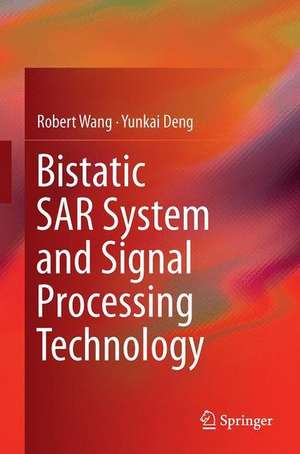
Bistatic SAR System and Signal Processing Technology
Autor Robert Wang, Yunkai Dengen Limba Engleză Hardback – 29 ian 2018
The book will be of interest to university researchers, R&D engineers and graduate students in Remote Sensing who wish to learn the core principles, methods, algorithms, and applications of Bistatic/Multistatic SAR system.
Preț: 1154.11 lei
Preț vechi: 1407.45 lei
-18%
Puncte Express: 1731
Carte tipărită la comandă
Livrare economică 30 noiembrie-14 decembrie
Livrare prin curier în România Termenul estimat este afișat lângă disponibilitate.
Transport gratuit pentru acest produs Plată online sau ramburs, în funcție de opțiunile comenzii.
Retur gratuit în 14 zile Comandă securizată și suport în română.
Specificații
ISBN-13: 9789811030772
ISBN-10: 9811030774
Pagini: 292
Ilustrații: XIV, 275 p. 123 illus.
Dimensiuni: 160 x 241 x 22 mm
Greutate: 0.55 kg
Ediția:1st edition 2018
Editura: Springer
Locul publicării:Singapore, Singapore
ISBN-10: 9811030774
Pagini: 292
Ilustrații: XIV, 275 p. 123 illus.
Dimensiuni: 160 x 241 x 22 mm
Greutate: 0.55 kg
Ediția:1st edition 2018
Editura: Springer
Locul publicării:Singapore, Singapore
V-ar putea interesa
-
 Golden Dawn Tarot DeckRegardiePreț: 112.63 lei
 -
 Digital Signal Processing in Power System Protection and ControlWaldemar Rebizant-18%Preț: 950.43 lei1159.05 lei
 -
 -15%Preț: 620.86 lei730.42 lei
 -
 Signal Analysis and PredictionAles Prochazka-15%Preț: 631.86 lei743.36 lei
 -
 Handbook of Data Communications and NetworksWilliam Buchanan-15%Preț: 666.90 lei784.59 lei
 -
 Acoustical ImagingPeter N. T. Wells-18%Preț: 963.84 lei1175.41 lei
 -
 Adaptive Filtering: Algorithms and Practical ImplementationPaulo S. R. Diniz-19%Preț: 1196.40 lei1477.04 lei
 -
 Entropy and Information TheoryRobert M. Gray-18%Preț: 1084.03 lei1321.98 lei
 -
 Embedded Image Processing on the TMS320C6000(TM) DSPShehrzad Qureshi-18%Preț: 1187.61 lei1448.31 lei
 -
 Speech Processing in Embedded SystemsPriyabrata Sinha-18%Preț: 705.21 lei860.01 lei
 -
 Smart CamerasAhmed Nabil Belbachir-18%Preț: 845.88 lei1031.56 lei
 -
 MIMO Communication for Cellular NetworksHoward Huang-18%Preț: 708.68 lei864.25 lei
 -
 Speech TechnologyFang Chen-15%Preț: 677.20 lei796.70 lei
 -
 The Jungian TarotRobert WangPreț: 117.40 lei
 -
 The Jungian Tarot and Its Archetypal ImageryRobert Wang-19%Preț: 93.57 lei115.22 lei
 -
 Tarot PsychologyRobert WangPreț: 71.45 lei
 -
 The Qabalistic Tarot BookRobert WangPreț: 198.43 lei
 -
 Computer Music Modeling and RetrievalUffe K. Wiil-15%Preț: 617.19 lei726.11 lei
 -
 Sound Capture for Human / Machine InterfacesWolfgang Herbordt-15%Preț: 699.86 lei823.35 lei
 -
 Microphone ArraysMichael Brandstein-18%Preț: 1154.92 lei1408.45 lei
 -
 -15%Preț: 644.90 lei758.71 lei
 -
 Advances in Document Image AnalysisNabeel A. MurshedPreț: 380.05 lei
 -
 Processing of Multidimensional SignalsAlexandre Smirnov-18%Preț: 913.32 lei1113.81 lei
 -
 -10%Preț: 76.58 lei84.96 lei
Cuprins
Introduction.- Fundamentals of Bistatic SAR.- Fundamentals of Bistatic SAR Imaging Algorithms.- Azimuth-Invariant Frequency-Domain Processing.- Azimuth-Variant Frequency-Domain Processing.- Bistatic Motion Compensation.- One-stationary Processing Algorithms.- Synchronization.- Design of Interferometric SAR system.
Textul de pe ultima copertă
This book reports the latest results in the study of Bistatic/Multistatic SAR system and signal processing techniques. Novel research ideas and experimental verification have been collected on all kinds of configurations of Bistatic/Multistatic SAR system, including the preliminary construction of system model, imaging algorithm design, mission design and the corresponding application representations etc. Handy well-prepared tables are provided for readers’ quick-reference, and the practical design of an interferometric SAR system is illustrated step by step.
The book will be of interest to university researchers, R&D engineers and graduate students in Remote Sensing who wish to learn the core principles, methods, algorithms, and applications of Bistatic/Multistatic SAR system.
The book will be of interest to university researchers, R&D engineers and graduate students in Remote Sensing who wish to learn the core principles, methods, algorithms, and applications of Bistatic/Multistatic SAR system.
Caracteristici
Offers in-depth research of all kinds of configurations of Bistatic /Multistatic SAR system both theoretically experimentally Represents the top overall mission design of Bistatic/Multistatic Interferometric SAR in China Offers the analysis of different configurations of bistatic synthetic aperture radar in detail Presents different kinds of imaging algorithms to solve all configurations Includes supplementary material: sn.pub/extras
Notă biografică
Robert Wang (Senior Member, IEEE) received his B.S. degree in control engineering from the University of Henan, Kaifeng, China, in 2002, and his Dr. Eng. degree from the Graduate University of Chinese Academy of Sciences, Beijing, China, in 2007. In 2007, he joined the Center for Sensor Systems (ZESS) at the University of Siegen, Siegen, Germany, where he participated in various collaborative projects supported by ZESS and Fraunhofer-FHR, Wachtberg, Germany. Since 2011, Dr. Wang has been with the Aerospace Information Research Institute, Chinese Academy of Sciences (AIRCAS), Beijing, where he currently serves as Director of the National Key Laboratory of Microwave Imaging. Since 2012, he has also been Co-Principal Investigator (PI) of the Helmholtz-CAS Joint Research Group in Beijing, focusing on spaceborne microwave remote sensing for the prevention and forensic analysis of natural hazards and extreme events. He is Radar Payload Principal Investigator of for LuTan-1 mission.
Wei Wang (Member, IEEE) received the B.S. degree from the National University of Defence Technology, Changsha, China, in 2008, and the Ph.D. degree in communication and information system from the University of Chinese Academy of Sciences, Beijing, China, in 2016. In 2016, he joined the Institute of Electronics, Chinese Academy of Sciences, Beijing, China. From 2018 to 2025, he was Researcher Fellow in radar system design and signal processing with the Aerospace Information Research Institute, Chinese Academy of Sciences. Since 2025, he has been Professor in radar system design and signal processing with the University of Chinese Academy of Sciences. He is also Doctoral Supervisor in communication and information system. His research interests include spaceborne synthetic aperture radar (SAR) system design and signal processing, radar waveform design, high-resolution SAR imaging, multichannel and digital beamforming SAR.