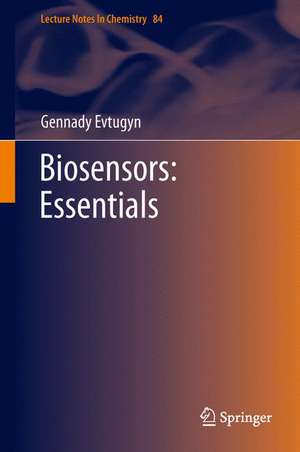
Biosensors: Essentials: Lecture Notes in Chemistry, cartea 84
Autor Gennady Evtugynen Limba Engleză Hardback – 21 oct 2013
elements, such as enzymes, antibodies, aptamers or even whole cells. Various signal transducers such as electrochemical and optical transducers, luminescence devices and advanced techniques such as quartz crystal microbalances and MEMS systems are covered as well. Current applications are introduced through various case studies, rounded out by a forward-looking chapter on the prospects for biosensor development offered by nanotechnology, lab-on-a-chip, and biomimetic systems.
Din seria Lecture Notes in Chemistry
- 18%
 Preț: 1159.04 lei
 - 18%
 Preț: 780.09 lei
 - 18%
 Preț: 783.15 lei
 - 24%
 Preț: 966.50 lei
 - 18%
 Preț: 1007.64 lei
 - 18%
 Preț: 899.30 lei
 - 18%
 Preț: 1135.59 lei
 - 18%
 Preț: 1125.57 lei
 - 18%
 Preț: 933.30 lei
 -
 Preț: 92.94 lei
 -
 Preț: 365.51 lei
 -
 Preț: 399.19 lei
 - 18%
 Preț: 731.22 lei
 - 18%
 Preț: 785.42 lei
 - 18%
 Preț: 1267.85 lei
 - 15%
 Preț: 665.08 lei
 - 15%
 Preț: 624.84 lei
 - 23%
 Preț: 751.21 lei
 -
 Preț: 381.83 lei
 - 18%
 Preț: 1236.98 lei
 - 24%
 Preț: 1176.38 lei
 - 18%
 Preț: 1073.03 lei
 -
 Preț: 372.96 lei
 -
 Preț: 371.77 lei
 -
 Preț: 380.93 lei
 -
 Preț: 372.05 lei
 -
 Preț: 371.37 lei
 -
 Preț: 391.95 lei
 -
 Preț: 381.83 lei
 -
 Preț: 386.59 lei
 -
 Preț: 379.78 lei
 -
 Preț: 370.95 lei
 -
 Preț: 372.70 lei
 - 15%
 Preț: 648.32 lei
 -
 Preț: 374.14 lei
 -
 Preț: 392.73 lei
 -
 Preț: 372.05 lei
 -
 Preț: 373.40 lei
 -
 Preț: 380.47 lei
 -
 Preț: 374.23 lei
Preț: 668.50 lei
Preț vechi: 786.47 lei
-15%
Puncte Express: 1003
Carte tipărită la comandă
Livrare economică 21 noiembrie-05 decembrie
Livrare prin curier în România Termenul estimat este afișat lângă disponibilitate.
Transport gratuit pentru acest produs Plată online sau ramburs, în funcție de opțiunile comenzii.
Retur gratuit în 14 zile Comandă securizată și suport în română.
Specificații
ISBN-13: 9783642402401
ISBN-10: 3642402402
Pagini: 276
Ilustrații: X, 265 p. 133 illus.
Dimensiuni: 160 x 241 x 21 mm
Greutate: 0.53 kg
Ediția:2014
Editura: Springer
Colecția Lecture Notes in Chemistry
Seria Lecture Notes in Chemistry
Locul publicării:Berlin, Heidelberg, Germany
ISBN-10: 3642402402
Pagini: 276
Ilustrații: X, 265 p. 133 illus.
Dimensiuni: 160 x 241 x 21 mm
Greutate: 0.53 kg
Ediția:2014
Editura: Springer
Colecția Lecture Notes in Chemistry
Seria Lecture Notes in Chemistry
Locul publicării:Berlin, Heidelberg, Germany
V-ar putea interesa
-
 Write Like a Chemist: A Textbook and ResourceMarin S. Robinson-20%Preț: 533.69 lei668.70 lei
 -
 Digital ForensicsMarshall-5%Preț: 488.90 lei514.63 lei
 -
 Introduction to Spectroscopy, International EditionDonald L. Pavia-27%Preț: 646.35 lei885.80 lei
 -
 Miniaturization and Mass SpectrometrySeverine Le Gac-14%Preț: 1063.52 lei1236.66 lei
 -
 Practical Statistics for the Analytical ScientistPeter BedsonPreț: 292.86 lei
 -
 Chemoinformatics Approaches to Virtual ScreeningAlexandre Varnek-14%Preț: 1093.72 lei1271.76 lei
 -
 -40%Preț: 474.27 lei791.09 lei
 -
 -26%Preț: 395.84 lei536.61 lei
 -
 BerylliumMike J Brisson-14%Preț: 706.89 lei821.97 lei
 -
 New Techniques in Solid-State NMRJacek Klinowski-18%Preț: 1754.19 lei2139.25 lei
 -
 Determination of AnionsThomas R. Crompton-18%Preț: 1895.10 lei2311.10 lei
 -
 -18%Preț: 981.32 lei1196.72 lei
 -
 -15%Preț: 570.54 lei671.23 lei
 -
 Handbook of Practical X-Ray Fluorescence AnalysisBurkhard Beckhoff-18%Preț: 4083.83 lei4980.28 lei
Public țintă
GraduateCuprins
Introduction and Historic Overview.- Biochemical Components Used in Biosensor Assemblies: Enzymes.- Antibodies.- Protein / Peptide Receptors.- Nucleic Acids.- Whole Cells as Biosensing Elements.- Immobilization of Biochemical Elements of Biosensors.- Biosensor Signal Transducers: Electrochemical Transducers.- Optical Transducers.- Other Techniques.- How does it Work? – Case Studies.- Biosensors Prospects: Quo vadis? (Conclusion).
Recenzii
From the book reviews:
“This book is a useful introductory reading for undergraduate and graduate students, as well as for researchers in the related subjects of chemistry and biology … . is well organized and covers the basic principles of biosensors, with emphasis on the main biological recognition elements and on the physical signal transducers used for the development of these devices, which are clearly and concisely described. … a useful book for students and researchers interested in a general overview of this topic.” (María Cruz Moreno-Bondi, Analytical and Bioanalytical Chemistry, Vol. 406, October, 2014)
“This book is a useful introductory reading for undergraduate and graduate students, as well as for researchers in the related subjects of chemistry and biology … . is well organized and covers the basic principles of biosensors, with emphasis on the main biological recognition elements and on the physical signal transducers used for the development of these devices, which are clearly and concisely described. … a useful book for students and researchers interested in a general overview of this topic.” (María Cruz Moreno-Bondi, Analytical and Bioanalytical Chemistry, Vol. 406, October, 2014)
Textul de pe ultima copertă
Today, biosensors are broadly applied in research, clinical diagnosis and monitoring, as well as in pharmaceutical, environmental or food analysis. In this work, the author presents the essentials that advanced students and researchers need to know in order to make full use of this technology. This includes a description of biochemical recognition
elements, such as enzymes, antibodies, aptamers or even whole cells. Various signal transducers such as electrochemical and optical transducers, luminescence devices and advanced techniques such as quartz crystal microbalances and MEMS systems are covered as well. Current applications are introduced through various case studies, rounded out by a forward-looking chapter on the prospects for biosensor development offered by nanotechnology, lab-on-a-chip, and biomimetic systems.
elements, such as enzymes, antibodies, aptamers or even whole cells. Various signal transducers such as electrochemical and optical transducers, luminescence devices and advanced techniques such as quartz crystal microbalances and MEMS systems are covered as well. Current applications are introduced through various case studies, rounded out by a forward-looking chapter on the prospects for biosensor development offered by nanotechnology, lab-on-a-chip, and biomimetic systems.
Caracteristici
Covers essentials that advanced students and researchers need to know With a forward-looking chapter on biosensor development Presented in a consistent style by an expert author Includes supplementary material: sn.pub/extras