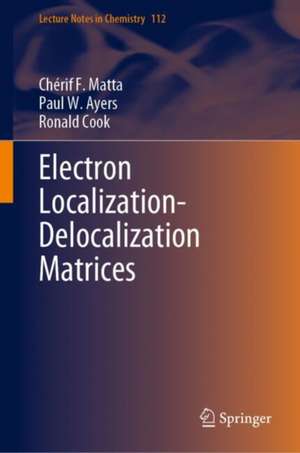
Electron Localization-Delocalization Matrices: Lecture Notes in Chemistry, cartea 112
Autor Chérif F. Matta, Paul W. Ayers, Ronald Cooken Limba Engleză Hardback – 3 mai 2024
Găsim în Electron Localization-Delocalization Matrices o resursă aplicată care debutează direct cu propunerea unor modele de calcul pentru fenomene complexe, precum activitatea de respingere a țânțarilor, inhibarea coroziunii sau interacțiunile enzimă-substrat. Suntem de părere că această lucrare reușește să umple un gol metodologic major, oferind cititorului nu doar fundamentul teoretic, ci și instrumentele software necesare pentru a procesa datele electronice sub forma unor obiecte matematice ușor de gestionat. Abordarea se bazează pe conceptul de matrice de localizare-delocalizare (LDM), un descriptor molecular inovator care sintetizează informația electronică complexă într-o amprentă digitală precisă. Structura volumului este una progresivă, pornind de la fizica localizării electronilor și teoria cuantică a atomilor în molecule (QTAIM), trecând prin aspectele computaționale ale amprentării moleculare și culminând cu analiza sistemelor mari. Un punct forte al cărții este capitolul dedicat analizei componentelor principale (PCA), care facilitează interpretarea volumelor mari de date chimice. Acoperă parțial aceeași arie tematică precum Graph-Theoretical Matrices in Chemistry de Dusanka Janezic, dar cu o abordare mult mai axată pe integrarea structurii electronice cuantice, depășind limitele pur topologice ale teoriei grafurilor clasice. De asemenea, spre deosebire de Localization and Delocalization in Quantum Chemistry, care se concentrează pe stări ionizate și excitate, volumul de față este orientat spre predictibilitate și aplicații practice în chemoinformatică și design molecular. Putem afirma că includerea software-ului gratuit transformă textul dintr-o monografie teoretică într-un manual de lucru indispensabil pentru laboratoarele de chimie computațională moderne.
Din seria Lecture Notes in Chemistry
- 18%
 Preț: 1163.84 lei
 - 18%
 Preț: 780.09 lei
 - 18%
 Preț: 783.15 lei
 - 24%
 Preț: 1005.98 lei
 - 18%
 Preț: 924.85 lei
 - 18%
 Preț: 1159.08 lei
 - 18%
 Preț: 1162.18 lei
 - 18%
 Preț: 937.21 lei
 -
 Preț: 92.94 lei
 -
 Preț: 365.51 lei
 -
 Preț: 399.19 lei
 - 18%
 Preț: 754.29 lei
 - 18%
 Preț: 810.36 lei
 - 18%
 Preț: 1265.99 lei
 - 15%
 Preț: 665.08 lei
 - 15%
 Preț: 669.62 lei
 - 23%
 Preț: 751.21 lei
 -
 Preț: 381.83 lei
 - 24%
 Preț: 1199.27 lei
 - 24%
 Preț: 1231.41 lei
 - 18%
 Preț: 1151.76 lei
 -
 Preț: 372.96 lei
 -
 Preț: 371.77 lei
 -
 Preț: 380.93 lei
 -
 Preț: 372.05 lei
 -
 Preț: 371.37 lei
 -
 Preț: 391.95 lei
 -
 Preț: 381.83 lei
 -
 Preț: 386.59 lei
 -
 Preț: 379.78 lei
 -
 Preț: 370.95 lei
 -
 Preț: 372.70 lei
 - 15%
 Preț: 648.32 lei
 -
 Preț: 374.14 lei
 -
 Preț: 392.73 lei
 -
 Preț: 372.05 lei
 -
 Preț: 373.40 lei
 -
 Preț: 380.47 lei
 -
 Preț: 374.23 lei
Preț: 1040.19 lei
Preț vechi: 1268.53 lei
-18%
Carte disponibilă
Livrare economică 13-27 noiembrie
Specificații
ISBN-10: 3031514327
Pagini: 244
Ilustrații: XIX, 222 p. 88 illus., 66 illus. in color.
Dimensiuni: 160 x 241 x 18 mm
Greutate: 0.53 kg
Ediția:2024
Editura: Springer
Colecția Lecture Notes in Chemistry
Seria Lecture Notes in Chemistry
Locul publicării:Cham, Switzerland
De ce să citești această carte
Această carte este esențială pentru cercetătorii în chimie fizică și chemoinformatică dornici să utilizeze noi descriptori moleculari. Cititorul câștigă acces la o metodologie hibridă ce combină acuratețea calculelor cuantice cu eficiența teoriei grafurilor. Motivul principal pentru achiziție este pachetul software inclus, care permite aplicarea imediată a matricelor LDM în predicția proprietăților chimice și biologice, oferind un avantaj competitiv în modelarea moleculară.
Despre autor
Chérif F. Matta, Paul W. Ayers și Ronald Cook sunt cercetători de prestigiu în domeniul chimiei teoretice și computaționale. Chérif F. Matta este cunoscut pentru contribuțiile sale extinse în aplicarea teoriei cuantice a atomilor în molecule în biologie și proiectarea medicamentelor. Paul W. Ayers deține o expertiză recunoscută în dezvoltarea de noi metode pentru teoria funcționalei de densitate și dinamica chimică. Împreună, autorii combină rigoarea matematică a teoriei grafurilor cu precizia fizicii cuantice, oferind prin acest volum din seria Lecture Notes in Chemistry o viziune unificată asupra structurii electronice moderne.
Descriere scurtă
Cuprins
Notă biografică
Ronald L. Cook is currently the CTO of Molecular Design Innovations, LLC., 754 S BraunSt, Lakewood CO USA (formerly a Principal Scientist TDA Research, Inc., in Golden, CO, USA). He obtained his B.A. in Chemistry from the University of North Colorado in 1977 and a Ph.D. in Organometallic Chemistry from Utah State University in 1983. In the years 1982-84, he worked as a Postdoc at the Ohio State University, before joining Eltron Research, Inc., as a Scientist/Research Manager. From 1992 to 2021, he was with TDA Research, Inc., as Principal Scientist. His current interest and research focus is on the development of novel descriptors from localization-delocalization matrices that can be used to develop predictive models for new materials and molecules. His achievements are documented in 21 patents, numerous original publications (57), and conference presentations. As Principal Scientist, Ronald Cook often leads in-house workshops on various topics, such as nanotechnology, nonlinear modeling, and data analysis and investing.
Paul W. Ayers is Professor at the Department of Chemistry & Chemical Biology, McMaster University, Canada. He received his B.S. in chemistry, mathematics, and physics from Lipscomb University (Nashville, Tennessee, USA) and a Ph.D. in Chemistry from the University of North Carolina at Chapel Hill (USA) in 2001 (with Robert Parr); he was then a National Institutes of Health postdoctoral fellow at Duke University (with Weitao Yang). Since 2002, he has been a faculty member at McMaster University, rising to full professor in 2013. His research interests in developing new mathematical and computational tools for describing and predicting chemical processes, especially chemical reactions, are documented in nearly 400 publications and have been the subject of more than 300 invited presentations. He co-founded the QC-Devs international consortium for free and open-source software.