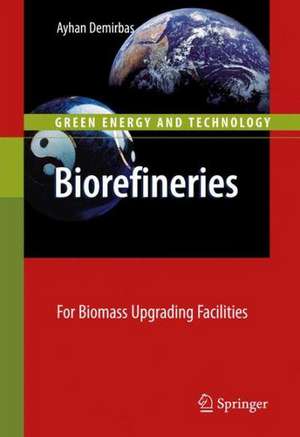
Biorefineries
Autor Ayhan Demirbasen Limba Engleză Hardback – 13 oct 2009
Biorefineries: For Biomass Upgrading Facilities will prove a practical resource for chemical engineers, and fuel and environmental engineers. It will also be invaluable in academic fields, providing useful information for both researchers and students.
| Toate formatele și edițiile | Preț | Express |
|---|---|---|
| Paperback (1) | 905.87 lei 43-57 zile | |
| SPRINGER LONDON – 14 mar 2012 | 905.87 lei 43-57 zile | |
| Hardback (1) | 911.19 lei 43-57 zile | |
| SPRINGER LONDON – 13 oct 2009 | 911.19 lei 43-57 zile |
Preț: 911.19 lei
Preț vechi: 1111.20 lei
-18% Nou
Puncte Express: 1367
Preț estimativ în valută:
161.24€ • 189.07$ • 141.60£
161.24€ • 189.07$ • 141.60£
Carte tipărită la comandă
Livrare economică 09-23 februarie 26
Preluare comenzi: 021 569.72.76
Specificații
ISBN-13: 9781848827202
ISBN-10: 1848827202
Pagini: 240
Ilustrații: IX, 240 p.
Dimensiuni: 166 x 243 x 25 mm
Greutate: 0.52 kg
Ediția:2010 edition
Editura: SPRINGER LONDON
Locul publicării:London, United Kingdom
ISBN-10: 1848827202
Pagini: 240
Ilustrații: IX, 240 p.
Dimensiuni: 166 x 243 x 25 mm
Greutate: 0.52 kg
Ediția:2010 edition
Editura: SPRINGER LONDON
Locul publicării:London, United Kingdom
V-ar putea interesa
-
 -9%Preț: 755.06 lei829.74 lei
 -
 Reliability TechnologyNorman Pascoe-8%Preț: 664.41 lei722.19 lei
 -
 -11%Preț: 501.54 lei563.54 lei
 -
 Biohydrogen: For Future Engine Fuel DemandsAyhan Demirbas-18%Preț: 907.54 lei1106.75 lei
 -
 Methane Gas HydrateAyhan Demirbas-18%Preț: 903.76 lei1102.15 lei
 -
 Algae Energy: Algae as a New Source of BiodieselAyhan Demirbas-24%Preț: 841.89 lei1107.75 lei
 -
 Solid Biofuels for Energy: A Lower Greenhouse Gas AlternativePanagiotis Grammelis-18%Preț: 906.17 lei1105.08 lei
 -
 -18%Preț: 749.68 lei914.25 lei
 -
 Modern Energy Markets: Real-Time Pricing, Renewable Resources and Efficient DistributionMaria Kopsakangas-Savolainen-15%Preț: 608.90 lei716.36 lei
 -
 Underground Thermal Energy StorageKun Sang Lee-15%Preț: 609.53 lei717.10 lei
 -
 Switchgrass: A Valuable Biomass Crop for EnergyAndrea Monti-18%Preț: 906.03 lei1104.92 lei
 -
 Photovoltaic Sources: Modeling and EmulationMaria Carmela Di Piazza-18%Preț: 908.77 lei1108.26 lei
 -
 -15%Preț: 610.96 lei718.77 lei
 -
 Wind Power Electric SystemsDjamila Rekioua-15%Preț: 618.75 lei727.94 lei
 -
 Sustainable Indoor LightingPaola Sansoni-15%Preț: 625.09 lei735.40 lei
 -
 -20%Preț: 606.05 lei757.56 lei
 -
 World ESCO OutlookPierre Langlois-29%Preț: 707.15 lei993.48 lei
 -
 Ethanol Economics & Ethanol's Impact on Food Prices & Greenhouse Gas EmissionsDarlene E. Marshall-30%Preț: 991.23 lei1425.01 lei
 -
 Advances in Energy ResearchNicu Bizon-30%Preț: 1480.22 lei2120.79 lei
 -
 Renewable Electricity GenerationLen G. Irwin-31%Preț: 810.33 lei1167.98 lei
 -
 Ocean EnergyCharlotte E. Williams-31%Preț: 1411.45 lei2035.81 lei
 -
 Solar Power for Communities: Guidance for Local StakeholdersDylan K Herrera-31%Preț: 1411.49 lei2035.82 lei
 -
 Biofuel Use in the U.S.Stefania Alonso-31%Preț: 810.76 lei1168.22 lei
 -
 Biodiesel: A Realistic Fuel Alternative for Diesel EnginesAyhan Demirbas-15%Preț: 617.25 lei726.17 lei
 -
 Biofuels: Securing the Planet’s Future Energy NeedsAyhan Demirbas-18%Preț: 965.29 lei1177.19 lei
 -
 Biofuels HandbookJames G Speight-14%Preț: 2071.47 lei2408.69 lei
 -
 Waste Energy for Life Cycle AssessmentAyhan Demirbas-15%Preț: 621.34 lei730.99 lei
Public țintă
ResearchCuprins
Fuels from Biomass.- Biorefinery.- Transportation Fuels.- Biomass Fractionation and Valorization.- Thermochemical Processes.- Biochemical Processes.- Biorefining Economy.- Political Impacts of Biorefinery.- Environmental Impacts of Biorefineries.
Recenzii
From the reviews:
“This book attempts to address the needs of energy researchers, chemical engineers, energy resources specialists, agriculturists, crop cultivators, and others interested in bioenergy. … for non-engineering readers and students, this book may be adequate for a comprehensive overview of the field. It may also be useful … for engineering students. … Summing Up: Recommended. Lower- and upper-division undergraduates, two-year technical program students, general readers.” (A. C. Sheth, Choice, Vol. 47 (8), April, 2010)
“Describes the main biorefinery concepts for the production of fuels based on biomass and their technical opportunities. … In the more technical parts he shows the biomass fractionation and valorisation, the different thermochemical and biochemical processes and an overview to economical, political and environmental impacts of biorefineries. Overall this book is a good reference for biofuel production in biorefineries.” (Bio-based News, Issue 8, February/March, 2011)
“The book clearly aims towards both general and advanced level readers. … The main focus of the book is however on various thermo chemical and biochemical processes that take place in the biorefinery. … the author particularly discusses the technological, economical and policy barriers which need to be overcome for full fledged deployment of a biorefinery based economy. … To gain a comprehensive outlook on this concept is thus highly desired and this is deservedly fulfilled by the book.” (Vishal Toro, Green Energy, Vol. 6 (5), September-October, 2010)
“This book attempts to address the needs of energy researchers, chemical engineers, energy resources specialists, agriculturists, crop cultivators, and others interested in bioenergy. … for non-engineering readers and students, this book may be adequate for a comprehensive overview of the field. It may also be useful … for engineering students. … Summing Up: Recommended. Lower- and upper-division undergraduates, two-year technical program students, general readers.” (A. C. Sheth, Choice, Vol. 47 (8), April, 2010)
“Describes the main biorefinery concepts for the production of fuels based on biomass and their technical opportunities. … In the more technical parts he shows the biomass fractionation and valorisation, the different thermochemical and biochemical processes and an overview to economical, political and environmental impacts of biorefineries. Overall this book is a good reference for biofuel production in biorefineries.” (Bio-based News, Issue 8, February/March, 2011)
“The book clearly aims towards both general and advanced level readers. … The main focus of the book is however on various thermo chemical and biochemical processes that take place in the biorefinery. … the author particularly discusses the technological, economical and policy barriers which need to be overcome for full fledged deployment of a biorefinery based economy. … To gain a comprehensive outlook on this concept is thus highly desired and this is deservedly fulfilled by the book.” (Vishal Toro, Green Energy, Vol. 6 (5), September-October, 2010)
Notă biografică
Ayhan Demirbas is a full professor at Sila Science and Energy, Turkey. He was a professor in Energy Technologies Science at Karadeniz Technical University, Turkey, between 1991 and 2001, and at Selcuk University, Turkey, from 2003 to 2007. His research is mainly concerned with renewable and sustainable energy.
Textul de pe ultima copertă
Climate change, environmental impact and declining natural resources are driving scientific research and novel technical solutions. Green Energy and Technology serves as a publishing platform for scientific and technological approaches to "green" - i.e., environmentally friendly and sustainable - technologies. While the main focus lies on energy and power supply, the series also covers green solutions in industrial engineering and engineering design. Green Energy and Technology is a monograph series addressing researchers, advanced students and technical consultants, as well as decision makers in industry and politics. The level presentation ranges from instructional to highly technical.
Industrial biorefineries have been identified as the most promising routes to the creation of a bio-based economy. Partial biorefineries already exist in some energy crop, forest-based, and lignocellulosic product facilities. Biorefineries: For Biomass Upgrading Facilities examines the variety of different technologies which integrated bio-based industries use to produce chemicals; biofuels; food and feed ingredients; biomaterials; and power from biomass raw materials. These systems can be improved through better utilization of agricultural residues and solid wastes, and through the optimization of total value-added products.
Conversion technologies are also covered, since biomass can be converted into useful biofuels and biochemicals via biomass upgrading and biorefinery technologies. Upgrading processes discussed in this book include fractionation, liquefaction, pyrolysis, hydrolysis, fermentation, and gasification.
Biorefineries: For Biomass Upgrading Facilities will prove a practical resource for chemical engineers, and fuel and environmental engineers. It will also be invaluable in academic fields, providing useful information for both researchers and students.
Industrial biorefineries have been identified as the most promising routes to the creation of a bio-based economy. Partial biorefineries already exist in some energy crop, forest-based, and lignocellulosic product facilities. Biorefineries: For Biomass Upgrading Facilities examines the variety of different technologies which integrated bio-based industries use to produce chemicals; biofuels; food and feed ingredients; biomaterials; and power from biomass raw materials. These systems can be improved through better utilization of agricultural residues and solid wastes, and through the optimization of total value-added products.
Conversion technologies are also covered, since biomass can be converted into useful biofuels and biochemicals via biomass upgrading and biorefinery technologies. Upgrading processes discussed in this book include fractionation, liquefaction, pyrolysis, hydrolysis, fermentation, and gasification.
Biorefineries: For Biomass Upgrading Facilities will prove a practical resource for chemical engineers, and fuel and environmental engineers. It will also be invaluable in academic fields, providing useful information for both researchers and students.
Caracteristici
Analyses modern methods of biomass conversion Reviews the environmental effects of a range of biorefining products and fuels Includes supplementary material: sn.pub/extras