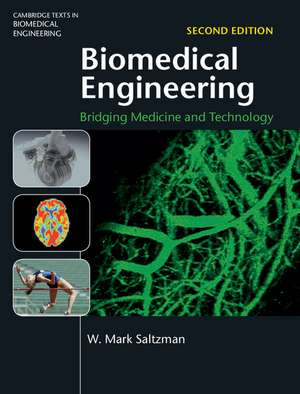
Biomedical Engineering: Cambridge Texts in Biomedical Engineering
Autor W. Mark Saltzmanen Limba Engleză Hardback – 21 mai 2015
Bazându-ne pe cele mai recente progrese tehnologice și studii de caz din medicina modernă, considerăm că a doua ediție a volumului Biomedical Engineering reprezintă o resursă academică esențială pentru studenții și specialiștii aflați la intersecția dintre biologie și inginerie. Autorul W Mark Saltzman reușește să ancoreze teoria în aplicații clinice concrete, oferind o perspectivă clinică riguroasă asupra modului în care ingineria rezolvă problemele fiziologice umane. Structura cursului este organizată progresiv, începând cu bazele moleculare și celulare, trecând prin sistemele de comunicare și echilibru ale corpului (precum respirația și circulația), pentru a culmina cu aplicațiile avansate de bioinstrumentație, imagistică și biomateriale. Găsim în acest text o actualizare necesară a subdomeniilor emergente, precum nanomedicina și senzorii biologici, elemente care lipsesc adesea din manualele clasice. Din punctul nostru de vedere, acest volum completează excelent lucrarea Introduction to Biomedical Engineering de John Enderle. În timp ce textul lui Enderle oferă o acoperire enciclopedică și modelare matematică vastă, Biomedical Engineering de Saltzman aduce un plus de context biologic și profiluri profesionale care umanizează disciplina. Stilul narativ este susținut de un aparat grafic impresionant, format din aproape 500 de ilustrații, facilitând înțelegerea mecanismelor complexe precum ingineria imunității sau biomecanica. Cele peste 200 de exerciții incluse transformă lectura dintr-una pasivă într-un instrument activ de învățare, pregătind viitorii ingineri pentru provocările reale din spitale și laboratoarele de cercetare.


Preț: 571.05 lei
Preț vechi: 601.11 lei
-5%
Carte disponibilă
Livrare economică 07-21 noiembrie
Livrare express 24-30 octombrie pentru 89.79 lei
Specificații
ISBN-10: 1107037190
Pagini: 779
Ilustrații: 253 b/w illus. 245 colour illus. 30 tables
Dimensiuni: 192 x 254 x 40 mm
Greutate: 1.79 kg
Ediția:Revizuită
Editura: Cambridge University Press
Colecția Cambridge Texts in Biomedical Engineering
Seria Cambridge Texts in Biomedical Engineering
Locul publicării:New York, United States
V-ar putea interesa
-
 Biomaterials Science: An Introduction to Materials in MedicineWilliam R Wagner-29%Preț: 922.59 lei1293.49 lei
 -
 Bioprocess Engineering PrinciplesRoss Carlson-32%Preț: 599.19 lei881.03 lei
 -
 CytopathologyBehdad Shambayati-5%Preț: 442.20 lei465.48 lei
 -
 -41%Preț: 601.71 lei1017.61 lei
 -
 -31%Preț: 840.65 lei1218.05 lei
 -
 Physics in Biology and MedicinePaul Davidovits-32%Preț: 507.95 lei747.60 lei
 -
 -30%Preț: 710.22 lei1017.64 lei
 -
 -28%Preț: 810.11 lei1121.58 leiRecomandat
 -
 Cellular and Molecular ImmunologyAbul K. Abbas-28%Preț: 508.56 lei710.50 leiRecomandat
 -
 Medical SciencesDenise Syndercombe Court-26%Preț: 418.08 lei565.64 lei
 -
 Physical Biology of the CellRob Phillips-9%Preț: 847.96 lei931.82 lei
 -
 Biophysical ChemistryDagmar Klostermeier-19%Preț: 788.10 lei972.96 lei
 -
 Biology of DiseaseNessar Ahmed-8%Preț: 504.96 lei548.87 lei
 -
 Fundamentals of NanomedicineJames F Leary-5%Preț: 702.81 lei739.79 lei
 -
 Preț: 386.19 lei
 -
 Cell Biology: A Short CourseAndrea Townsend-Nicholson-23%Preț: 600.85 lei780.33 lei
 -
 Systems BiologyEdda Klipp-11%Preț: 540.07 lei606.83 lei
 -
 -11%Preț: 481.24 lei540.71 lei
De ce să citești această carte
Recomandăm această carte pentru abordarea sa integrată care nu doar explică teoria, ci o și aplică în scenarii medicale reale. Cititorul câștigă o înțelegere profundă a fundamentelor de biologie moleculară necesare pentru a inova în domenii precum organele artificiale sau tratamentul cancerului. Este o investiție valoroasă pentru studenții la inginerie care doresc o carieră în tehnologie medicală, oferind totodată o perspectivă modernă asupra nanomedicinei și biosenzorilor.
Cuprins
1. Introduction: what is biomedical engineering?; Part I. Molecular and Cellular Principles: 2. Biomolecular principles; 3. Biomolecular principles: nucleic acids; 4. Biomolecular principles: proteins; 5. Cellular principles; Part II. Physiological Principles: 6. Communication systems in the body; 7. Engineering balances: respiration and digestion; 8. Circulation; 9. Removal of molecules from the body; Part III. Biomedical Engineering: 10. Biomechanics; 11. Bioinstrumentation; 12. Bioimaging; 13. Biomolecular engineering I: biotechnology; 14. Biomolecular engineering II: engineering of immunity; 15. Biomaterials and artificial organs; 16. Biomedical engineering and cancer.
Recenzii
'This textbook is a wonderful summary of the field of biomedical engineering - a must-have for any faculty member teaching an introductory BME course. As usual, Professor Saltzman has provided rich context and broad examples; he does an excellent job of weaving in valuable scenarios that are realistic, yet interesting - a great tool for engaging students. There are many creative and useful features to the text: the figures and illustrations provide much value to understanding the material, the problem sets offer both conceptual and quantitative review of the material, and the 'Key Concepts and Definitions' and 'Useful Links' sections at the end of each chapter are very practical for a student new to the field of BME. Of particular note, the 'Profiles in BME' vignettes for each chapter add a personal touch and serve to connect students to role models who are real people (with real stories) making an impact on the world.' Christine E. Schmidt, University of Florida
'This is an excellent book that covers the fundamentals of a broad array of specific fields within biomedical engineering. This textbook will certainly be adopted by many introductory biomedical engineering courses due to its meaningful organization, clear writing, illuminative figures, and variety of problems for students to work through. Its breadth and scope will stimulate all readers. Once again, Mark Saltzman has accomplished a major achievement by providing such a comprehensive text for students and educators alike.' Melissa Krebs, Colorado School of Mines
Descriere
The second edition of this popular introductory undergraduate textbook uses examples, applications, and profiles of biomedical engineers to show students the relevance of the theory and how it can be used to solve real problems in human medicine. The essential molecular biology, cellular biology, and human physiology background is included for students to understand the context in which biomedical engineers work. Updates throughout highlight important advances made over recent years, including iPS cells, microRNA, nanomedicine, imaging technology, biosensors, and drug delivery systems, giving students a modern description of the various subfields of biomedical engineering. Over two hundred quantitative and qualitative exercises, many new to this edition, help consolidate learning, whilst a solutions manual, password-protected for instructors, is available online. Finally, students can enjoy an expanded set of leader profiles in biomedical engineering within the book, showcasing the broad range of career paths open to students who make biomedical engineering their calling.