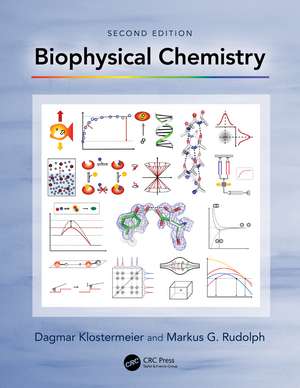
Biophysical Chemistry
Autor Dagmar Klostermeier, Markus G. Rudolphen Limba Engleză Hardback – 18 apr 2025
This second edition has been fully updated throughout with novel techniques, with a new chapter on advances in cryo-electron microscopy and exciting new content throughout on big data techniques, structural bioinformatics, systems biology and interaction networks, and artificial intelligence and machine learning.
The book is organized in four parts, covering thermodynamics, kinetics, molecular structure and stability, and biophysical methods. Cross-references within and between these parts emphasize common themes and highlight recurrent principles. End of chapter problems illustrate the main points explored and their relevance for biochemistry, enabling students to apply their knowledge and to transfer it to laboratory projects.
Key Features:
- Connects principles of physical chemistry to biochemistry
- Emphasizes the role of organic reactions as tools for modification and manipulation of biomolecules
- Includes a comprehensive section on the theory of modern biophysical methods and their applications
Preț: 788.10 lei
Preț vechi: 972.96 lei
-19%
Puncte Express: 1182
Carte disponibilă
Livrare economică 18 noiembrie-02 decembrie
Livrare prin curier în România Termenul estimat este afișat lângă disponibilitate.
Transport gratuit pentru acest produs Plată online sau ramburs, în funcție de opțiunile comenzii.
Retur gratuit în 14 zile Comandă securizată și suport în română.
Specificații
ISBN-13: 9781032060835
ISBN-10: 1032060832
Pagini: 944
Ilustrații: 1104
Dimensiuni: 216 x 279 x 47 mm
Greutate: 2.82 kg
Ediția:2
Editura: CRC Press
Colecția CRC Press
Locul publicării:Boca Raton, United States
ISBN-10: 1032060832
Pagini: 944
Ilustrații: 1104
Dimensiuni: 216 x 279 x 47 mm
Greutate: 2.82 kg
Ediția:2
Editura: CRC Press
Colecția CRC Press
Locul publicării:Boca Raton, United States
V-ar putea interesa
-
 Bioprocess Engineering PrinciplesRoss Carlson-31%Preț: 605.17 lei881.03 lei
 -
 Thermodynamics of Chemical ProcessesGareth PricePreț: 254.89 lei
 -
 Physical Chemistry for the Life SciencesPeter Atkins-23%Preț: 1077.50 lei1392.51 lei
 -
 -31%Preț: 390.55 lei567.01 lei
 -
 BIOS Instant Notes in BiochemistryDavid HamesPreț: 276.91 lei
 -
 -31%Preț: 840.65 lei1218.05 lei
 -
 Physics in Biology and MedicinePaul Davidovits-32%Preț: 508.24 lei747.60 lei
 -
 Clinical ChemistryWilliam J. Marshall-5%Preț: 357.78 lei376.60 leiRecomandat
 -
 Biological Science 1 & 2D. J. Taylor-8%Preț: 595.67 lei647.46 lei
 -
 Physical Biology of the CellRob Phillips-9%Preț: 847.96 lei931.82 lei
 -
 -19%Preț: 404.23 lei499.04 lei
 -
 Trends in Biochemistry and Molecular BiologyHossain Uddin Shekhar-26%Preț: 1497.58 lei2037.03 lei
 -
 -18%Preț: 1000.25 lei1219.82 lei
 -
 -11%Preț: 481.24 lei540.71 lei
Public țintă
Postgraduate and UndergraduateNotă biografică
Dagmar Klostermeier is of the University of Muenster, Germany.
Markus G. Rudolph is of the Pharma Research & Early Development Division in the Roche Group, Switzerland.
Markus G. Rudolph is of the Pharma Research & Early Development Division in the Roche Group, Switzerland.
Cuprins
Chapter 1: Systems, state functions, and the laws of thermodynamics. Chapter 2: Energetics and chemical equilibria. Chapter 3: Statistical thermodynamics. Chapter 4: Thermodynamics of transport processes. Chapter 5: Electrochemistry. Chapter 6: Reaction velocities and rate laws. Chapter 7: Integrated rate laws for uni- and bimolecular reactions. Chapter 8: Reaction types. Chapter 9: Deriving integrated rate laws by solving sets of differential equations with matrix algebra. Chapter 10: Rate-limiting steps. Chapter 11: Binding reactions: one-step and two-step binding. Chapter 12: Single-molecule kinetics. Chapter 13: Steady-state (enzyme) kinetics. Chapter 14: Complex reaction schemes and their analysis. Chapter 15: Temperature dependence of rate constants. Chapter 16: Principles of catalysis. Chapter 17: Molecular Structure and Interactions. Chapter 18: Proteins. Chapter 19: Nucleic Acids. Chapter 20: Macromolecular Modeling. Chapter 21: Optical Spectroscopy. Chapter 22: Magnetic Resonance. Chapter 23: Solution Scattering. Chapter 24: Crystallography. Chapter 25: Fluorescence Imaging and Microscopy. Chapter 26: Electron Microscopy. Chapter 27: Scanning Probe Microscopy and Force Measurements. Chapter 28: Transient Kinetic Methods. Chapter 29: Molecular Mass, Size, and Shape. Chapter 30: Calorimetry. Chapter 31: Mathematical Concepts Used in this Book. Chapter 32: Prefixes, Units, Constants.
Recenzii
'The authors indicate in the preface that the main target readers of this book are undergraduate students and scientists with a background in life sciences. This is definitely the least that can be said about this impressive compilation of knowledge presented in a very attractive way, with ‘boxes’ throughout the book giving some explanation of the concepts or remarks on unexpected applications, enlightened by numerous illustrations, schemes and molecular modeling that should inspire numerous teachers.
This really is a massive and impressive book overviewing a wide field of knowledge, especially when one considers that only two authors contributed.'
- Marc Hebrant, Universite´de Lorraine, Acta Crystallographica, 2025.
This really is a massive and impressive book overviewing a wide field of knowledge, especially when one considers that only two authors contributed.'
- Marc Hebrant, Universite´de Lorraine, Acta Crystallographica, 2025.
Descriere
This second edition has been fully updated throughout with novel techniques, with a new chapter on advances in cryo-electron microscopy and exciting new content throughout on big data techniques, structural bioinformatics, systems biology and interaction networks, and artificial intelligence and machine learning.