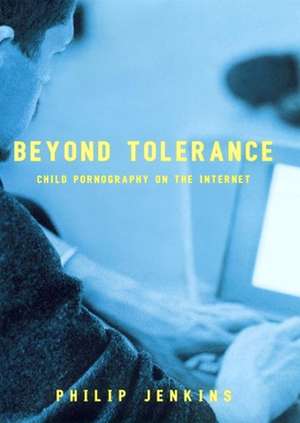
Beyond Tolerance
Autor Philip Jenkinsen Limba Engleză Hardback – aug 2001
Preț: 629.96 lei
Preț vechi: 818.13 lei
-23%
Puncte Express: 945
Carte tipărită la comandă
Livrare economică 27 noiembrie-11 decembrie
Livrare prin curier în România Termenul estimat este afișat lângă disponibilitate.
Transport gratuit pentru acest produs Plată online sau ramburs, în funcție de opțiunile comenzii.
Retur gratuit în 14 zile Comandă securizată și suport în română.
Specificații
ISBN-13: 9780814742624
ISBN-10: 0814742629
Pagini: 274
Dimensiuni: 159 x 236 x 23 mm
Greutate: 0.49 kg
Ediția:New.
Editura: NYU Press - IPS
ISBN-10: 0814742629
Pagini: 274
Dimensiuni: 159 x 236 x 23 mm
Greutate: 0.49 kg
Ediția:New.
Editura: NYU Press - IPS
V-ar putea interesa
-
 Preț: 112.63 lei
 -
 -19%Preț: 241.54 lei299.70 lei
 -
 Next Christendom: The Coming of Global ChristianityPhilip Jenkins-18%Preț: 137.04 lei166.90 lei
 -
 -17%Preț: 339.04 lei406.19 lei
 -
 Against ManagementMartin ParkerPreț: 225.34 lei
 -
 The Lost History of ChristianityPhilip JenkinsPreț: 100.92 lei
 -
 The New Map of the Global ChurchPhilip JenkinsPreț: 81.55 lei
 -
 Preț: 104.17 lei
 -
 -5%Preț: 713.73 lei751.29 lei
 -
 Child Pornography: An Internet CrimeEthel Quayle-5%Preț: 390.71 lei411.28 lei
 -
 Golden GoddessesJill C. NelsonPreț: 352.36 lei
 -
 Preț: 350.42 lei
 -
 Art/Porn: A History of Seeing and TouchingKelly DennisPreț: 183.55 lei
Recenzii
"There is much of value in Jenkins' work. He manages to discuss CP calmly, while at the same time making clear his personal revulsion, an achievement in itself in an area characterized by so much hysteria."
The Journal of Sex Research "Magnificently readable social science on a widely misunderstood subject."
Booklist "A useful introduction to the methods that the kiddie-porn community uses to hide its activities...a smart history of the child-porn industry"
The Washington Monthly, Nov. 2001 "This is a troubling book that exposes how child pornography has found a safe haven on the Internet. Philip Jenkins's innovative research methods let him explore and map the secret electronic networks that link individuals whose deviance seems not just outrageous, but incomprehensible. Jenkins shows how culture and social structure emerge in a virtualand decidedly not virtuousworld. This book raises profound questions about the nature of deviance in an electronic future."
Joel Best, University of Delaware "A disturbing, thought-provoking study"
Library Journal "A detailed yet engaging account . . . . Engrossing"
Liberty, Jan. 2002
"There is much of value in Jenkins' work. He manages to discuss CP calmly, while at the same time making clear his personal revulsion, an achievement in itself in an area characterized by so much hysteria." -- The Journal of Sex Research "Magnificently readable social science on a widely misunderstood subject." --Booklist "A useful introduction to the methods that the kiddie-porn community uses to hide its activities...a smart history of the child-porn industry" --The Washington Monthly, Nov. 2001 "This is a troubling book that exposes how child pornography has found a safe haven on the Internet. Philip Jenkins's innovative research methods let him explore and map the secret electronic networks that link individuals whose deviance seems not just outrageous, but incomprehensible. Jenkins shows how culture and social structure emerge in a virtual--and decidedly not virtuous--world. This book raises profound questions about the nature of deviance in an electronic future." --Joel Best, University of Delaware "A disturbing, thought-provoking study" --Library Journal "A detailed yet engaging account ... Engrossing" --Liberty, Jan. 2002
"Liebowitz and Margolis are masters of neoclassical theory. The book mixes theoretical and historical analysis, effectively confronting one with the other, and exposing both their weaknesses and strenghs."-"EH.NET",
The Journal of Sex Research "Magnificently readable social science on a widely misunderstood subject."
Booklist "A useful introduction to the methods that the kiddie-porn community uses to hide its activities...a smart history of the child-porn industry"
The Washington Monthly, Nov. 2001 "This is a troubling book that exposes how child pornography has found a safe haven on the Internet. Philip Jenkins's innovative research methods let him explore and map the secret electronic networks that link individuals whose deviance seems not just outrageous, but incomprehensible. Jenkins shows how culture and social structure emerge in a virtualand decidedly not virtuousworld. This book raises profound questions about the nature of deviance in an electronic future."
Joel Best, University of Delaware "A disturbing, thought-provoking study"
Library Journal "A detailed yet engaging account . . . . Engrossing"
Liberty, Jan. 2002
"There is much of value in Jenkins' work. He manages to discuss CP calmly, while at the same time making clear his personal revulsion, an achievement in itself in an area characterized by so much hysteria." -- The Journal of Sex Research "Magnificently readable social science on a widely misunderstood subject." --Booklist "A useful introduction to the methods that the kiddie-porn community uses to hide its activities...a smart history of the child-porn industry" --The Washington Monthly, Nov. 2001 "This is a troubling book that exposes how child pornography has found a safe haven on the Internet. Philip Jenkins's innovative research methods let him explore and map the secret electronic networks that link individuals whose deviance seems not just outrageous, but incomprehensible. Jenkins shows how culture and social structure emerge in a virtual--and decidedly not virtuous--world. This book raises profound questions about the nature of deviance in an electronic future." --Joel Best, University of Delaware "A disturbing, thought-provoking study" --Library Journal "A detailed yet engaging account ... Engrossing" --Liberty, Jan. 2002
"Liebowitz and Margolis are masters of neoclassical theory. The book mixes theoretical and historical analysis, effectively confronting one with the other, and exposing both their weaknesses and strenghs."-"EH.NET",
Descriere
Descriere de la o altă ediție sau format:
This text delves into the myths and realities of child pornography and the complex process to stamp out criminal activity over the web, including the debates over trade regulation, users' privacy and individual rights.
This text delves into the myths and realities of child pornography and the complex process to stamp out criminal activity over the web, including the debates over trade regulation, users' privacy and individual rights.