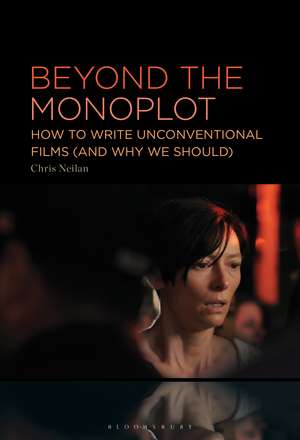
Beyond the Monoplot: How to Write Unconventional Films (and Why We Should)
Autor Chris Neilanen Limba Engleză Paperback – 20 aug 2026
Formed from Aristotelian principles and a three-act shape brought to Hollywood by Broadway playwrights after the advent of sync sound, Conventional Monoplot has come to dominate screen storytelling practice throughout the Western world. For the experimental, rule-suspicious, unconventional screenwriter, alternative storytelling models are available. Beyond the Monoplot offers screenwriters and screenwriting students a new way of approaching and quantifying conventional practice, whilst equipping them with the skills and tools to subvert convention and expectation in dynamic and innovative ways.
Where the revolutionary New Hollywood period of the '60s and '70s saw strikingly iconoclastic, original, rule-breaking narratives attracting enormous audiences and making indelible cultural imprints, today's most widely seen films stick rigidly to the Conventional Monoplot model. Shaped and solidified by best-selling screenwriting handbooks of the '80s and 90s, this model proved incredibly useful for a rapidly industrialising consumerist approach to screen entertainment, pushing unconventional and innovative storytelling practices to the cultural fringe. Whilst bold, daring films are still made, their impact is muted: Moonlight, despite winning Best Picture, was only the 92nd highest grossing film of its year. And whilst great strides are made towards diversity and representation, story shapes remain cloistered within a consumerist and highly conventionalised form, against which this book pushes back.
Preț: 211.87 lei
Preț vechi: 284.06 lei
-25% Nou
Puncte Express: 318
Carte disponibilă
Livrare economică 28 octombrie-11 noiembrie
Livrare prin curier în România Termenul estimat este afișat lângă disponibilitate.
Transport gratuit de la 400.00 lei Plată online sau ramburs, în funcție de opțiunile comenzii.
Retur gratuit în 14 zile Comandă securizată și suport în română.
Specificații
ISBN-13: 9798765107546
Pagini: 288
Ilustrații: 27 bw illus
Dimensiuni: 148 x 226 x 18 mm
Greutate: 0.42 kg
Editura: Bloomsbury Publishing
Colecția Bloomsbury Academic
Locul publicării:New York, United States
Pagini: 288
Ilustrații: 27 bw illus
Dimensiuni: 148 x 226 x 18 mm
Greutate: 0.42 kg
Editura: Bloomsbury Publishing
Colecția Bloomsbury Academic
Locul publicării:New York, United States
V-ar putea interesa
-
 Preț: 165.79 lei
 -
 Into The WoodsJohn Yorke-31%Preț: 64.56 lei93.27 lei
 -
 Preț: 113.86 lei
 -
 Preț: 111.03 lei
 -
 StoryRobert McKeePreț: 206.55 lei
 -
 Narration in the Fiction FilmDavid BordwellPreț: 343.19 lei
 -
 Beyond The Hero's JourneyAnthony Mullins-20%Preț: 106.42 lei133.03 lei
 -
 ScriptnotesCraig MazinPreț: 156.95 lei
 -
 Mastering Screenplay Form and StyleMick Hurbis-CherrierPreț: 389.67 lei
 -
 The Big PictureBen FritzPreț: 97.40 lei
 -
 Writing Movies: A practical guide from New York's acclaimed creative writing schoolGotham Writers' Workshop-16%Preț: 111.10 lei132.31 lei
 -
 -37%Preț: 134.77 lei213.52 lei
 -
 The Bloomsbury Handbook of Global Screenplay TheoryAndrew Kenneth Gay-29%Preț: 973.93 lei1378.74 lei
 -
 The Writer's Journey - 25th Anniversary EditionChristopher Vogler-16%Preț: 139.98 lei166.54 lei
 -
 -16%Preț: 144.56 lei171.24 lei
 -
 -10%Preț: 161.12 lei179.35 lei
 -
 Cinematic StorytellingJennifer van Sijll-24%Preț: 152.67 lei200.13 lei
 -
 Preț: 132.66 lei
 -
 -19%Preț: 115.58 lei143.23 leiRecomandat
 -
 Screenwriting: The Sequence ApproachProfessor Paul Joseph GulinoPreț: 133.95 lei
Cuprins
Acknowledgements
PART ONE: THE MONOPLOT
1. Neoliberal Screenwriting & the Corporate Takeover
2. Alternative Meanings
3. What the Handbooks Say
4. Conventional Monoplot
5. The Conventionalisation Effect
PART TWO: ALT PLOT
6. Unconventional Narrative Structures
7. On Dissonance and Disorder
References
List of Figures
List of Tables and Graphs
Index
PART ONE: THE MONOPLOT
1. Neoliberal Screenwriting & the Corporate Takeover
2. Alternative Meanings
3. What the Handbooks Say
4. Conventional Monoplot
5. The Conventionalisation Effect
PART TWO: ALT PLOT
6. Unconventional Narrative Structures
7. On Dissonance and Disorder
References
List of Figures
List of Tables and Graphs
Index
Recenzii
A cogent and scholarly analysis, Beyond the Monoplot argues that since the '80s and '90s the linear, chronological, one-hero Hollywood story model has come to dominate both theory and practice of screenwriting, resulting in a serious drop in quality, originality and experimentation. Provocative and thought-provoking, Chris Neilan vigorously interrogates the received wisdom and sets out a range of structural alternatives to the Hollywood template. A striking new voice in the study of screenwriting.
Chris Neilan has provided a meticulously researched and highly readable wrecking ball aimed directly at the flawed, creativity-deadening screenwriting models that have dominated screenwriting discourse and practice for more than forty years. He connects a catastrophic decline in the quality of American films starting in 1980 to changes in the corporate structure of the studios, reinforced by the concurrent popularity of screenwriting manuals that have served more to enrich their authors than to provide genuine insight into the craft. Having demolished these popular theories, Professor Neilan goes on to explore alternative models in detailed and insightful analyses, providing mind-opening inspiration for creatives yearning to be free of the stultifying encumbrances of fashionable convention.
Chris Neilan has provided a meticulously researched and highly readable wrecking ball aimed directly at the flawed, creativity-deadening screenwriting models that have dominated screenwriting discourse and practice for more than forty years. He connects a catastrophic decline in the quality of American films starting in 1980 to changes in the corporate structure of the studios, reinforced by the concurrent popularity of screenwriting manuals that have served more to enrich their authors than to provide genuine insight into the craft. Having demolished these popular theories, Professor Neilan goes on to explore alternative models in detailed and insightful analyses, providing mind-opening inspiration for creatives yearning to be free of the stultifying encumbrances of fashionable convention.
Notă biografică
Chris Neilan is Programme Leader and Lecturer in Screenwriting & Development at Edinburgh Napier University, UK. He is an award-winning writer and filmmaker with a PhD in creative writing from Manchester Metropolitan University, UK. His films have been selected for 30 international film festivals, and his widely-published fiction has been nominated, shortlisted, and longlisted for several international awards, winning 2nd place in the Bridport Prize in 2017. He is the author the screenwriting anti-handbook, Beyond the Monoplot (Bloomsbury, 2025) and the experimental novel, Stellify (2022). He has contributed to Little White Lies, Film International, Sight and Sound, and the Journal of Screenwriting.