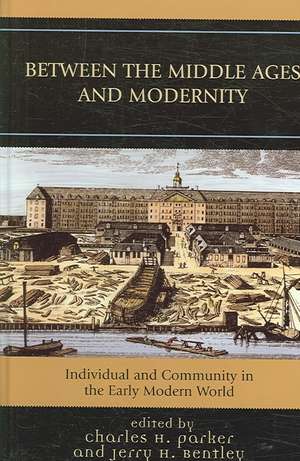
Between the Middle Ages and Modernity: Individual and Community in the Early Modern World
Editat de Charles H. Parker, Jerry H. Bentleyen Limba Engleză Hardback – 28 dec 2006
Contributions by: Jerry H. Bentley, Thomas A. Brady Jr., Douglas Catterall, Donald J. Harreld, Susan C. Karant-Nunn, Marie Seong-Hak Kim, Henk van Nierop, Charles H. Parker, Michael N. Pearson, Carla Rahn Phillips, William D. Phillips Jr., Elizabeth Bradbury Pollnow, Kathryn L. Reyerson, Hugo de Schepper, Ulrike Strasser, Sanjay Subrahmanyam, and Markus P. M. Vink
| Toate formatele și edițiile | Preț | Express |
|---|---|---|
| Paperback (1) | 350.48 lei 43-57 zile | |
| Bloomsbury Publishing – 21 dec 2006 | 350.48 lei 43-57 zile | |
| Hardback (1) | 690.66 lei 43-57 zile | |
| Bloomsbury Publishing – 28 dec 2006 | 690.66 lei 43-57 zile |
Preț: 690.66 lei
Preț vechi: 1114.26 lei
-38%
Puncte Express: 1036
Preț estimativ în valută:
122.07€ • 143.61$ • 106.56£
122.07€ • 143.61$ • 106.56£
Carte tipărită la comandă
Livrare economică 06-20 aprilie
Specificații
ISBN-13: 9780742553095
ISBN-10: 0742553094
Pagini: 332
Dimensiuni: 164 x 242 x 26 mm
Greutate: 0.66 kg
Ediția:New.
Editura: Bloomsbury Publishing
Colecția Rowman & Littlefield
Locul publicării:New York, United States
ISBN-10: 0742553094
Pagini: 332
Dimensiuni: 164 x 242 x 26 mm
Greutate: 0.66 kg
Ediția:New.
Editura: Bloomsbury Publishing
Colecția Rowman & Littlefield
Locul publicării:New York, United States
V-ar putea interesa
-
 Toward Democracy: The Struggle for Self-Rule in European and American ThoughtJames T. Kloppenberg-10%Preț: 198.56 lei221.51 lei
 -
 The Oxford Handbook of Cities in World HistoryPeter Clark-14%Preț: 342.40 lei398.89 lei
 -
 Spanish Legacies – The Coming of Age of the Second GenerationAlejandro PortesPreț: 232.67 lei
 -
 Preț: 232.67 lei
 -
 -23%Preț: 544.47 lei707.09 lei
 -
 The School of Libanius in Late Antique AntiochRaffaella CribiorePreț: 272.66 lei
 -
 Preț: 273.39 lei
 -
 -26%Preț: 72.17 lei97.69 lei
 -
 Preț: 308.16 lei
 -
 World History WorkbookDavid HertzelPreț: 329.55 lei
 -
 -19%Preț: 676.17 lei834.78 lei
 -
 The Stuart Restoration and the English in IrelandDanielle Mccormack-19%Preț: 674.52 lei832.74 lei
 -
 -23%Preț: 697.90 lei906.37 lei
 -
 South Africa - The Present as HistoryJohn S SaulPreț: 201.30 lei
 -
 Writing the Nigeria–Biafra WarToyin Falola-23%Preț: 1017.47 lei1321.39 lei
 -
 Das Römische Imperium der CäsarenTheodor MommsenPreț: 361.12 lei
 -
 Die Zeit Constantins des GroßenJacob BurckhardtPreț: 261.84 lei
Cuprins
Introduction: Individual and Community in the Early Modern World
Part I: Structures
Chapter 1: Early Modern Europe and the Early Modern World
Chapter 2: German Burghers and Peasants in the Reformation and the Peasants' War: Partners or Competitors?
Chapter 3: A Tale of Two Brothers: Corporate Identity and the Revolt in the Towns of Holland
Chapter 4: Family and Community in the Spanish World
Part II: Interactions
Chapter 5: Individual and Community among the Medieval Travelers to Asia
Chapter 6: Settle or Return: Migrant Communities in Northern Europe, c. 1600-1800
Chapter 7: Forcing the Doors of Heathendom: Ethnography, Violence, and the Dutch East India Company
Chapter 8: Creating a Littoral Community: Muslim Reformers in the Early Modern Indian Ocean World
Part III: Transitions
Chapter 9: Custom, Community, and the Crown: Lawyers and the Reordering of French Customary Law
Chapter 10: The Individual on Trial in Sixteenth-Century Netherlands: Between Tradition and Modernity
Chapter 11: "They have highly offended the community of God": Rituals of Ecclesiastical Discipline and Pastoral Membership in the Community in Sixteenth- and Seventeenth-Century German Parishes
Chapter 12: Embodying the Middle Ages, Advancing Modernity: Religious Women in Sixteenth- and Seventeenth-Century Europe and Beyond
Chapter 13: The Transitional Role of Jacques Coeur in the Fifteenth Century
Chapter 14: The Individual Merchant and the Trading Nation in Sixteenth-Century Antwerp
Chapter 15: Between Profit and Power: The Dutch East India Company and Institutional Early Modernities in the Age of Mercantilism
Part I: Structures
Chapter 1: Early Modern Europe and the Early Modern World
Chapter 2: German Burghers and Peasants in the Reformation and the Peasants' War: Partners or Competitors?
Chapter 3: A Tale of Two Brothers: Corporate Identity and the Revolt in the Towns of Holland
Chapter 4: Family and Community in the Spanish World
Part II: Interactions
Chapter 5: Individual and Community among the Medieval Travelers to Asia
Chapter 6: Settle or Return: Migrant Communities in Northern Europe, c. 1600-1800
Chapter 7: Forcing the Doors of Heathendom: Ethnography, Violence, and the Dutch East India Company
Chapter 8: Creating a Littoral Community: Muslim Reformers in the Early Modern Indian Ocean World
Part III: Transitions
Chapter 9: Custom, Community, and the Crown: Lawyers and the Reordering of French Customary Law
Chapter 10: The Individual on Trial in Sixteenth-Century Netherlands: Between Tradition and Modernity
Chapter 11: "They have highly offended the community of God": Rituals of Ecclesiastical Discipline and Pastoral Membership in the Community in Sixteenth- and Seventeenth-Century German Parishes
Chapter 12: Embodying the Middle Ages, Advancing Modernity: Religious Women in Sixteenth- and Seventeenth-Century Europe and Beyond
Chapter 13: The Transitional Role of Jacques Coeur in the Fifteenth Century
Chapter 14: The Individual Merchant and the Trading Nation in Sixteenth-Century Antwerp
Chapter 15: Between Profit and Power: The Dutch East India Company and Institutional Early Modernities in the Age of Mercantilism
Recenzii
Parker and Bentley have done a nice job of pulling together a wide range of topics in these 16 essays, which make the case for the early modern world as a field of historical studies. . . . This collection is a significant contribution to the study of early modernity. Highly recommended.
The editors selected a program of . . . broad relevance to the early modern subfield, one that successfully accommodates both methodological reflections and more empirical studies.
This excellent volume powerfully makes the case for Early Modernity as a field of historical studies, doing so specifically from the perspective of the 'new social history.' It is impressive both in its insistence on bringing the 'structures of everyday life' to the fore and its vigour in moving away from eurocentrism.
A fine volume that will contribute significantly to understanding of both the early modern period and its historiography. At the cutting edge of historical scholarship, it is particularly illuminating in combining European with non-European histories and exploring interactions between cultures and continents.
The editors selected a program of . . . broad relevance to the early modern subfield, one that successfully accommodates both methodological reflections and more empirical studies.
This excellent volume powerfully makes the case for Early Modernity as a field of historical studies, doing so specifically from the perspective of the 'new social history.' It is impressive both in its insistence on bringing the 'structures of everyday life' to the fore and its vigour in moving away from eurocentrism.
A fine volume that will contribute significantly to understanding of both the early modern period and its historiography. At the cutting edge of historical scholarship, it is particularly illuminating in combining European with non-European histories and exploring interactions between cultures and continents.