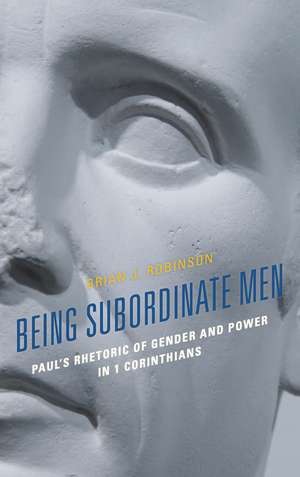
Being Subordinate Men: Paul's Rhetoric of Gender and Power in 1 Corinthians: Fortress Academic
Autor Brian J. Robinsonen Limba Engleză Paperback – 22 aug 2022
Din seria Fortress Academic
- 27%
 Preț: 268.04 lei
 - 27%
 Preț: 271.41 lei
 - 24%
 Preț: 308.39 lei
 - 22%
 Preț: 318.80 lei
 - 27%
 Preț: 254.83 lei
 - 24%
 Preț: 310.42 lei
 - 26%
 Preț: 258.60 lei
 - 27%
 Preț: 256.21 lei
 - 31%
 Preț: 462.98 lei
 - 33%
 Preț: 614.37 lei
 - 32%
 Preț: 584.40 lei
 - 34%
 Preț: 570.62 lei
 - 27%
 Preț: 253.34 lei
 - 27%
 Preț: 258.08 lei
 - 27%
 Preț: 257.19 lei
 - 34%
 Preț: 597.72 lei
 - 28%
 Preț: 223.03 lei
 - 27%
 Preț: 256.60 lei
 - 26%
 Preț: 259.28 lei
 - 27%
 Preț: 258.00 lei
 - 22%
 Preț: 331.35 lei
 - 28%
 Preț: 222.43 lei
 - 27%
 Preț: 253.54 lei
 - 27%
 Preț: 255.62 lei
 - 27%
 Preț: 255.62 lei
 - 33%
 Preț: 517.72 lei
 - 33%
 Preț: 569.50 lei
 - 25%
 Preț: 209.19 lei
 - 25%
 Preț: 209.19 lei
 - 26%
 Preț: 207.60 lei
 - nou
 Preț: 210.32 lei
 - nou
 Preț: 209.19 lei
 - nou
 Preț: 209.19 lei
 - nou
 Preț: 214.19 lei
Preț: 258.08 lei
Preț vechi: 313.44 lei
-18%
Puncte Express: 387
Carte tipărită la comandă
Livrare economică 20 noiembrie-04 decembrie
Livrare prin curier în România Termenul estimat este afișat lângă disponibilitate.
Transport gratuit de la 400.00 lei Plată online sau ramburs, în funcție de opțiunile comenzii.
Retur gratuit în 14 zile Comandă securizată și suport în română.
Specificații
ISBN-13: 9781978703353
ISBN-10: 197870335X
Pagini: 282
Dimensiuni: 154 x 230 x 21 mm
Greutate: 0.42 kg
Editura: Bloomsbury Publishing
Colecția Fortress Academic
Seria Fortress Academic
Locul publicării:New York, United States
ISBN-10: 197870335X
Pagini: 282
Dimensiuni: 154 x 230 x 21 mm
Greutate: 0.42 kg
Editura: Bloomsbury Publishing
Colecția Fortress Academic
Seria Fortress Academic
Locul publicării:New York, United States
Descriere
Being Subordinate Men offers a gender critical examination of Paul's use of gender and power in the argument of 1 Corinthians. By elevating femininity and misperforming masculinity, Paul consistently undermines first century Roman norms of masculinity. Such norms of masculinity would have allowed some of the higher status men among the Corinthian believers to occupy positions of power that would give them control over lower status members of the community. Instead of supporting such a patriarchal model, Paul articulates a form of masculinity that would require these higher status men to abandon their positions of power and occupy positions that would put them on equal status with women and men whose bodies and identities forced them to the margins of society. Such a move subverts forms of toxic, or hegemonic, masculinity that give a select few men power over the bodies of others. Instead of a toxic masculinity, Paul commands the men in his audience to embody a failed, or subordinate, masculinity. This failed masculinity not only imitates Paul's own subordinate masculinity, seen in his embrace of feminine imagery and his failure to live up to first century Roman norms of masculinity, but also supports Paul's main reason for writing 1 Corinthians by confronting the factionalism that threatens to destroy the believing community. Paul's vision for the believing community is one of equality that centers itself in imitation of the crucified body of Jesus, a body that demonstrates that equality, not domination, is the path to the kingdom of God.
Cuprins
Chapter 1: Uncovering Paul's Body
Chapter 2: The Body, Masculinity, and Power
Chapter 3: Reconstructing Masculinities
Chapter 4: Paul's Subordinate Masculinity in 1 Corinthians
Chapter 5: Manifestations of Subordinate Masculinity in Paul's Paraenesis
Chapter 6: Summary and an Interpretive Exploration of Paul's Veils
Chapter 2: The Body, Masculinity, and Power
Chapter 3: Reconstructing Masculinities
Chapter 4: Paul's Subordinate Masculinity in 1 Corinthians
Chapter 5: Manifestations of Subordinate Masculinity in Paul's Paraenesis
Chapter 6: Summary and an Interpretive Exploration of Paul's Veils
Recenzii
Robinson's work stands out for its profound engagement with a wide range of rhetoricians, scholars, and critical theorists. His explorations of Paul's rhetoric in 1 Corinthians are detailed and attuned to both argumentation and ideology
[T]he book will be valuable to a wide variety of scholars, regardless of whether their approach to biblical texts is confessional or not. . . . Robinson engages in a remarkable analysis of the complicit masculinity of three men who were roughly contemporaries of Paul: Flavius Josephus, Philo of Alexandria, and Favorinus of Arelate. Particularly enlightening among them is the discussion of Favorinus, who rarely figures into New Testament scholarship in any capacity. . . . the present book. . . will be of interest to graduate students, scholars, and theological libraries.
Paul's masculinity is often taken for granted as consistently authoritative and hierarchical. In this nuanced study, Brian Robinson explores different rhetorical valences and effects of ancient discourses on maleness, revealing a more textured array of options for interpretation of the Corinthian correspondence than a binary construction of gender affords. Readers interested in both the intersection of critical theory and biblical interpretation and in the resonances of Paul's letters with contemporary social issues and concerns will find much with which to dialog.
Arguably, Paul is the most fully-fleshed out man in the New Testament; as such, a book-length analysis of how Paul constructs and performs his masculinity is long overdue. Brian Robinson fills this need admirably. His erudition on ancient protocols of masculinity is impressive; his analysis of Paul's performance of gender in 1 Corinthians is thoroughly informed by feminist and queer Pauline scholarship; and the Paul with which he presents us ultimately is both thought-provokingly unfamiliar and compellingly rendered.
Brian Robinson's Being Subordinate Men: Paul's Rhetoric of Gender and Power in 1 Corinthians compares cultural notions of masculinity in the ancient world with Paul's rhetoric in 1 Corinthians, and shows that Paul deliberately undermines ancient masculine ideals about crafting powerful public personas explicitly tied to the performance of masculinity. Robinson maintains that Paul repeatedly chooses to portray himself in modes that signal weakness and a subordinate status that embodies the way of Jesus. This is a prophetic book, ahead of its time and tailor-made for reading in the #Metoo moment.
[T]he book will be valuable to a wide variety of scholars, regardless of whether their approach to biblical texts is confessional or not. . . . Robinson engages in a remarkable analysis of the complicit masculinity of three men who were roughly contemporaries of Paul: Flavius Josephus, Philo of Alexandria, and Favorinus of Arelate. Particularly enlightening among them is the discussion of Favorinus, who rarely figures into New Testament scholarship in any capacity. . . . the present book. . . will be of interest to graduate students, scholars, and theological libraries.
Paul's masculinity is often taken for granted as consistently authoritative and hierarchical. In this nuanced study, Brian Robinson explores different rhetorical valences and effects of ancient discourses on maleness, revealing a more textured array of options for interpretation of the Corinthian correspondence than a binary construction of gender affords. Readers interested in both the intersection of critical theory and biblical interpretation and in the resonances of Paul's letters with contemporary social issues and concerns will find much with which to dialog.
Arguably, Paul is the most fully-fleshed out man in the New Testament; as such, a book-length analysis of how Paul constructs and performs his masculinity is long overdue. Brian Robinson fills this need admirably. His erudition on ancient protocols of masculinity is impressive; his analysis of Paul's performance of gender in 1 Corinthians is thoroughly informed by feminist and queer Pauline scholarship; and the Paul with which he presents us ultimately is both thought-provokingly unfamiliar and compellingly rendered.
Brian Robinson's Being Subordinate Men: Paul's Rhetoric of Gender and Power in 1 Corinthians compares cultural notions of masculinity in the ancient world with Paul's rhetoric in 1 Corinthians, and shows that Paul deliberately undermines ancient masculine ideals about crafting powerful public personas explicitly tied to the performance of masculinity. Robinson maintains that Paul repeatedly chooses to portray himself in modes that signal weakness and a subordinate status that embodies the way of Jesus. This is a prophetic book, ahead of its time and tailor-made for reading in the #Metoo moment.
Notă biografică
Brian J .Robinson grew up in suburban NJ and was diagnosed with ADHD at six years old. He graduated from Tulane University with a Philosophy degree, where, as a contributor to the university periodical, he developed an early talent toward writing. His first published work, a short story entitled "Tabula Rasa" was featured on the cover of The Write Room, a literary magazine, in 2012. In 2016, he was interviewed by Fox 5 NY about an early edition of his ADHD memoir and his personal experience with Adderall addiction. Today, Brian has emerged as a successful entrepreneur and continues to be very outspoken about society's miscomprehension about ADHD. He loves to travel, lift weights, talk philosophy at bars, and spend time with family and friends. He lives in NYC with his wife, Lindsey.