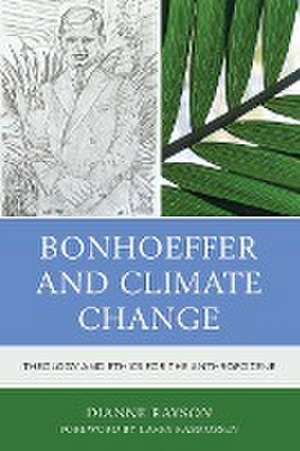
Bonhoeffer and Climate Change: Theology and Ethics for the Anthropocene: Fortress Academic
Autor Dianne Rayson Cuvânt înainte de Larry Rasmussenen Limba Engleză Paperback – 31 ian 2023
Din seria Fortress Academic
- 27%
 Preț: 268.04 lei
 - 24%
 Preț: 308.39 lei
 - 22%
 Preț: 318.80 lei
 - 27%
 Preț: 254.83 lei
 - 24%
 Preț: 310.42 lei
 - 26%
 Preț: 258.60 lei
 - 27%
 Preț: 256.21 lei
 - 31%
 Preț: 462.98 lei
 - 32%
 Preț: 632.90 lei
 - 32%
 Preț: 584.40 lei
 - 34%
 Preț: 570.62 lei
 - 27%
 Preț: 253.34 lei
 - 27%
 Preț: 258.08 lei
 - 27%
 Preț: 257.19 lei
 - 34%
 Preț: 597.72 lei
 - 28%
 Preț: 223.03 lei
 - 27%
 Preț: 256.60 lei
 - 26%
 Preț: 259.28 lei
 - 22%
 Preț: 331.35 lei
 - 28%
 Preț: 222.43 lei
 - 18%
 Preț: 258.08 lei
 - 27%
 Preț: 253.54 lei
 - 27%
 Preț: 255.62 lei
 - 27%
 Preț: 255.62 lei
 - 33%
 Preț: 517.72 lei
 - 33%
 Preț: 569.50 lei
 - 25%
 Preț: 209.19 lei
 - 25%
 Preț: 209.19 lei
 - 26%
 Preț: 207.60 lei
 - nou
 Preț: 210.32 lei
 - nou
 Preț: 209.19 lei
 - nou
 Preț: 209.19 lei
 - nou
 Preț: 214.19 lei
Preț: 258.00 lei
Preț vechi: 351.27 lei
-27%
Puncte Express: 387
Carte tipărită la comandă
Livrare economică 07-21 decembrie
Livrare prin curier în România Termenul estimat este afișat lângă disponibilitate.
Transport gratuit de la 400.00 lei Plată online sau ramburs, în funcție de opțiunile comenzii.
Retur gratuit în 14 zile Comandă securizată și suport în română.
Specificații
ISBN-13: 9781978701854
ISBN-10: 1978701853
Pagini: 306
Dimensiuni: 150 x 226 x 20 mm
Greutate: 0.41 kg
Editura: Bloomsbury Publishing
Colecția Fortress Academic
Seria Fortress Academic
Locul publicării:New York, United States
ISBN-10: 1978701853
Pagini: 306
Dimensiuni: 150 x 226 x 20 mm
Greutate: 0.41 kg
Editura: Bloomsbury Publishing
Colecția Fortress Academic
Seria Fortress Academic
Locul publicării:New York, United States
Descriere
Where is the voice of theology in the public discourse around anthropogenic climate change? How do we understand the human relationship to Earth and the ecology of which we are a part? How can we account for the human attempt to dominate nature and the devastation we have caused to our own home?
Dianne Rayson addresses these questions. She uses the creation theology of Dietrich Bonhoeffer to examine what it means to be human in the post-Holocene age. Employing a range of Bonhoeffer's texts, Rayson posits that Bonhoeffer's Christological theology and this-worldly ethical orientation provide the tools for an Earthly Christianity. She responds to Bonhoeffer's question, "who actually is Jesus Christ, for us, today?" and proposes a Bonhoefferian ecoethic.
Dianne Rayson addresses these questions. She uses the creation theology of Dietrich Bonhoeffer to examine what it means to be human in the post-Holocene age. Employing a range of Bonhoeffer's texts, Rayson posits that Bonhoeffer's Christological theology and this-worldly ethical orientation provide the tools for an Earthly Christianity. She responds to Bonhoeffer's question, "who actually is Jesus Christ, for us, today?" and proposes a Bonhoefferian ecoethic.
Cuprins
1 Theology and Climate Change
2 The Problems
3 Bonhoeffer's Christology
4 Creator and Creation
5 Creaturely Theological Anthropology
6 God's Kingdom on Earth
7 Ecoethics
8 Who Actually Is Christ in the Anthropocene?
2 The Problems
3 Bonhoeffer's Christology
4 Creator and Creation
5 Creaturely Theological Anthropology
6 God's Kingdom on Earth
7 Ecoethics
8 Who Actually Is Christ in the Anthropocene?
Recenzii
Dianne Rayson's Bonhoeffer and Climate Change: Theology and Ethics for the Anthropocene is a timely book for reckoning with the entanglement of Christianity with colonialist and capitalist views of the Earth's resources as there 'to dominate and ransack. This book is recommended for climate activists of faith, particularly those seeking a systematic theological foundation for climate action led by faith-based communities.
Dianne Rayson's constructive use of Dietrich Bonhoeffer's theology to articulate an ecoethic and ecotheology is precisely what the world needs. She explains that catastrophic climate change, ushered in by humans, is looming and that changing course requires both individual and communal conviction and moral courage. Rayson's careful and creative use of Bonhoeffer's work allows her to make a compelling case for us - for humans - to take responsibility for earth, to embrace an "Earthly Christianity." The call is urgent.
An important and rich theological contribution to the pressing climate concerns in the epoch of the Anthropocene. Dianne Rayson explores Dietrich Bonhoeffer's Christological ethic to develop a deep relational response to the unprecedented ecological challenges of the current age. The spiritual, moral, and theological richness of Rayson's book gives the reader a new ground for raising the question, what it means to speak of an "earthly Christianity" today.
In this timely book, Dianne Rayson combines a keen sense of place, theological acumen and a deep concern for the Earth and our common future with a thorough and illuminating engagement with the theology of Dietrich Bonhoeffer. The result is a ground-breaking work that proposes an "Earthly Christianity" as antidote to harmful theologies of domination. This beautifully written piece of scholarship provides a well-grounded and empowering theological response to the urgent challenges posed by climate disruption. It deserves to be read and discussed widely!
For the past fifty years, eco-theologians have rightly maintained that a significant barrier to a Christian ecological ethic are theologies of domination, and they have provided what at times amounts to devastating critiques of the tradition. The brilliance of Rayson's eco-theology and eco-ethic is that it offers an entry point for Christians into this conversation that is both familiar and challenging: the person and work of Jesus Christ. Rooted in Bonhoeffer's expansive understanding of Christology, Rayson turns our attention to the One who in becoming a creature established divine immanence within creation; who, through the reconciliation of all things, beckons us to profoundly love the earth upon which God's kingdom comes; and, out of that love, calls us to be the creatures we were created to be - to act responsibly, combat climate change, and, in doing so, live in right relationship with all of creation.
Dianne Rayson's constructive use of Dietrich Bonhoeffer's theology to articulate an ecoethic and ecotheology is precisely what the world needs. She explains that catastrophic climate change, ushered in by humans, is looming and that changing course requires both individual and communal conviction and moral courage. Rayson's careful and creative use of Bonhoeffer's work allows her to make a compelling case for us - for humans - to take responsibility for earth, to embrace an "Earthly Christianity." The call is urgent.
An important and rich theological contribution to the pressing climate concerns in the epoch of the Anthropocene. Dianne Rayson explores Dietrich Bonhoeffer's Christological ethic to develop a deep relational response to the unprecedented ecological challenges of the current age. The spiritual, moral, and theological richness of Rayson's book gives the reader a new ground for raising the question, what it means to speak of an "earthly Christianity" today.
In this timely book, Dianne Rayson combines a keen sense of place, theological acumen and a deep concern for the Earth and our common future with a thorough and illuminating engagement with the theology of Dietrich Bonhoeffer. The result is a ground-breaking work that proposes an "Earthly Christianity" as antidote to harmful theologies of domination. This beautifully written piece of scholarship provides a well-grounded and empowering theological response to the urgent challenges posed by climate disruption. It deserves to be read and discussed widely!
For the past fifty years, eco-theologians have rightly maintained that a significant barrier to a Christian ecological ethic are theologies of domination, and they have provided what at times amounts to devastating critiques of the tradition. The brilliance of Rayson's eco-theology and eco-ethic is that it offers an entry point for Christians into this conversation that is both familiar and challenging: the person and work of Jesus Christ. Rooted in Bonhoeffer's expansive understanding of Christology, Rayson turns our attention to the One who in becoming a creature established divine immanence within creation; who, through the reconciliation of all things, beckons us to profoundly love the earth upon which God's kingdom comes; and, out of that love, calls us to be the creatures we were created to be - to act responsibly, combat climate change, and, in doing so, live in right relationship with all of creation.
Notă biografică
Dianne Raysonis Associate Professor in Theology and Ethics at Pacific Theological College, Fiji.