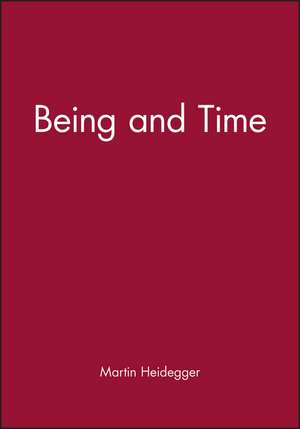
Being and Time
Autor Martin Heideggeren Limba Engleză Paperback – 12 oct 1978
Preț: 244.63 lei
Puncte Express: 367
Carte disponibilă
Livrare economică 28 octombrie-11 noiembrie
Livrare express 14-20 octombrie pentru 45.30 lei
Livrare prin curier în România Termenul estimat este afișat lângă disponibilitate.
Transport gratuit de la 400.00 lei Plată online sau ramburs, în funcție de opțiunile comenzii.
Retur gratuit în 14 zile Comandă securizată și suport în română.
Specificații
ISBN-13: 9780631197706
ISBN-10: 0631197702
Pagini: 592
Dimensiuni: 140 x 216 x 31 mm
Greutate: 0.72 kg
Editura: John Wiley and Sons Ltd
Locul publicării:Chichester, United Kingdom
ISBN-10: 0631197702
Pagini: 592
Dimensiuni: 140 x 216 x 31 mm
Greutate: 0.72 kg
Editura: John Wiley and Sons Ltd
Locul publicării:Chichester, United Kingdom
V-ar putea interesa
-
 The Awakening of IntelligenceJiddu KrishnamurtiPreț: 127.19 lei
 -
 The Blank SlateSteven Pinker-28%Preț: 78.31 lei108.82 lei
 -
 FragmentsHeraclitusPreț: 82.91 lei
 -
 Games People PlayEric Berne-27%Preț: 62.28 lei84.96 lei
 -
 Irrational ManWilliam BarrettPreț: 99.68 lei
 -
 The Language of ChangePaul WatzlawickPreț: 113.96 lei
 -
 The Annotated TuringC. Petzold-20%Preț: 154.81 lei193.52 lei
 -
 The Cambridge Companion to GadamerRobert J. Dostal-23%Preț: 192.67 lei250.45 lei
 -
 The Cambridge Companion to HeideggerCharles B. GuignonPreț: 284.83 lei
 -
 An Introduction to MetaphysicsJohn CarrollPreț: 342.50 lei
 -
 KierkegaardC. Stephen EvansPreț: 222.28 lei
 -
 Heidegger, Philosophy, NazismJulian YoungPreț: 337.04 lei
 -
 An Introduction to Non-Classical LogicGraham PriestPreț: 346.80 lei
 -
 Hegel Freedom Truth History 2eStephen HoulgatePreț: 316.62 lei
 -
 Urban ShamanSerge Kahili King-19%Preț: 69.55 lei86.04 lei
 -
 E-Myth RevisitedMichael E. GerberPreț: 134.74 lei
 -
 Power Up Your BrainDavid PerlmutterPreț: 112.67 lei
 -
 Postautonomous Ego DevelopmentSusanne Cook-GreuterPreț: 163.14 lei
 -
 Origins of Analytical PhilosophyMichael Dummett-22%Preț: 137.58 lei176.76 lei
 -
 Head First Design PatternsEric Freeman-20%Preț: 416.12 lei520.15 lei
 -
 Tractatus Logico-PhilosophicusLudwig WittgensteinPreț: 37.12 lei
 -
 In an Unspoken VoicePeter A. Levine-22%Preț: 125.60 lei160.64 lei
 -
 Cutting Through Spiritual MaterialismChögyam Trungpa-19%Preț: 99.76 lei122.63 lei
 -
 Thinking in SystemsDonella MeadowsPreț: 122.73 lei
 -
 Truth and MethodHans-Georg Gadamer-24%Preț: 195.19 lei255.90 lei
 -
 Scattered MindsGabor Maté-19%Preț: 75.42 lei93.34 lei
Textul de pe ultima copertă
"What is the meaning of being?" This is the central question of Martin Heidegger's profoundly important work, in which the great philosopher seeks to explain the basic problems of existence. A central influence on later philosophy, literature, art, and criticism—as well as existentialism and much of postmodern thought—Being and Time forever changed the intellectual map of the modern world. As Richard Rorty wrote in the New York Times Book Review, "You cannot read most of the important thinkers of recent times without taking Heidegger's thought into account."
This first paperback edition of John Macquarrie and Edward Robinson's definitive translation also features a new foreword by Heidegger scholar Taylor Carman.
This first paperback edition of John Macquarrie and Edward Robinson's definitive translation also features a new foreword by Heidegger scholar Taylor Carman.
Recenzii
“Cyril Welch’s accurate and elegantly written translation of Heidegger’s Being and Time provides the best available English translation of this difficult work. It makes a welcome contribution to the interpretation of Heidegger’s thought and of twentieth-century philosophy more generally.”—Jeffrey Andrew Barash, author of The Politics of Historical Interpretation: Reflections on Ideology and the Perplexities of Political Myth
“Cyril Welch’s translation of Being and Time is a remarkable achievement. Welch has avoided the palimpsest of linguistic obfuscation that plagued earlier translations, while remaining true to the colloquial flavor of Heidegger’s German. At long last, English-speaking readers have at their disposal a lucid and readable translation of Heidegger’s 1927 masterpiece.”—Richard Wolin, author of Heidegger in Ruins
“Cyril Welch’s translation of Being and Time is a remarkable achievement. Welch has avoided the palimpsest of linguistic obfuscation that plagued earlier translations, while remaining true to the colloquial flavor of Heidegger’s German. At long last, English-speaking readers have at their disposal a lucid and readable translation of Heidegger’s 1927 masterpiece.”—Richard Wolin, author of Heidegger in Ruins
Notă biografică
Martin Heidegger (1889–1976), one of the most original and important philosophers of the twentieth century, spent most of his career at the University of Freiburg. His work deeply influenced many of the schools of modern philosophy, including existentialism, phenomenology, deconstructionism, and postmodernism. Cyril Welch is professor emeritus of philosophy at Mount Allison University, New Brunswick, Canada.