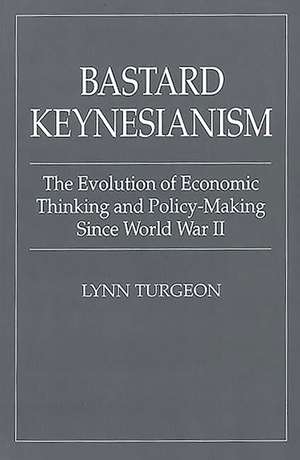
Bastard Keynesianism: The Evolution of Economic Thinking and Policy-Making Since World War II
Autor Lynn Turgeonen Limba Engleză Paperback – 22 apr 1997
Preț: 255.10 lei
Preț vechi: 325.01 lei
-22%
Puncte Express: 383
Carte tipărită la comandă
Livrare economică 03-17 decembrie
Livrare prin curier în România Termenul estimat este afișat lângă disponibilitate.
Transport gratuit de la 400.00 lei Plată online sau ramburs, în funcție de opțiunile comenzii.
Retur gratuit în 14 zile Comandă securizată și suport în română.
Specificații
ISBN-13: 9780275960155
ISBN-10: 0275960153
Pagini: 184
Dimensiuni: 156 x 235 x 14 mm
Greutate: 0.28 kg
Ediția:Revised
Editura: Bloomsbury Publishing
Colecția Praeger
Locul publicării:New York, United States
ISBN-10: 0275960153
Pagini: 184
Dimensiuni: 156 x 235 x 14 mm
Greutate: 0.28 kg
Ediția:Revised
Editura: Bloomsbury Publishing
Colecția Praeger
Locul publicării:New York, United States
V-ar putea interesa
-
 -32%Preț: 1235.46 lei1809.02 lei
 -
 -28%Preț: 380.74 lei528.40 lei
 -
 -23%Preț: 149.75 lei194.01 lei
 -
 The Fall and Rise of Keynesian EconomicsJohn Eatwell-24%Preț: 607.73 lei797.92 lei
 -
 Knowledge and Coordination: A Liberal InterpretationDaniel Klein-28%Preț: 541.41 lei754.36 lei
 -
 Happiness 2/eRichard Layard-30%Preț: 65.41 lei93.78 lei
 -
 Frontiers in Applied General Equilibrium ModelingTimothy J. KehoePreț: 436.25 lei
 -
 The World in the ModelMary S. MorganPreț: 403.44 lei
 -
 Government and MarketsEdward J. BalleisenPreț: 382.85 lei
 -
 The Human EconomyKeith HartPreț: 254.27 lei
 -
 Law, the State & Other Political Writings, 1843-1850Frédéric Bastiat-9%Preț: 90.90 lei99.59 lei
 -
 Complexity and InstitutionsM. AokiPreț: 387.19 lei
 -
 Capitalism: A Structural GenocideGarry Leech-11%Preț: 122.43 lei137.36 lei
 -
 Wealth of NationsAdam SmithPreț: 50.72 lei
 -
 The Value Of NothingRaj PatelPreț: 64.84 lei
 -
 What is Money?Joseph BeuysPreț: 90.44 lei
 -
 The End of GrowthRichard HeinbergPreț: 109.70 lei
Cuprins
Preface
Introduction
Classical Keynesian Thinking
Economic Thinking during and after World War II
Eisenhower and the Rejection of Military Keynesianism
The Return of Military Keynesianism under Kennedy-Johnson
Conversion of President Nixon to Non-Military Keynesianism
The Non-Military Non-Keynesian Ford Interregnum
Jimmy Carter, the Populist and Military Non-Keynesian
Military Keynesian and Supply-Side President Ronald Reagan
George Bush, Another Non-Military, Non-Keynesian President
Can President Clinton Become a Non-Military Keynesian?
The Unraveling of Classical Keynesian Economics in the United States over the Past Half-Century
Where Do We Go from Here?
What Would Keynes Say Today?
Appendix A: Development of Keynesianism within the History of Economic Doctrines
Appendix B: What Is Military Keynesianism (and What Is the Alternative)?
Appendix C: Thinking about the Partial Devaluation of the Dollar
Appendix D: Incomes Policies at Home and Abroad
Appendix E: How Keynesian Are the Canadians?
Notes
Glossary
Annotated Bibliography
Introduction
Classical Keynesian Thinking
Economic Thinking during and after World War II
Eisenhower and the Rejection of Military Keynesianism
The Return of Military Keynesianism under Kennedy-Johnson
Conversion of President Nixon to Non-Military Keynesianism
The Non-Military Non-Keynesian Ford Interregnum
Jimmy Carter, the Populist and Military Non-Keynesian
Military Keynesian and Supply-Side President Ronald Reagan
George Bush, Another Non-Military, Non-Keynesian President
Can President Clinton Become a Non-Military Keynesian?
The Unraveling of Classical Keynesian Economics in the United States over the Past Half-Century
Where Do We Go from Here?
What Would Keynes Say Today?
Appendix A: Development of Keynesianism within the History of Economic Doctrines
Appendix B: What Is Military Keynesianism (and What Is the Alternative)?
Appendix C: Thinking about the Partial Devaluation of the Dollar
Appendix D: Incomes Policies at Home and Abroad
Appendix E: How Keynesian Are the Canadians?
Notes
Glossary
Annotated Bibliography