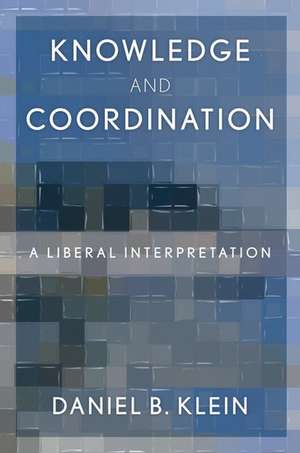
Knowledge and Coordination: A Liberal Interpretation
Autor Daniel Kleinen Limba Engleză Hardback – 16 feb 2012
Preț: 541.41 lei
Preț vechi: 754.36 lei
-28%
Puncte Express: 812
Carte tipărită la comandă
Livrare economică 26 noiembrie-02 decembrie
Livrare prin curier în România Termenul estimat este afișat lângă disponibilitate.
Transport gratuit pentru acest produs Plată online sau ramburs, în funcție de opțiunile comenzii.
Retur gratuit în 14 zile Comandă securizată și suport în română.
Specificații
ISBN-13: 9780199794126
ISBN-10: 019979412X
Pagini: 372
Ilustrații: 25 black and white illustrations
Dimensiuni: 239 x 163 x 33 mm
Greutate: 0.68 kg
Ediția:New.
Editura: Oxford University Press
Colecția OUP USA
Locul publicării:New York, United States
ISBN-10: 019979412X
Pagini: 372
Ilustrații: 25 black and white illustrations
Dimensiuni: 239 x 163 x 33 mm
Greutate: 0.68 kg
Ediția:New.
Editura: Oxford University Press
Colecția OUP USA
Locul publicării:New York, United States
V-ar putea interesa
-
 The Social Construction of RealityPeter L. Berger-19%Preț: 63.68 lei78.73 lei
 -
 How Markets Fail: The Logic of Economic CalamitiesCassidy John-19%Preț: 75.16 lei92.53 lei
 -
 -32%Preț: 821.92 lei1217.60 lei
 -
 -15%Preț: 69.83 lei82.36 lei
 -
 The Tacit DimensionMichael PolanyiPreț: 107.31 lei
 -
 Bettering Humanomics: A New, and Old, Approach to Economic ScienceDeirdre Nansen McCloskeyPreț: 137.61 lei
 -
 When Everyone Knows That Everyone Knows...Steven PinkerPreț: 136.05 lei
 -
 The Infinite AlphabetCésar A. HidalgoPreț: 191.23 lei
 -
 Preț: 106.40 lei
 -
 -14%Preț: 80.35 lei93.36 lei
 -
 Competition, Economic Planning & the Knowledge ProblemIsrael M. KirznerPreț: 113.41 lei
 -
 Competition, Economic Planning and the Knowledge ProblemIsrael M. Kirzner-11%Preț: 69.66 lei78.57 lei
 -
 Economic Approaches to OrganizationsSytse Douma-15%Preț: 630.84 lei742.16 lei
 -
 Preț: 140.76 lei
 -
 Institutional and Organizational EconomicsTore EllingsenPreț: 141.57 lei
 -
 When Everyone Knows That Everyone Knows . . .Steven PinkerPreț: 184.79 lei
 -
 -17%Preț: 82.53 lei99.21 lei
 -
 Hayek's BastardsQuinn SlobodianPreț: 172.53 lei
 -
 Supply and DemandHubert Douglas HendersonPreț: 112.30 lei
 -
 The Power of AgencyFrederick A. MillerPreț: 128.52 lei
Recenzii
The best book on Smithian economics, or for that matter Austrian economics, in many years.
A profound, brilliant book that returns Adam Smith to the centre of the classical liberal worldview. It should provoke a paradigm shift among classical liberals and libertarians.
Daniel Klein is one of those original thinkers that stands him out from the crowd of overly-safe players who dominate in academe... His recent thinking, expressed in his new book, Knowledge and Coordination: A Liberal Interpretation, is typical of his, on and beyond the frontier of accepted doctrine.
Klein seeks to show that the best in economics from Marx and Mill to Hayek and Samuelson is 'Smithian'--that is, humanistic and scientific, historical and analytic, sympathetic and impartial, and above all 'liberal' in the root sense, suited to a free human. He succeeds brilliantly.
Some books explain and defend principles with clear formulations and precise analysis; some books illustrate principles with vivid examples. Knowledge and Coordination does both. It is an engaging narrative exploring Adam Smithian spontaneous order that is enriched by genuine economic analysis, framed by personal history, and punctuated by compelling examples. It somehow manages to combine a plausible reinterpretation of Smith with an integration of Smith's insights into contemporary economic thought, while maintaining the reader's interest with fascinating stories and allusions from numerous sources. Klein has accomplished what some might have thought impossible: He has told a story about economics that is humane, compelling, enlightening--and interesting. There is no other book like it. You may think you know Adam Smith or modern economics, but you have not intellectually lived it until you have read Klein's book.
A profound, brilliant book that returns Adam Smith to the centre of the classical liberal worldview. It should provoke a paradigm shift among classical liberals and libertarians.
Daniel Klein is one of those original thinkers that stands him out from the crowd of overly-safe players who dominate in academe... His recent thinking, expressed in his new book, Knowledge and Coordination: A Liberal Interpretation, is typical of his, on and beyond the frontier of accepted doctrine.
Klein seeks to show that the best in economics from Marx and Mill to Hayek and Samuelson is 'Smithian'--that is, humanistic and scientific, historical and analytic, sympathetic and impartial, and above all 'liberal' in the root sense, suited to a free human. He succeeds brilliantly.
Some books explain and defend principles with clear formulations and precise analysis; some books illustrate principles with vivid examples. Knowledge and Coordination does both. It is an engaging narrative exploring Adam Smithian spontaneous order that is enriched by genuine economic analysis, framed by personal history, and punctuated by compelling examples. It somehow manages to combine a plausible reinterpretation of Smith with an integration of Smith's insights into contemporary economic thought, while maintaining the reader's interest with fascinating stories and allusions from numerous sources. Klein has accomplished what some might have thought impossible: He has told a story about economics that is humane, compelling, enlightening--and interesting. There is no other book like it. You may think you know Adam Smith or modern economics, but you have not intellectually lived it until you have read Klein's book.
Notă biografică
Daniel Klein is Professor of Economics at George Mason University, and Associate Fellow at the Ratio Institute in Stockholm. He is the creator and chief-editor of the scholarly journal Econ Journal Watch.