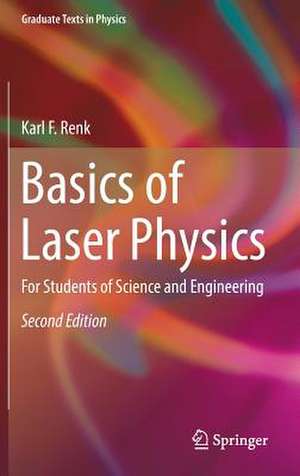
Basics of Laser Physics: For Students of Science and Engineering: Graduate Texts in Physics
Autor Karl F. Renken Limba Engleză Hardback – 7 apr 2017
| Toate formatele și edițiile | Preț | Express |
|---|---|---|
| Paperback (1) | 580.31 lei 6-8 săpt. | |
| Springer International Publishing – 8 mai 2018 | 580.31 lei 6-8 săpt. | |
| Hardback (1) | 775.32 lei 6-8 săpt. | |
| Springer International Publishing – 7 apr 2017 | 775.32 lei 6-8 săpt. |
Din seria Graduate Texts in Physics
- 20%
 Preț: 616.77 lei
 - 22%
 Preț: 435.13 lei
 - 15%
 Preț: 627.14 lei
 - 15%
 Preț: 464.60 lei
 - 15%
 Preț: 593.52 lei
 - 15%
 Preț: 578.40 lei
 - 15%
 Preț: 500.10 lei
 - 15%
 Preț: 497.17 lei
 - 18%
 Preț: 755.70 lei
 - 15%
 Preț: 461.63 lei
 - 15%
 Preț: 696.78 lei
 - 15%
 Preț: 598.20 lei
 -
 Preț: 494.46 lei
 - 15%
 Preț: 624.14 lei
 - 15%
 Preț: 512.42 lei
 - 14%
 Preț: 326.80 lei
 - 15%
 Preț: 695.54 lei
 - 56%
 Preț: 253.93 lei
 - 15%
 Preț: 485.10 lei
 -
 Preț: 388.40 lei
 - 15%
 Preț: 529.38 lei
 - 18%
 Preț: 724.64 lei
 - 15%
 Preț: 461.45 lei
 - 15%
 Preț: 492.53 lei
 - 15%
 Preț: 573.68 lei
 - 18%
 Preț: 722.23 lei
 - 15%
 Preț: 584.40 lei
 -
 Preț: 381.55 lei
 - 15%
 Preț: 464.25 lei
 - 15%
 Preț: 574.33 lei
 -
 Preț: 432.39 lei
 - 15%
 Preț: 460.03 lei
 -
 Preț: 438.52 lei
 - 15%
 Preț: 419.71 lei
 - 15%
 Preț: 575.73 lei
 - 19%
 Preț: 406.98 lei
 - 15%
 Preț: 578.40 lei
 -
 Preț: 396.94 lei
 -
 Preț: 489.97 lei
 - 15%
 Preț: 582.36 lei
 -
 Preț: 382.49 lei
 -
 Preț: 380.46 lei
 - 15%
 Preț: 616.15 lei
 -
 Preț: 438.72 lei
Preț: 775.32 lei
Preț vechi: 945.52 lei
-18%
Puncte Express: 1163
Preț estimativ în valută:
137.07€ • 157.25$ • 118.43£
137.07€ • 157.25$ • 118.43£
Carte tipărită la comandă
Livrare economică 02-16 mai
Specificații
ISBN-13: 9783319506500
ISBN-10: 3319506501
Pagini: 702
Ilustrații: XIX, 676 p. 344 illus., 7 illus. in color.
Dimensiuni: 155 x 235 x 38 mm
Greutate: 1.15 kg
Ediția:2nd ed. 2017
Editura: Springer International Publishing
Colecția Springer
Seria Graduate Texts in Physics
Locul publicării:Cham, Switzerland
ISBN-10: 3319506501
Pagini: 702
Ilustrații: XIX, 676 p. 344 illus., 7 illus. in color.
Dimensiuni: 155 x 235 x 38 mm
Greutate: 1.15 kg
Ediția:2nd ed. 2017
Editura: Springer International Publishing
Colecția Springer
Seria Graduate Texts in Physics
Locul publicării:Cham, Switzerland
V-ar putea interesa
-
 Quantum Optics: An IntroductionMark Fox-11%Preț: 312.48 lei349.95 lei
 -
 Laser Experiments for Chemistry and Physics, Second EditionRobert N. Compton-12%Preț: 302.19 lei342.86 lei
 -
 Optical Properties of SolidsMark Fox-11%Preț: 313.36 lei350.42 lei
 -
 -20%Preț: 629.77 lei787.21 lei
 -
 Light and MatterYehuda B Band-19%Preț: 507.73 lei626.82 lei
 -
 Introduction to Modern OpticsGrant R. Fowles-19%Preț: 94.92 lei117.64 lei
 -
 Physics of Atoms and MoleculesBrian H. Bransden-10%Preț: 557.76 lei619.74 lei
 -
 Principles of Laser Spectroscopy and Quantum OpticsPaul R. Berman-23%Preț: 814.63 lei1057.96 lei
 -
 Lasers (Revised)Anthony E Siegman-9%Preț: 745.70 lei819.45 lei
 -
 Electromagnetism: Volume 2David TongPreț: 239.14 lei
 -
 Laser Physics and SpectroscopyPradip Narayan GhoshPreț: 424.91 lei
 -
 Fundamentals of Photonics, 2 Volume SetBahaa E. A. Saleh-23%Preț: 1135.34 lei1474.47 lei
 -
 Nonlinear PhotonicsJia-Ming Liu-19%Preț: 642.08 lei792.68 lei
 -
 Fundamentals of Electron Emission PhysicsKevin L. University of Maryland) Jensen-23%Preț: 653.12 lei848.21 lei
 -
 Preț: 90.60 lei
 -
 Lasers: A Guide to the Book LiteratureCharles Blain-23%Preț: 450.55 lei581.90 lei
 -
 Preț: 446.65 lei
 -
 Preț: 509.49 lei
 -
 -18%Preț: 756.98 lei923.14 lei
 -
 MechanicsStefan Roth-15%Preț: 398.83 lei469.22 lei
Cuprins
Part I - General Description of a Laser and an Example.- Part II - Theoretical Basis of the Laser.- Part III - Operation of a Laser.- Part IV - Types of Lasers (Except Semiconductor Lasers).- Part V - Semiconductor Lasers.- Part VI - Laser Related Topics.
Notă biografică
Karl F. Renk received a diploma degree (1962) and a Ph.D. (1966) in physics from the Universität Freiburg, Germany. He worked as a Senior Research Physicist at the University Reading, Great Britain (1966/67) and as Wissenschaftlicher Assistant at the Technische Universität München (1967-72). From 1972 to 2006, he was a Professor of Physics at the Universität Regensburg, Germany, and since 2006, Professor Emeritus. He had visiting appointments at the Research Center Jülich (1974), High-Field Magnet Laboratory of the Max-Planck Society, Grenoble (1976), University of California, Los Angeles (1980/81), Université Scientific et Médicale de Grenoble (1985/86), and at the University of Canterbury, Christchurch, New Zealand (1992) as a New Zealand Erskine Fellow. Professor Renk is a fellow of the American Physical Society, the Deutsche Physikalische Gesellschaft, and the Gesellschaft Deutscher Naturforscher und Ärzte. He developed the first Fabry-Perot interferometer for the far infrared (1962), later far infrared lasers and, finally, millimeter wave devices based on semiconductor superlattices and applied the techniques together with optical laser techniques to study dynamical processes of low-energy excitations in solids. The work is documented in about 250 scientific publications.
Textul de pe ultima copertă
This textbook provides an introductory presentation of all types of lasers. It contains a general description of the laser, a theoretical treatment and a characterization of its operation as it deals with gas, solid state, free-electron and semiconductor lasers. This expanded and updated second edition of the book presents a description of the dynamics of free-electron laser oscillation using a model introduced in the first edition that allows a reader to understand basic properties of a free-electron laser and makes the difference to “conventional” lasers. The discussions and the treatment of equations are presented in a way that a reader can immediately follow. The book addresses graduate and undergraduate students in science and engineering, featuring problems with solutions and over 400 illustrations.
Caracteristici
Covers all types of lasers, including semiconductor lasers and free-electron lasers Structured in a modular form, so that a student can study a particular chapter without reading all the preceding ones Includes problems and solutions and over 400 illustrations Expanded and completely updated new edition Includes supplementary material: sn.pub/extras