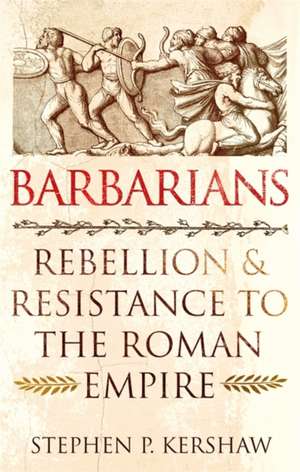
Barbarians: Rebellion and Resistance to the Roman Empire
Autor Dr Stephen P. Kershawen Limba Engleză Paperback – 9 iul 2020
A fresh new look at the Roman Empire, from the point of view of those regarded by the Romans as 'barbarians'. Kershaw builds a narrative around the lives, personalities, successes and failures both of the key opponents of Rome's rise and dominance, and of the those who ultimately brought the empire down. 'And now what will become of us without barbarians?Those people were a sort of solution.' 'Waiting for the Barbarians' C.
P. CavafyHistory is written by the victors, and Rome had some very eloquent historians. Those the Romans regarded as barbarians left few records of their own, but they had a tremendous impact on the Roman imagination.
Resisting from outside Rome's borders or rebelling from within, they emerge vividly in Rome's historical tradition, and left a significant footprint in archaeology. Rome's history, as written by the Romans, follows a remarkable trajectory from its origins as a tiny village of refugees from a conflict zone to a dominant superpower, before being transformed into the medieval and Byzantine worlds. But throughout this history, Rome faced significant resistance and rebellion from peoples whom it regarded as barbarians.
Gibbon saw the Roman Empire as one of the highest points of human achievement destroyed by barbarian invaders: Ostrogoths, Visigoths, Goths, Vandals, Huns, Picts and Scots. To others, as Rome was ravaged, new life was infused into an expiring Italy. Gibbon's 'decline and fall' has been reappraised as transformation, through religious and cultural revolution.
Based both on ancient historical writings and modern archaeological research, this new history takes a fresh look at the Roman Empire, through the personalities and lives of key opponents of Rome's rise, dominance and fall - or transformation. These include: Brennus, the Gaul who sacked Rome; the Plebs, those barbarous insiders and internal resistors; Hannibal; Viriathus, the Iberian shepherd and skilled guerilla; Jugurtha and the struggle to free Africa; the Germanic threat from the Cimbri and the Teutones; Spartacus, the gladiator; Vercingetorix and rebellion in Gaul; Cleopatra; Boudicca, the Queen of the Iceni and the scourge of Rome; the Great Jewish Revolt; Alaric the Goth and the Sack of Rome; Attila the Hun, 'Born to Shake the Nations'; and the Vandals and the fall of Rome.
Preț: 81.19 lei
Preț vechi: 108.07 lei
-25%
Carte disponibilă
Livrare economică 02-16 noiembrie
Livrare express 16-22 octombrie pentru 58.03 lei
Specificații
ISBN-10: 1472142136
Pagini: 592
Dimensiuni: 130 x 196 x 40 mm
Greutate: 0.46 kg
Editura: Little Brown
Colecția Robinson
Locul publicării:London, United Kingdom
V-ar putea interesa
-
 Postsocial History: An IntroductionMiguel A. Cabrera-34%Preț: 536.65 lei815.22 lei
 -
 Chinese Dialectics: From Yijing to MarxismChenshan Tian-34%Preț: 601.56 lei911.01 lei
 -
 -33%Preț: 358.17 lei534.20 lei
 -
 Brown v. Board of Education at Fifty: A Rhetorical RetrospectiveClarke Rountree-23%Preț: 321.53 lei416.66 lei
 -
 -24%Preț: 304.98 lei403.06 lei
 -
 Robert Redfield and the Development of American AnthropologyClifford Wilcox-24%Preț: 307.73 lei404.53 lei
 -
 -22%Preț: 339.69 lei437.42 lei
 -
 Revolutionary Currents: Nation Building in the Transatlantic WorldMichael A. Morrison-19%Preț: 313.80 lei388.57 lei
 -
 Henry Wilson and the Coming of the Civil WarJohn L. Myers-36%Preț: 553.29 lei868.83 lei
 -
 London's South BankGalinouPreț: 344.20 lei
 -
 Burton Holmes TraveloguesBurton HolmesPreț: 146.30 lei
 -
 A Brief History of Atlantis: Plato's Ideal StateDr Stephen P. Kershaw-26%Preț: 73.88 lei99.91 lei
 -
 Three Epic Battles that Saved Democracy: Marathon, Thermopylae and SalamisDr Stephen P. Kershaw-26%Preț: 169.22 lei228.24 lei
 -
 Hidden HistoriesMonique MoultriePreț: 187.96 lei
 -
 Envisioning African IntersexAmanda Lock SwarrPreț: 178.67 lei
 -
 A Bridge Over the Sins of Your FathersSteve GarrettPreț: 110.39 lei
 -
 A Brief Guide to the Greek MythsDr Stephen P. Kershaw-26%Preț: 80.79 lei108.79 lei
 -
 A Brief Guide to Classical CivilizationDr Stephen P. Kershaw-27%Preț: 72.88 lei99.32 lei
 -
 Studies of Religious History and CriticismErnest RenanPreț: 290.53 lei
 -
 History of CaliforniaTheodore Henry Hittell-19%Preț: 429.00 lei529.64 lei
 -
 The Pacific Coast PulpitD. Hanson IrwinPreț: 248.46 lei
 -
 Ruch antywojenny w czasie wojny w RPAJodie Mader-8%Preț: 409.02 lei444.59 lei
 -
 Conflitos étnicos & construção da nação em África pós-colonialOladipupo OlugbodiPreț: 327.96 lei
 -
 AS TRIBULAÇÕES DO POVO BEMBEMuhunga Ramazani W'ApoloPreț: 390.71 lei
 -
 NESChAST'Ya NARODA BEMBEMuhunga Ramazani V'ApoloPreț: 130.51 lei
 -
 Lions of MedinaDoyle GlassPreț: 111.02 lei
 -
 Mystery & History in Georgia (Volume 2)R. Olin JacksonPreț: 231.68 lei
Recenzii
Those people were a sort of solution.'
'Waiting for the Barbarians'
C. P. Cavafy
History is written by the victors, and Rome had some very eloquent historians. Those the Romans
regarded as barbarians left few records of their own, but they had a tremendous impact on the Roman imagination. Resisting from outside Rome's borders or rebelling from within, they emerge vividly in Rome's historical tradition, and left a significant footprint in archaeology.
Rome's history, as written by the Romans, follows a remarkable trajectory from its origins as a tiny
village of refugees from a conflict zone to a dominant superpower, before being transformed into the medieval and Byzantine worlds. But throughout this history, Rome faced significant resistance and rebellion from peoples whom it regarded as barbarians.
Gibbon saw the Roman Empire as one of the highest points of human achievement destroyed by
barbarian invaders. But this 'decline and fall' has been reappraised by some as transformation, through religious and cultural revolution.
Based both on ancient historical writings and modern archaeological research, this new history takes a fresh look at the Roman Empire through the personalities and lives of key opponents of Rome's rise, dominance and fall - or transformation. These include, among many others: Brennus,
the Gaul who sacked Rome; the Plebs, those barbarous insiders and internal resistors; Viriathus,
the Iberian shepherd and skilled guerilla; and Boudicca, the Queen of the Iceni and the scourge of
Rome.
Praise for the author's A Brief Guide to the Greek Myths:
Eminently sane, highly informative, and reasonably priced.
Praise for the author's A Brief History of Atlantis:
As his exhaustive survey shows, Atlantis has been adapted to countless ideologies and agendas over time, serving the needs of every sort of reader - "harmless hippies or Heinrich Himmler", in Mr Kershaw's memorable phrase.
Praise for the author:
The experts interviewed (a diverse bunch that includes academics, military leaders, civil-rights figures and more) [for TV documentary series Barbarians Rising] are both entertaining and illuminating, framing the barbarian cause, broadly, as a struggle for freedom against an iron-fisted opponent with unparalleled resources.