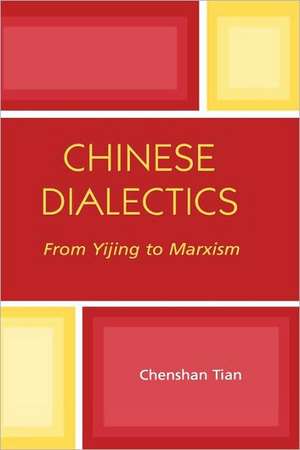
Chinese Dialectics: From Yijing to Marxism
Autor Chenshan Tianen Limba Engleză Hardback – 22 mar 2005
Preț: 601.56 lei
Preț vechi: 911.01 lei
-34%
Puncte Express: 902
Carte tipărită la comandă
Livrare economică 23 noiembrie-07 decembrie
Livrare prin curier în România Termenul estimat este afișat lângă disponibilitate.
Transport gratuit pentru acest produs Plată online sau ramburs, în funcție de opțiunile comenzii.
Retur gratuit în 14 zile Comandă securizată și suport în română.
Specificații
ISBN-13: 9780739109229
ISBN-10: 0739109227
Pagini: 237
Dimensiuni: 157 x 236 x 23 mm
Greutate: 0.49 kg
Editura: Bloomsbury Publishing
Colecția Lexington Books
Locul publicării:New York, United States
ISBN-10: 0739109227
Pagini: 237
Dimensiuni: 157 x 236 x 23 mm
Greutate: 0.49 kg
Editura: Bloomsbury Publishing
Colecția Lexington Books
Locul publicării:New York, United States
V-ar putea interesa
-
 -31%Preț: 740.67 lei1076.24 lei
 -
 -24%Preț: 369.54 lei487.65 lei
 -
 The Essential HuainanziKing Of Huainan LiPreț: 255.82 lei
 -
 Introducing BuddhismCharles S. PrebishPreț: 408.60 lei
 -
 Preț: 195.94 lei
 -
 Chinese PhilosophyHaiming WenPreț: 208.40 lei
 -
 Meditation Now or NeverSteve Hagen-32%Preț: 61.58 lei90.98 lei
 -
 Pilgrims to OpennessShambhavi SarasvatiPreț: 100.83 lei
 -
 Essence of the UpanishadsEknath EaswaranPreț: 100.22 lei
 -
 Secret Teachings of PadmasambhavaPadmasambhava-33%Preț: 93.92 lei139.23 lei
 -
 Freedom from the KnownJ. Krishnamurti-32%Preț: 61.90 lei91.58 lei
 -
 Creativity and Taoism: A Study of Chinese Philosophy, Art and PoetryChung-yuan Chang-20%Preț: 131.05 lei163.53 lei
Cuprins
Chapter 1 Tongbian A Chinese Strand of Thought
Chapter 2 Marxism in China: Initial Encounters
Chapter 3 Tongbian in Preliminary Reading of "Dialectics"
Chapter 4 Qu Qiubai's Reading of Dialectical Materialism
Chapter 5 Popularizing Dialectical Materialism
Chapter 6 Ai Siqi: Sinizing Dialectical Materialism
Chapter 7 Mao Zedong: The Mature Formulation of Dialectical Materialism
Chapter 8 Epilogue: Marxian Dialectics after Mao
Chapter 2 Marxism in China: Initial Encounters
Chapter 3 Tongbian in Preliminary Reading of "Dialectics"
Chapter 4 Qu Qiubai's Reading of Dialectical Materialism
Chapter 5 Popularizing Dialectical Materialism
Chapter 6 Ai Siqi: Sinizing Dialectical Materialism
Chapter 7 Mao Zedong: The Mature Formulation of Dialectical Materialism
Chapter 8 Epilogue: Marxian Dialectics after Mao
Recenzii
This book will make a significant contribution into the field of Chinese philosophy and Chinese intellectual history....I would require my undergraduate and graduate students in philosophy to read it....The last chapter is very unique and gives a timely warning about Chinese style of liberalism.
Chenshan Tian's brilliant study forces us to rethink conventional accounts of the reception of Marxism in East Asia, particularly in China. Drawing on untranslated Chinese primary sources, Tian convincingly argues that the integration of major Marxist concepts occurred within the larger intellectual and cultural framework of Chinese tongbian philosophy. This book is a major contribution to the growing discipline of comparative political theory.
By drawing in detail on a long and powerful tradition in Chinese philosophy, this book shows that the conventional understandings of Chinese Marxism demand careful reconsideration. It turns out, indeed, that getting this straight casts new light on current debates. An important book.
Chenshan Tian's book is an important contribution to the study of Chinese dialectical materialism. His argument that Marxist dialectics was received in China through the lens of tongbian or 'continuity through change' is well-sustained. Concise, insightful, and excellent in scholarship.
This is a most welcome monograph drawing upon both philosophy and political science to make explicit what has only been hinted at by our best interpreters of modern China. In this rigorously reasoned analysis, Tian Chenshan crafts a subtle yet compelling argument that the dialectical sensibilities of Chinese Marxism are distinctively Chinese, informed as this 'modern' Marxist way of thinking is by persistent cosmological assumptions recovered from the canons of Chinese philosophy, especially the biantong dialectic endorsed by the Book of Changes (Yijing).
An important contribution to the study of Chinese dialectical materialism. . . . Tian Chenshan's book on this much-neglected topic is indispensable for those who want to understand the intellectual history of China.
Chenshan Tian's book is a rare combination of excellent comparative philosophy and critical depth. It is analytically keen and extraordinarily informative about the geography and heritages of political philosophy.
Chenshan Tian's brilliant study forces us to rethink conventional accounts of the reception of Marxism in East Asia, particularly in China. Drawing on untranslated Chinese primary sources, Tian convincingly argues that the integration of major Marxist concepts occurred within the larger intellectual and cultural framework of Chinese tongbian philosophy. This book is a major contribution to the growing discipline of comparative political theory.
By drawing in detail on a long and powerful tradition in Chinese philosophy, this book shows that the conventional understandings of Chinese Marxism demand careful reconsideration. It turns out, indeed, that getting this straight casts new light on current debates. An important book.
Chenshan Tian's book is an important contribution to the study of Chinese dialectical materialism. His argument that Marxist dialectics was received in China through the lens of tongbian or 'continuity through change' is well-sustained. Concise, insightful, and excellent in scholarship.
This is a most welcome monograph drawing upon both philosophy and political science to make explicit what has only been hinted at by our best interpreters of modern China. In this rigorously reasoned analysis, Tian Chenshan crafts a subtle yet compelling argument that the dialectical sensibilities of Chinese Marxism are distinctively Chinese, informed as this 'modern' Marxist way of thinking is by persistent cosmological assumptions recovered from the canons of Chinese philosophy, especially the biantong dialectic endorsed by the Book of Changes (Yijing).
An important contribution to the study of Chinese dialectical materialism. . . . Tian Chenshan's book on this much-neglected topic is indispensable for those who want to understand the intellectual history of China.
Chenshan Tian's book is a rare combination of excellent comparative philosophy and critical depth. It is analytically keen and extraordinarily informative about the geography and heritages of political philosophy.