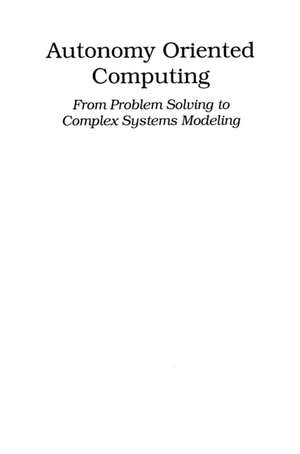
Autonomy Oriented Computing
Autor Jiming Liu, Xiaolong Jin, Kwok Ching Tsuien Limba Engleză Hardback – 3 dec 2004
Part One describes the basic concepts and characteristics of an AOC system and enumerates the critical design and engineering issues faced in AOC system development. Part Two gives detailed analyses of methodologies and case studies to evaluate AOC used in problem solving and complex system modeling. The final chapter outlines possibilities for future research and development.
Numerous illustrative examples, experimental case studies, and exercises at the end of each chapter of Autonomy Oriented Computing help particularize and consolidate the methodologies and theories presented.
Preț: 406.33 lei
Puncte Express: 609
Carte tipărită la comandă
Livrare economică 27 noiembrie-11 decembrie
Livrare prin curier în România Termenul estimat este afișat lângă disponibilitate.
Transport gratuit pentru acest produs Plată online sau ramburs, în funcție de opțiunile comenzii.
Retur gratuit în 14 zile Comandă securizată și suport în română.
Specificații
ISBN-13: 9781402081217
ISBN-10: 1402081219
Pagini: 216
Ilustrații: XXXII, 216 p. 57 illus.
Dimensiuni: 160 x 241 x 19 mm
Greutate: 0.55 kg
Ediția:2005 edition
Editura: Springer Us
Locul publicării:New York, NY, United States
ISBN-10: 1402081219
Pagini: 216
Ilustrații: XXXII, 216 p. 57 illus.
Dimensiuni: 160 x 241 x 19 mm
Greutate: 0.55 kg
Ediția:2005 edition
Editura: Springer Us
Locul publicării:New York, NY, United States
V-ar putea interesa
-
 The Computer and the BrainJohn Von NeumannPreț: 113.01 lei
 -
 The Cyborg HandbookChris Gray-15%Preț: 542.29 lei637.99 lei
 -
 Geometric Control of Mechanical SystemsFrancesco BulloPreț: 519.32 lei
 -
 Preț: 371.48 lei
 -
 -15%Preț: 572.75 lei673.83 lei
 -
 -15%Preț: 520.40 lei612.23 lei
 -
 Stochastic Networked Control SystemsSerdar Yüksel-18%Preț: 909.87 lei1109.60 lei
 -
 -18%Preț: 918.59 lei1120.23 lei
 -
 Discrete-Time Stochastic Control and Dynamic Potential GamesDavid González-SánchezPreț: 340.29 lei
 -
 Complex Systems Design & ManagementMarc Aiguier-20%Preț: 1328.56 lei1660.69 lei
 -
 Model-Based Control of Networked SystemsEloy Garcia-15%Preț: 675.30 lei794.47 lei
 -
 Optimization Techniques IIJ. StoerPreț: 401.62 lei
 -
 Extensions of Linear-Quadratic Control TheoryD. H. JacobsonPreț: 379.38 lei
 -
 Preț: 373.98 lei
 -
 -20%Preț: 1048.31 lei1310.38 lei
 -
 Active Media TechnologyJiming Liu-20%Preț: 341.41 lei426.76 lei
 -
 -20%Preț: 328.94 lei411.17 lei
 -
 -20%Preț: 322.61 lei403.26 lei
 -
 -20%Preț: 345.05 lei431.32 lei
 -
 -18%Preț: 912.40 lei1112.68 lei
 -
 Preț: 370.10 lei
 -
 Micro - QUALIFLEXJ. P. AncotPreț: 364.16 lei
 -
 SYS OF SYS COLLABORATIVE FORMATION (V1)Dimario Michael J-15%Preț: 576.55 lei678.29 lei
 -
 FRONT IN STUDY OF CHAOTIC DYN SYS WITH..Elhadj Zeraoulia-15%Preț: 652.66 lei767.83 lei
Public țintă
ResearchCuprins
Fundamentals.- From Autonomy to AOC.- AOC at a Glance.- Design and Engineering Issues.- A Formal Framework of AOC.- AOC in Depth.- AOC in Constraint Satisfaction.- AOC in Complex Systems Modeling.- AOC in Optimization.- Challenges and Opportunities.
Textul de pe ultima copertă
Autonomy Oriented Computing explores the important theoretical and practical issues in AOC, by analyzing methodologies and presenting experimental case studies. The book serves as a comprehensive reference source for researchers, scientists, engineers, and professionals in all fields concerned with this promising new development in computer science. It can also be used as a main or supplementary text in graduate and undergraduate programs across a broad range of computer-related disciplines, including Robotics and Automation, Amorphous Computing, Image Processing and Computer Vision, Programming Paradigms, Computational Biology, and many others.
The first part of the book, Fundamentals, describes the basic concepts and characteristics of an AOC system, and then it enumerates the critical design and engineering issues faced in AOC system development. The second part of the book, AOC in Depth, provides a detailed analysis of methodologies and case studies to evaluate the use of AOC in problem solving and complex system modeling. The final chapter reviews the essential features of the AOC paradigm and outlines a number of possibilities for future research and development.
Numerous illustrative examples, experimental case studies, and exercises at the end of each chapter of Autonomy Oriented Computing help particularize and consolidate the methodologies and theories as they are presented.
The first part of the book, Fundamentals, describes the basic concepts and characteristics of an AOC system, and then it enumerates the critical design and engineering issues faced in AOC system development. The second part of the book, AOC in Depth, provides a detailed analysis of methodologies and case studies to evaluate the use of AOC in problem solving and complex system modeling. The final chapter reviews the essential features of the AOC paradigm and outlines a number of possibilities for future research and development.
Numerous illustrative examples, experimental case studies, and exercises at the end of each chapter of Autonomy Oriented Computing help particularize and consolidate the methodologies and theories as they are presented.
Caracteristici
Essential introduction that presents the basic concepts and characteristics of an AOC system Enumerates the critical design and engineering issues of AOC system development Examines the use of AOC in problem solving and complex system modeling Includes supplementary material: sn.pub/extras
Notă biografică
Prof. Jiming Liu has been Chair Professor in Computer Science at Hong Kong Baptist University since 2010, where he also directs Centre for Health Informatics, as well as Joint Research Laboratory for Intelligent Disease Surveillance and Control (a research partnership with Chinese Center for Disease Control and Prevention). He received his MEng and PhD in Electrical Engineering (Robotics) from McGill University, after earning a BSc in Physics from East China Normal University and an interdisciplinary Master of Arts from Concordia University. He has been a Fellow of the IEEE since 2011. Prof. Liu's research interests include AI for Social Good, Machine Learning, Complex Systems, Data-Driven Modeling, Complex Networks, Web Intelligence (WI), and Autonomy-Oriented Computing (AOC) Paradigms. He has served as Editor-in-Chief of Web Intelligence Journal, and Associate Editor of Big Data and Information Analytics, IEEE Transactions on Knowledge and Data Engineering, IEEE Transactions on Cybernetics, and Computational Intelligence, among a dozen of others.
Dr. Shang Xia is currently an Associate Professor at the National Institute of Parasitic Diseases, Chinese Center for Diseases Control and Prevention (NIPD, China CDC), which is also recognized as the Chinese Center for Tropical Diseases Research (CTDR), and WHO Collaborating Centre for Tropical Diseases. He also works as a member of Joint Research Laboratory for Intelligent Disease Surveillance and Control (a research partnership with Hong Kong Baptist University). He received his PhD degree in Computer Science from Hong Kong Baptist University (HKBU) in Hong Kong, having obtained MEng and BEng degrees from Shanghai Jiao Tong University (SJTU), China. He has completed his Postdoctoral Research Program in the Chinese Center for Diseases Control and Prevention (China CDC) in Beijing, China. He is the committee member of International Society of Geospatial Health (GnosisGIS). He has served as the section editors of BMC Infectious Diseases of Poverty (IDP), and Climate Change Research (in Chinese).