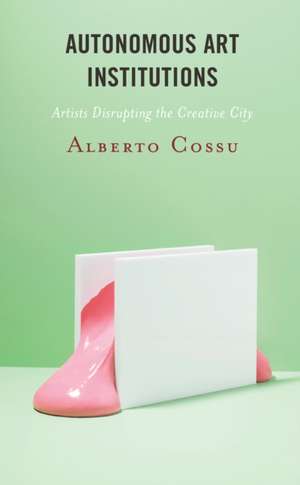
Autonomous Art Institutions: Artists Disrupting the Creative City
Autor Alberto Cossuen Limba Engleză Paperback – 17 mai 2022
Autonomous Art Institutions provides a unique perspective on the political engagement of artists in order to investigate the reconfiguration of contemporary art practices as they dissolve in social and economic processes. The book provides insight into the making of a radical art institution across seven years of activity, showing how social, cultural and economic elements are appropriated and repurposed by artists in the process. Based on years of sociological research as well as direct involvement of the author in the artistic practices, the book illuminates the spark of society-to-come by examining the doings of artists as they attempt to disrupt the 'creative city.'
Preț: 253.93 lei
Preț vechi: 333.22 lei
-24%
Puncte Express: 381
Carte tipărită la comandă
Livrare economică 07-21 decembrie
Livrare prin curier în România Termenul estimat este afișat lângă disponibilitate.
Transport gratuit de la 400.00 lei Plată online sau ramburs, în funcție de opțiunile comenzii.
Retur gratuit în 14 zile Comandă securizată și suport în română.
Specificații
ISBN-13: 9781538164303
ISBN-10: 1538164302
Pagini: 150
Ilustrații: 12 b/w photos; 2 tables; 4 textboxes;
Dimensiuni: 156 x 218 x 11 mm
Greutate: 0.23 kg
Editura: Bloomsbury Publishing
Colecția Rowman & Littlefield
Locul publicării:New York, United States
ISBN-10: 1538164302
Pagini: 150
Ilustrații: 12 b/w photos; 2 tables; 4 textboxes;
Dimensiuni: 156 x 218 x 11 mm
Greutate: 0.23 kg
Editura: Bloomsbury Publishing
Colecția Rowman & Littlefield
Locul publicării:New York, United States
V-ar putea interesa
-
 How Institutions ThinkPaul O'NeillPreț: 223.85 lei
 -
 Curating the Commons: Socially Engaged Public ArtKatia ArfaraPreț: 348.08 lei
 -
 ActivismAfonso Dias Ramos-17%Preț: 113.04 lei136.84 lei
 -
 Contemporary Art in the Conflicts of GlobalizationJonathan HarrisPreț: 387.01 lei
 -
 -9%Preț: 1328.29 lei1459.66 lei
 -
 Contemporary Art and Other ObstructionsAdam Geczy-31%Preț: 572.96 lei833.90 lei
 -
 Preț: 123.93 lei
 -
 Place-Keepers: Latina/x Art, Performance, and Organizing in the Twin CitiesJessica Lopez LymanPreț: 140.95 lei
 -
 Preț: 344.81 lei
 -
 Culture StrikeLaura RaicovichPreț: 82.88 lei
 -
 The Art of Activism and the Activism of ArtGregory SholettePreț: 261.48 lei
 -
 The Art Institution of TomorrowFatos ÜstekPreț: 164.05 lei
 -
 Towards the Ethical Art MuseumGareth HarrisPreț: 161.52 lei
 -
 Climate Action in the Art World: Towards a Greener FutureAnnabel KeenanPreț: 197.30 lei
 -
 Innovating Institutions and Inequities in the ArtsJoanna Woronkowicz-9%Preț: 804.83 lei884.43 lei
 -
 -18%Preț: 352.98 lei432.00 lei
 -
 What about Activism?Steven Henry MadoffPreț: 156.09 lei
 -
 Residencies ReflectedIrmeli Kokko-16%Preț: 139.38 lei166.07 lei
 -
 -19%Preț: 215.16 lei265.26 lei
Cuprins
INTRODUCTION: From Reaction to Autonomy: Protesting, Resisting and Creating Institutions
1. Framing Art & Political Mobilisation
2. Revealing the Backstage of an Ethnographic Study of Artists
3. Art's Own Activism
4. Organising for Being an Institution
5. Producing Culture in the Neoliberal City
CONCLUSION: Doing the unthinkable: Becoming Institutions
1. Framing Art & Political Mobilisation
2. Revealing the Backstage of an Ethnographic Study of Artists
3. Art's Own Activism
4. Organising for Being an Institution
5. Producing Culture in the Neoliberal City
CONCLUSION: Doing the unthinkable: Becoming Institutions
Recenzii
In his breakthrough study of autonomous cultural institutions, Alberto Cossu tells us that artists are operating at the frontlines of transformative political mobilization, and yet with his uniquely engaged approach to urban research it is Cossu himself who joins the frontline as a new type of socially active ethnographer. Cossu's investigation into contemporary forms of bottom-up community organizing will prove to be a requisite reference for transformative artists, scholars, theorists and activists in the foreseeable future.
At the level of theory the autonomy of art is presented as a problem to be debated and perhaps overcome. But in the lived reality of artists today, during an age of precarity where anything 'creative' is weaponized as part of arts-based gentrification, achieving autonomy for art in a different way is something to be wished for and struggled over. What could an autonomous art institution look like today? Here Alberto Cossu explores the struggles, dreams, lives, and campaigns of those who are struggling to answer that question.
Building on the experience of the art center Macao in Milan, and weaving together contemporary debates on art, social movements, class and the creative city, this book makes an excellent contribution not only to the sociology of art, but to contemporary social and political thought in general. Readers will find it full of novel ideas and inspiration!
In a moment of perpetual capitalist crisis, artists around the world are mobilizing both for their own benefit and to change society. Alberto Cossu's intimate ethnography of Milan's radical squatted Macau cultural centre offers us a vital case study of this trend, and shows us the potentials and the pitfalls as artists form new, horizontal institutions. It will be of great benefit not only to scholars following the changing politics and economics of culture, but also to a new generation of artist-activists looking for inspiration and lessons on how to create shared commons for the radical imagination.
At the level of theory the autonomy of art is presented as a problem to be debated and perhaps overcome. But in the lived reality of artists today, during an age of precarity where anything 'creative' is weaponized as part of arts-based gentrification, achieving autonomy for art in a different way is something to be wished for and struggled over. What could an autonomous art institution look like today? Here Alberto Cossu explores the struggles, dreams, lives, and campaigns of those who are struggling to answer that question.
Building on the experience of the art center Macao in Milan, and weaving together contemporary debates on art, social movements, class and the creative city, this book makes an excellent contribution not only to the sociology of art, but to contemporary social and political thought in general. Readers will find it full of novel ideas and inspiration!
In a moment of perpetual capitalist crisis, artists around the world are mobilizing both for their own benefit and to change society. Alberto Cossu's intimate ethnography of Milan's radical squatted Macau cultural centre offers us a vital case study of this trend, and shows us the potentials and the pitfalls as artists form new, horizontal institutions. It will be of great benefit not only to scholars following the changing politics and economics of culture, but also to a new generation of artist-activists looking for inspiration and lessons on how to create shared commons for the radical imagination.