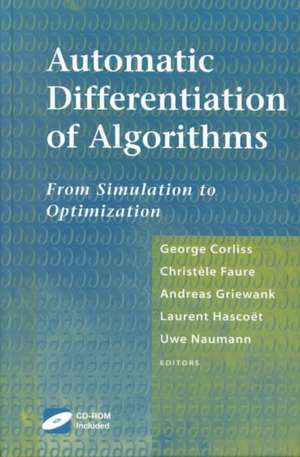
Automatic Differentiation of Algorithms
Editat de George Corliss, Christele Faure, Andreas Griewank, Laurent Hascoet, Uwe Naumannen Limba Engleză Hardback – 8 ian 2002
Automatic Differentiation of Algorithms provides a comprehensive and authoritative survey of all recent developments, new techniques, and tools for AD use. The book covers all aspects of the subject: mathematics, scientific programming (i.e., use of adjoints in optimization) and implementation (i.e., memory management problems). A strong theme of the book is the relationships between AD tools and other software tools, such as compilers and parallelizers. A rich variety of significant applications are presented as well, including optimum-shape design problems, for which AD offers more efficient tools and techniques.
Preț: 345.88 lei
Preț vechi: 432.35 lei
-20%
Puncte Express: 519
Carte tipărită la comandă
Livrare economică 27 noiembrie-11 decembrie
Livrare prin curier în România Termenul estimat este afișat lângă disponibilitate.
Transport gratuit de la 400.00 lei Plată online sau ramburs, în funcție de opțiunile comenzii.
Retur gratuit în 14 zile Comandă securizată și suport în română.
Specificații
ISBN-13: 9780387953052
ISBN-10: 0387953051
Pagini: 432
Ilustrații: XXVII, 432 p. 84 illus.
Dimensiuni: 162 x 243 x 27 mm
Greutate: 0.75 kg
Ediția:2002 edition
Editura: Springer
Locul publicării:New York, NY, United States
ISBN-10: 0387953051
Pagini: 432
Ilustrații: XXVII, 432 p. 84 illus.
Dimensiuni: 162 x 243 x 27 mm
Greutate: 0.75 kg
Ediția:2002 edition
Editura: Springer
Locul publicării:New York, NY, United States
V-ar putea interesa
-
 Computer VisionSimon J. D. Prince-20%Preț: 582.72 lei728.39 lei
 -
 Enterprise Content and Search Management for Building Digital PlatformsShailesh Kumar Shivakumar-20%Preț: 528.34 lei660.43 lei
 -
 Spock: Up and RunningRob Fletcher-20%Preț: 351.55 lei439.44 lei
 -
 Tragic DesignJonathan Shariat-20%Preț: 192.19 lei240.24 lei
 -
 Thoughtful Machine Learning with PythonMatthew Kirk-20%Preț: 258.34 lei322.92 lei
 -
 This is Service Design DoingMarc Stickdorn-20%Preț: 264.28 lei330.35 lei
 -
 Karau, H: High Performance SparkHolden Karau-20%Preț: 242.50 lei303.13 lei
 -
 Practical TableauRyan Sleeper-20%Preț: 319.04 lei398.80 lei
 -
 -18%Preț: 965.90 lei1177.93 lei
 -
 Course in Mathematical CryptographyGilbert Baumslag-20%Preț: 343.49 lei429.36 lei
 -
 -20%Preț: 403.84 lei504.81 lei
 -
 -20%Preț: 397.97 lei497.46 lei
 -
 -20%Preț: 409.39 lei511.74 lei
 -
 -20%Preț: 423.33 lei529.16 lei
 -
 -20%Preț: 407.01 lei508.77 lei
 -
 -20%Preț: 415.57 lei519.47 lei
 -
 Automatic Differentiation: Applications, Theory, and ImplementationsH. Martin Bücker-18%Preț: 1173.54 lei1431.15 lei
 -
 Einführung in die RechtsinformatikElmar Bund-20%Preț: 417.87 lei522.34 lei
 -
 Computer Aided VerificationKim G. Larsen-20%Preț: 332.60 lei415.75 lei
 -
 -20%Preț: 403.07 lei503.84 lei
Public țintă
Professional/practitionerCuprins
Part titles: Invited Contributions.- Parameter Identification and Least Squares.- Applications in Ode's and Optimal Control.- Applications in PDE's.- Applications in Science and Engineering.- Maintaining and Enhancing Parallelism.- Exploiting Structure and Sparsity.- Space-Time Tradeoffs in the Reverse Mode.- Use of Second and Higher Derivatives.- Error Estimates and Inclusions.