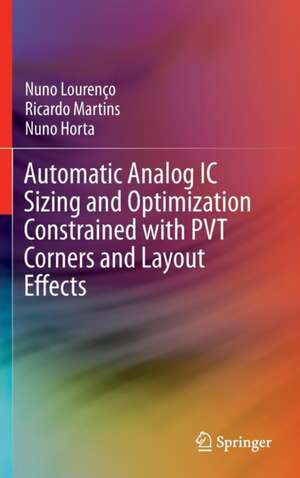
Automatic Analog IC Sizing and Optimization Constrained with PVT Corners and Layout Effects
Autor Nuno Lourenço, Ricardo Martins, Nuno Hortaen Limba Engleză Hardback – 9 aug 2016
Preț: 665.01 lei
Preț vechi: 782.36 lei
-15%
Puncte Express: 998
Carte tipărită la comandă
Livrare economică 28 noiembrie-12 decembrie
Livrare prin curier în România Termenul estimat este afișat lângă disponibilitate.
Transport gratuit pentru acest produs Plată online sau ramburs, în funcție de opțiunile comenzii.
Retur gratuit în 14 zile Comandă securizată și suport în română.
Specificații
ISBN-13: 9783319420363
ISBN-10: 3319420364
Pagini: 212
Ilustrații: XXVII, 182 p. 112 illus., 90 illus. in color.
Dimensiuni: 160 x 241 x 18 mm
Greutate: 0.44 kg
Ediția:1st edition 2017
Editura: Springer
Locul publicării:Cham, Switzerland
ISBN-10: 3319420364
Pagini: 212
Ilustrații: XXVII, 182 p. 112 illus., 90 illus. in color.
Dimensiuni: 160 x 241 x 18 mm
Greutate: 0.44 kg
Ediția:1st edition 2017
Editura: Springer
Locul publicării:Cham, Switzerland
V-ar putea interesa
-
 Valve AmplifiersMorgan Jones-28%Preț: 390.24 lei542.39 lei
 -
 -23%Preț: 457.84 lei594.82 lei
 -
 The Verilog(r) Hardware Description LanguageDonald Thomas-15%Preț: 508.12 lei597.79 lei
 -
 -18%Preț: 1613.42 lei1967.59 lei
 -
 Event-Based Neuromorphic SystemsShih-Chii Liu-9%Preț: 956.00 lei1050.55 lei
 -
 Detection Estimation and Modulation Theory, Part IHarry L van Trees-11%Preț: 679.81 lei763.82 lei
 -
 Fundamentals of High-Frequency CMOS Analog Integrated CircuitsDuran Leblebici-8%Preț: 596.44 lei648.30 lei
 -
 High Performance ASIC DesignRazak Hossain-11%Preț: 542.88 lei609.98 lei
 -
 Lcp for Microwave Packages and ModulesAnh-Vu H Pham-38%Preț: 568.12 lei909.15 lei
 -
 -19%Preț: 439.32 lei542.37 lei
 -
 -18%Preț: 1491.94 lei1819.45 lei
 -
 Green Mobile Devices and Networks: Energy Optimization and Scavenging TechniquesHrishikesh Venkataraman-18%Preț: 1065.79 lei1299.74 lei
 -
 -5%Preț: 1478.81 lei1556.64 lei
 -
 Electrical Machines with MATLAB®Turan Gonen-20%Preț: 1310.58 lei1638.23 lei
 -
 -11%Preț: 413.53 lei464.65 lei
Cuprins
Introduction.- Previous Works on Automatic Analog IC Sizing.- AIDA-C Architecture.- Multi-Objective Optimization Kernel.- AIDA-C Circuit Sizing Results.- Layout-Aware Circuit Sizing.- AIDA-C Layout-aware Circuit Sizing Results.- Conclusions.
Notă biografică
Rafael Vieira received the B.Sc. and M.Sc. degrees in Electrical Engineering from Instituto Superior Técnico (IST), University of Lisbon, Portugal, in 2019 and 2020, respectively. Since 2019, he has a research position at the Instituto de Telecomunicações, working on analog circuit design. At the same institutions, he is currently working toward the Ph.D. degree in Electrical Engineering in the area of analog and mixed-signal design for low-power and energy-efficient biomedical circuits and systems. His research interests are mainly in analog IC design for healthcare and biomedical applications as well as electronic design automation.
Nuno Horta (S¿89-M¿97-SM¿11) received the Licenciado, M.Sc., Ph.D. and Habilitation degrees in Electrical and Computer Engineering from Instituto Superior Técnico (IST), University of Lisbon, Portugal, in 1989, 1992, 1997 and 2014, respectively. In March 1998, he joined the IST Electrical and Computer Engineering Department where he is currently Associate Professor with Habilitation. Since 1998, he is, also, with Instituto de Telecomunicações, where he is the head of the Integrated Circuits Group. He has supervised more than 100 postgraduation works between M.Sc. and Ph.D. theses. He has authored or co-authored more than 150 publications such as books, book chapters, international journals papers and conference papers. He has also participated as Researcher or Coordinator in several national and European R&D projects. He was General Chair of AACD 2014, PRIME 2016 and SMACD 2016 and was Member of the organizing and technical program committees of several other conferences, e.g., IEEE ISCAS, IEEE LASCAS, DATE, NGCAS, etc. He is Associated Editor of Integration, The VLSI Journal, from Elsevier, and usually acts as Reviewer of several prestigious publications, e.g., IEEE TCAD, IEEE TEC, IEEE TCAS, ESWA, ASC, etc. His research interests are mainly in analog and mixed-signal IC design, analog IC design automation, soft computing and data science.
Nuno Lourenço received Licenciado, M.Sc. and Ph.D. degrees in Electrical and Computer Engineering from Instituto Superior Técnico, University of Lisbon, Portugal, in 2005, 2007, and 2014 respectively. He is with Instituto de Telecomunicações in Lisbon since 2005, where he now holds a postdoctoral research position. He has authored or co-authored over 80 works, including patents, books, book chapters, international journals and conferences papers. His current research interests include analog and mixed-signal IC design, electronic design automation tools, and artificial intelligence.
Ricardo Póvoa received the B.Sc., M.Sc. and Ph.D. degrees in Electrical Engineering from the Instituto Superior Técnico, University of Lisbon, Lisbon, Portugal, in 2011, 2013 and 2018, respectively. Since 2013, he has been with Instituto de Telecomunicações, Lisbon, where he is now Postdoctoral Researcher, researching on low-power analog and mixed-signal IC design applied to biometric applications and healthcare. In 2016, he joined the Marine Engineering Department, Escola Superior Náutica Infante D. Henrique, Lisbon, where he teaches the Naval Electronics and Automation course and the Marine Electrotechnical Engineering course. His current research interests include analog and mixed-signal circuit design, RF CMOS circuitry and applications, biomedical engineering and electronics and EDA.
Textul de pe ultima copertă
This book introduces readers to a variety of tools for automatic analog integrated circuit (IC) sizing and optimization. The authors provide a historical perspective on the early methods proposed to tackle automatic analog circuit sizing, with emphasis on the methodologies to size and optimize the circuit, and on the methodologies to estimate the circuit’s performance. The discussion also includes robust circuit design and optimization and the most recent advances in layout-aware analog sizing approaches. The authors describe a methodology for an automatic flow for analog IC design, including details of the inputs and interfaces, multi-objective optimization techniques, and the enhancements made in the base implementation by using machine leaning techniques. The Gradient model is discussed in detail, along with the methods to include layout effects in the circuit sizing. The concepts and algorithms of all the modules are thoroughly described, enabling readers to reproduce the methodologies, improve the quality of their designs, or use them as starting point for a new tool. An extensive set of application examples is included to demonstrate the capabilities and features of the methodologies described.
Caracteristici
Introduces readers to an efficient, multi-objective design methodology and tool for automatic analog IC sizing, which compensates for the effects of process variations Presents an innovative approach to enhance AIDA-C, by embedding statistical knowledge from an automatically generated gradient model into the NSGA-II operators Enables an efficient setup flow, which eases reuse and migration of designs to different specifications and technologies Includes supplementary material: sn.pub/extras