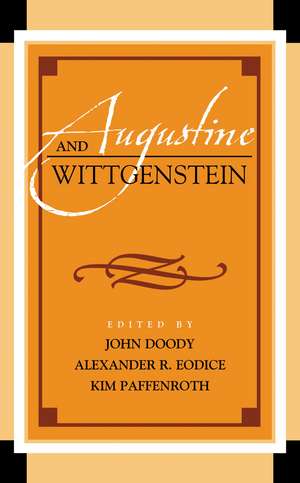
Augustine and Wittgenstein: Augustine in Conversation: Tradition and Innovation
Editat de Kim Paffenroth, Alexander R. Eodice, John Doody Contribuţii de Myles Burnyeat, Brian R. Clack, Espen Dahl, Chad Engelland, David Goodill, Blackfriars, University of Oxford, UK, Garry Hagberg, Miles Hollingworth, Erika Kidd, Duncan Richter, Caleb Thompsonen Limba Engleză Hardback – 15 sep 2018
Din seria Augustine in Conversation: Tradition and Innovation
- 22%
 Preț: 327.48 lei
 - 33%
 Preț: 357.42 lei
 - 23%
 Preț: 336.62 lei
 - 27%
 Preț: 354.08 lei
 - 34%
 Preț: 631.11 lei
 - 37%
 Preț: 659.28 lei
 - 28%
 Preț: 383.96 lei
 - 33%
 Preț: 557.89 lei
 - 28%
 Preț: 354.70 lei
 - 36%
 Preț: 680.52 lei
 - 27%
 Preț: 270.34 lei
 -
 Preț: 248.48 lei
 - 35%
 Preț: 626.32 lei
 - 32%
 Preț: 564.75 lei
 - 32%
 Preț: 362.42 lei
Preț: 584.74 lei
Preț vechi: 864.92 lei
-32%
Puncte Express: 877
Carte tipărită la comandă
Livrare economică 30 noiembrie-14 decembrie
Livrare prin curier în România Termenul estimat este afișat lângă disponibilitate.
Transport gratuit pentru acest produs Plată online sau ramburs, în funcție de opțiunile comenzii.
Retur gratuit în 14 zile Comandă securizată și suport în română.
Specificații
ISBN-13: 9781498585262
ISBN-10: 1498585264
Pagini: 242
Dimensiuni: 161 x 240 x 22 mm
Greutate: 0.6 kg
Editura: Bloomsbury Publishing
Colecția Lexington Books
Seria Augustine in Conversation: Tradition and Innovation
Locul publicării:New York, United States
ISBN-10: 1498585264
Pagini: 242
Dimensiuni: 161 x 240 x 22 mm
Greutate: 0.6 kg
Editura: Bloomsbury Publishing
Colecția Lexington Books
Seria Augustine in Conversation: Tradition and Innovation
Locul publicării:New York, United States
Cuprins
Chapter1. Wittgenstein and Augustine De Magistro
Chapter2. Learning by Ostension in Augustine and Wittgenstein
Chapter3. In the Beginning: Wittgenstein Reads Augustine
Chapter4. The Swine and the Chatterbox
Chapter5. Wittgenstein, Ritual, and "St. Augustine's Attitude to Sex"
Chapter6. Wittgenstein and Augustine on Seeing Miracles
Chapter7. Original Sense: Augustine and Wittgenstein on Religion and Origins
Chapter8. Wittgenstein, Augustine, and the Content of Memory
Chapter9. Time and freedom in the Confessions and the Tractatus
Chapter10. Augustine and Wittgenstein on the Will
Chapter2. Learning by Ostension in Augustine and Wittgenstein
Chapter3. In the Beginning: Wittgenstein Reads Augustine
Chapter4. The Swine and the Chatterbox
Chapter5. Wittgenstein, Ritual, and "St. Augustine's Attitude to Sex"
Chapter6. Wittgenstein and Augustine on Seeing Miracles
Chapter7. Original Sense: Augustine and Wittgenstein on Religion and Origins
Chapter8. Wittgenstein, Augustine, and the Content of Memory
Chapter9. Time and freedom in the Confessions and the Tractatus
Chapter10. Augustine and Wittgenstein on the Will
Recenzii
The series to which Augustine and Wittgenstein belongs is focused on Augustine. Editors John Doody, Alexander B. Eodice, and Kim Paffenroth, however, achieve a remarkable balance across all the chapters. The fact that its chapters pose questions worth pursuing beyond its own parameters demonstrates its potential relevance to readers from other fields. For this, the editors and authors are to be greatly thanked.
This wide-ranging and provocative collection of essays highlights the many connections between Augustine and Wittgenstein on language, memory, confession, and religion. While it was W. himself who said that A. was one of his favorite writers (along with Kierkegaard and Dostoevsky), exactly why that is so and how that admiration expresses itself in his writing has never before been so clearly and broadly presented as in this collection. I found myself understanding better each author through the other. This book is a must read for anyone interested in either of these deeply original and profoundly personal thinkers, or simply in thinking about the eternal questions that they raise.
Wittgenstein, who thought religiously but not from within a religion, had, to say the least, a complex debt to Augustine, whose surprisingly unsettled religiosity still manages to disturb the peace of a secular aesthetic. The ten essays that comprise Augustine and Wittgenstein stake out the terms of their arresting conjunction in inventive ways. There is no single paradigm of approach that the writers follow: along the way, we get manicured lawns, hot-house flowers, wild germinations, and ambiguous weeds. This is philosophy at the edge of reverence. Dig in.
This excellent collection of essays is poised to become the standard first resource for scholars and students examining connections between Augustine and Wittgenstein. These ten essays (one classic and nine newly written for the volume) address a diverse set of problems linking the two thinkers, including Wittgenstein's interpretation of Augustine, the role of ostention in language learning, difficulties concerning meaningful speech about ultimate reality, the perception and interpretation of miracles, human sexuality and the ritual imagination, the origins of religiosity, the relation between time and memory, and understanding the recalcitrant will. The collection provides a much needed scholarly resource for those interested in Wittgenstein's relation to Augustine as well as creative and critical examination of links and divergences between the two philosophers.
This wide-ranging and provocative collection of essays highlights the many connections between Augustine and Wittgenstein on language, memory, confession, and religion. While it was W. himself who said that A. was one of his favorite writers (along with Kierkegaard and Dostoevsky), exactly why that is so and how that admiration expresses itself in his writing has never before been so clearly and broadly presented as in this collection. I found myself understanding better each author through the other. This book is a must read for anyone interested in either of these deeply original and profoundly personal thinkers, or simply in thinking about the eternal questions that they raise.
Wittgenstein, who thought religiously but not from within a religion, had, to say the least, a complex debt to Augustine, whose surprisingly unsettled religiosity still manages to disturb the peace of a secular aesthetic. The ten essays that comprise Augustine and Wittgenstein stake out the terms of their arresting conjunction in inventive ways. There is no single paradigm of approach that the writers follow: along the way, we get manicured lawns, hot-house flowers, wild germinations, and ambiguous weeds. This is philosophy at the edge of reverence. Dig in.
This excellent collection of essays is poised to become the standard first resource for scholars and students examining connections between Augustine and Wittgenstein. These ten essays (one classic and nine newly written for the volume) address a diverse set of problems linking the two thinkers, including Wittgenstein's interpretation of Augustine, the role of ostention in language learning, difficulties concerning meaningful speech about ultimate reality, the perception and interpretation of miracles, human sexuality and the ritual imagination, the origins of religiosity, the relation between time and memory, and understanding the recalcitrant will. The collection provides a much needed scholarly resource for those interested in Wittgenstein's relation to Augustine as well as creative and critical examination of links and divergences between the two philosophers.