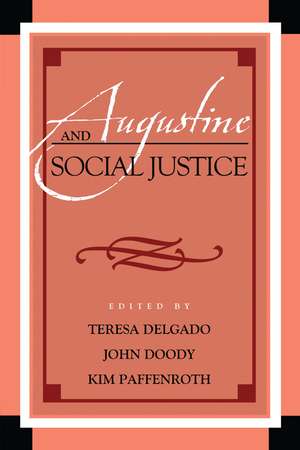
Augustine and Social Justice: Augustine in Conversation: Tradition and Innovation
Editat de Teresa Delgado, John Doody, Kim Paffenroth Contribuţii de Mary T. Clark, Aaron Conley, María Teresa Dávila, Mark Doorley, Todd French, J. Burton Fulmer, Jennifer Herdt, Rodolfo Hernandez-Diaz, John Kiess, Matthew J. Pereira, Siobhan Nash-Marshall, Edmund N. Santurri, George Schmidt, Sarah Stewart-Kroeker, Sergey Trostyanskiy, Darlene Weaver, William Werpehowskien Limba Engleză Hardback – 14 ian 2015
| Toate formatele și edițiile | Preț | Express |
|---|---|---|
| Paperback (1) | 366.32 lei 6-8 săpt. | |
| Bloomsbury Publishing – 14 noi 2016 | 366.32 lei 6-8 săpt. | |
| Hardback (1) | 732.44 lei 6-8 săpt. | |
| Bloomsbury Publishing – 14 ian 2015 | 732.44 lei 6-8 săpt. |
Din seria Augustine in Conversation: Tradition and Innovation
- 23%
 Preț: 752.49 lei
 - 23%
 Preț: 311.72 lei
 - 34%
 Preț: 340.37 lei
 - 24%
 Preț: 320.92 lei
 - 28%
 Preț: 337.18 lei
 - 35%
 Preț: 603.51 lei
 - 38%
 Preț: 628.23 lei
 - 29%
 Preț: 366.32 lei
 - 34%
 Preț: 519.29 lei
 - 30%
 Preț: 330.35 lei
 - 37%
 Preț: 648.45 lei
 - 28%
 Preț: 257.61 lei
 -
 Preț: 248.48 lei
 - 36%
 Preț: 596.17 lei
 - 34%
 Preț: 525.55 lei
 - 33%
 Preț: 345.21 lei
Preț: 732.44 lei
Preț vechi: 1114.04 lei
-34%
Puncte Express: 1099
Preț estimativ în valută:
129.53€ • 153.29$ • 112.95£
129.53€ • 153.29$ • 112.95£
Carte tipărită la comandă
Livrare economică 03-17 aprilie
Specificații
ISBN-13: 9781498509176
ISBN-10: 1498509177
Pagini: 344
Dimensiuni: 160 x 235 x 28 mm
Greutate: 0.64 kg
Editura: Bloomsbury Publishing
Colecția Lexington Books
Seria Augustine in Conversation: Tradition and Innovation
Locul publicării:New York, United States
ISBN-10: 1498509177
Pagini: 344
Dimensiuni: 160 x 235 x 28 mm
Greutate: 0.64 kg
Editura: Bloomsbury Publishing
Colecția Lexington Books
Seria Augustine in Conversation: Tradition and Innovation
Locul publicării:New York, United States
Cuprins
Introduction
I. Introductory and General Discussions
1. Augustine on Justice Mary T. Clark
2. The Pursuit of Social Justice: Some Augustinian Sources of Caution Mark Doorley
3. The Philosophical Tenets and Content of Augustine's Social Doctrine Sergey Trostyanskiy
II. Economic Justice
4. Altruism or Holy Economy: Ambrose and Augustine's Care for the Poor Todd French
5. The Consumer's Restless Heart J. Burton Fulmer
6. Eudaimonism and Dispossession: Augustine on AlmsgivingJennifer Herdt
7. Augustine and Political Economy Rodolfo Hernandez-Diaz
III. Politics, Power, and War
8. Augustine and Slavery: Freedom for the Free Aaron Conley
9. Interrupting Augustine's Inheritance: Breaking the Dominance of Power and Order in Augustine's Development of an Ethic of War through Latino/a Theology María Teresa Dávila
10. Augustinian Realism and the Morality of War: An Exchange Edmund N. Santurri and William Werpehowski
11. The Anarchistic Dimensions of Augustinian Realism George Schmidt
IV. Justice, Love, and Community
12. Common Ruins of Love: Augustine and the Politics of Mourning John Kiess
13. Augustine and Social Justice in John Calvin's Biblical Commentaries Matthew J. Pereira
14. Friendship and Moral Formation: Implications for Restorative Justice Sarah Stewart-Kroeker
15. Augustine, Families, and Social Justice Darlene Weaver
I. Introductory and General Discussions
1. Augustine on Justice Mary T. Clark
2. The Pursuit of Social Justice: Some Augustinian Sources of Caution Mark Doorley
3. The Philosophical Tenets and Content of Augustine's Social Doctrine Sergey Trostyanskiy
II. Economic Justice
4. Altruism or Holy Economy: Ambrose and Augustine's Care for the Poor Todd French
5. The Consumer's Restless Heart J. Burton Fulmer
6. Eudaimonism and Dispossession: Augustine on AlmsgivingJennifer Herdt
7. Augustine and Political Economy Rodolfo Hernandez-Diaz
III. Politics, Power, and War
8. Augustine and Slavery: Freedom for the Free Aaron Conley
9. Interrupting Augustine's Inheritance: Breaking the Dominance of Power and Order in Augustine's Development of an Ethic of War through Latino/a Theology María Teresa Dávila
10. Augustinian Realism and the Morality of War: An Exchange Edmund N. Santurri and William Werpehowski
11. The Anarchistic Dimensions of Augustinian Realism George Schmidt
IV. Justice, Love, and Community
12. Common Ruins of Love: Augustine and the Politics of Mourning John Kiess
13. Augustine and Social Justice in John Calvin's Biblical Commentaries Matthew J. Pereira
14. Friendship and Moral Formation: Implications for Restorative Justice Sarah Stewart-Kroeker
15. Augustine, Families, and Social Justice Darlene Weaver
Recenzii
How I would have loved a volume like Augustine and Social Justice to help me explore the implications of such reflections on justice. Despite the many works written on Augustine, including those that address Augustine's understanding of justice, very few helped me probe what Augustine's thought means for how we conceptualize and seek social justice. This volume does just that. The essays in this volume represent an impressive diversity of perspectives and cover a remarkable array of topics.
Scholars. . . who are interested in the topics of justice, wealth and poverty (esp. Herdt's essay), slavery, just war and friendship will find this book a helpful point of entry for their research.
The temptation in much conventional theological talk about Augustine is to reduce him to a limited set of clichés concerning the several heresies he critiqued: Manichaeism, Donatism, and Pelagianism. This fine collection of essays of course does not avoid all theoretical issues and abstract questions, but it primarily shows the way in which this practicing church theologian had a continuing concern for the administration of "the city of man." These scholars trace the ways in which his commitment, from classical categories, to order led him to think about justice as giving 'to each what belongs to him.' This book will be a significant contribution to current thinking about justice and the theological underpinnings that are required for faithfulness about the political economy. This discipline of first order thinking is indispensable in the face of crusading fads.
Sixteen hundred years later, Saint Augustine is as popular as ever. A plethora of scholarship on the Bishop of Hippo's political theology and theological ethics is now available, even with different schools of Augustinian thinking circulating. Just when one might believe that Augustine's work and legacy have been exhaustively mined?, along comes Augustine and Social Justice, a lode containing rich veins of original contributions by established and emerging scholars. With topics ranging from just war to restorative justice, and from consumerism to family ethics, this volume is a must-read for anyone interested in Augustine for today.
Scholars. . . who are interested in the topics of justice, wealth and poverty (esp. Herdt's essay), slavery, just war and friendship will find this book a helpful point of entry for their research.
The temptation in much conventional theological talk about Augustine is to reduce him to a limited set of clichés concerning the several heresies he critiqued: Manichaeism, Donatism, and Pelagianism. This fine collection of essays of course does not avoid all theoretical issues and abstract questions, but it primarily shows the way in which this practicing church theologian had a continuing concern for the administration of "the city of man." These scholars trace the ways in which his commitment, from classical categories, to order led him to think about justice as giving 'to each what belongs to him.' This book will be a significant contribution to current thinking about justice and the theological underpinnings that are required for faithfulness about the political economy. This discipline of first order thinking is indispensable in the face of crusading fads.
Sixteen hundred years later, Saint Augustine is as popular as ever. A plethora of scholarship on the Bishop of Hippo's political theology and theological ethics is now available, even with different schools of Augustinian thinking circulating. Just when one might believe that Augustine's work and legacy have been exhaustively mined?, along comes Augustine and Social Justice, a lode containing rich veins of original contributions by established and emerging scholars. With topics ranging from just war to restorative justice, and from consumerism to family ethics, this volume is a must-read for anyone interested in Augustine for today.