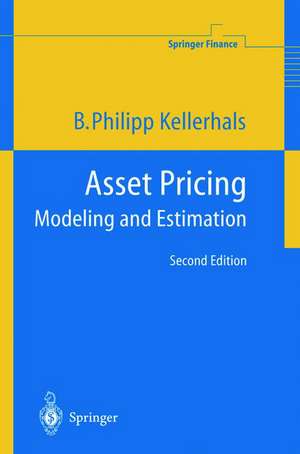
Asset Pricing: Springer Finance
Autor B. Philipp Kellerhalsen Limba Engleză Hardback – 6 apr 2004
Din seria Springer Finance
-
 Preț: 378.03 lei
 -
 Preț: 397.87 lei
 - 18%
 Preț: 816.31 lei
 -
 Preț: 410.70 lei
 - 18%
 Preț: 1212.11 lei
 - 15%
 Preț: 683.25 lei
 -
 Preț: 462.03 lei
 - 15%
 Preț: 664.01 lei
 - 18%
 Preț: 1034.69 lei
 - 18%
 Preț: 1112.87 lei
 - 18%
 Preț: 1117.48 lei
 -
 Preț: 409.69 lei
 - 18%
 Preț: 926.92 lei
 - 15%
 Preț: 616.89 lei
 - 15%
 Preț: 612.10 lei
 -
 Preț: 439.86 lei
 - 18%
 Preț: 987.53 lei
 - 15%
 Preț: 666.85 lei
 - 15%
 Preț: 551.04 lei
 - 18%
 Preț: 967.72 lei
 - 15%
 Preț: 635.29 lei
 -
 Preț: 390.72 lei
 - 17%
 Preț: 432.44 lei
 -
 Preț: 404.05 lei
 - 18%
 Preț: 839.74 lei
 - 18%
 Preț: 833.11 lei
 - 18%
 Preț: 943.27 lei
 - 19%
 Preț: 547.43 lei
 - 18%
 Preț: 779.29 lei
 -
 Preț: 373.03 lei
 - 18%
 Preț: 766.85 lei
 - 15%
 Preț: 671.02 lei
 - 18%
 Preț: 978.38 lei
 - 17%
 Preț: 410.51 lei
 - 15%
 Preț: 677.79 lei
Preț: 983.18 lei
Preț vechi: 1199.00 lei
-18%
Puncte Express: 1475
Carte tipărită la comandă
Livrare economică 05-19 decembrie
Livrare prin curier în România Termenul estimat este afișat lângă disponibilitate.
Transport gratuit pentru acest produs Plată online sau ramburs, în funcție de opțiunile comenzii.
Retur gratuit în 14 zile Comandă securizată și suport în română.
Specificații
ISBN-13: 9783540208532
ISBN-10: 3540208534
Pagini: 264
Ilustrații: XIV, 243 p.
Dimensiuni: 160 x 241 x 20 mm
Greutate: 0.51 kg
Ediția:Second Edition 2004
Editura: Springer
Colecția Springer Finance
Seria Springer Finance
Locul publicării:Berlin, Heidelberg, Germany
ISBN-10: 3540208534
Pagini: 264
Ilustrații: XIV, 243 p.
Dimensiuni: 160 x 241 x 20 mm
Greutate: 0.51 kg
Ediția:Second Edition 2004
Editura: Springer
Colecția Springer Finance
Seria Springer Finance
Locul publicării:Berlin, Heidelberg, Germany
V-ar putea interesa
-
 Finance Theory and Asset Pricing: Second EditionFrank Milne-18%Preț: 340.02 lei414.86 lei
 -
 Jesse LivermoreRichard SmittenPreț: 191.85 lei
 -
 Come Into My Trading Room Study GuideAlexander ElderPreț: 211.61 lei
 -
 Options on Futures WorkbookJohn F SummaPreț: 283.07 lei
 -
 Inventing MoneyNicholas DunbarPreț: 219.89 lei
 -
 Preț: 267.74 lei
 -
 Trade Stocks and Commodities with the InsidersLarry WilliamsPreț: 386.76 lei
 -
 The Insider's Guide to 52 Homes in 52 WeeksDolf de RoosPreț: 104.97 lei
 -
 The Econometrics of Financial MarketsJohn Y. Campbell-14%Preț: 510.27 lei593.34 lei
 -
 Asset Pricing - Revised EditionJohn H. Cochrane-14%Preț: 480.74 lei559.00 lei
 -
 Property Investment AppraisalAndrew E. Baum-15%Preț: 538.32 lei633.31 lei
 -
 Futures, Options, and SwapsRob Quail-8%Preț: 694.70 lei755.11 lei
 -
 Derivative Securities and Difference MethodsYou-Lan Zhu-18%Preț: 1004.72 lei1225.26 lei
 -
 Other People's MoneyNomi PrinsPreț: 161.63 lei
 -
 Biologically Inspired Algorithms for Financial ModellingAnthony Brabazon-20%Preț: 625.75 lei782.19 lei
 -
 Real Estate InvestmentG. Jason Goddard-26%Preț: 484.73 lei656.04 lei
Public țintă
ResearchCuprins
I Asset Pricing Framework.- 1 Financial Modeling.- 2 Estimation Principles.- II Pricing Equities.- 3 Introduction and Survey.- 4 Valuation Model.- 5 First Empirical Results.- 6 Implications for Investment Strategies.- 7 Summary and Conclusions.- III Pricing Fixed-Income Securites.- 8 Introduction and Survey.- 9 Term Structure Model.- 10 Initial Characteristic Results.- 11 Risk Management and Derivatives Pricing.- 12 Calibration to Standard Instruments.- 13 Summary and Conclusions.- IV Pricing Electricity Forwards.- 14 Introduction and Survey.- 15 Electricity Pricing Model.- 16 Empirical Inference.- 17 Summary and Conclusions.- List of Symbols and Notation.- List of Tables.- List of Figures.- References.
Recenzii
From the reviews of the second edition:
"This book provides a canonical framework that shows how to bridge the gap between the continuous-time pricing practice in financial engineering and the capital market data inevitably only available at discrete-time intervals. … The reorganized and improved text further integrates the latest research contributions in three covered application fields: equities with closed funds, fixed-income products and electricity derivatives." (T. Postelnicu, Zentralblatt MATH, Vol. 1086, 2006)
"This book provides a canonical framework that shows how to bridge the gap between the continuous-time pricing practice in financial engineering and the capital market data inevitably only available at discrete-time intervals. … The reorganized and improved text further integrates the latest research contributions in three covered application fields: equities with closed funds, fixed-income products and electricity derivatives." (T. Postelnicu, Zentralblatt MATH, Vol. 1086, 2006)