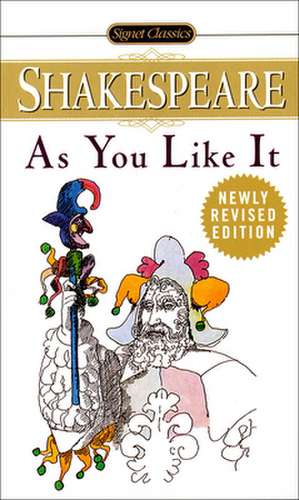
As You Like It
Autor William Shakespeare Editat de Albert Gilmanen Limba Engleză Hardback – 31 dec 1998 – vârsta de la 12 ani
-- Grow with the times by including both historical and thoroughly contemporary critical commentary on such issues as feminist, political, and theatrical interpretations of the plays -- with recent full-length essays by such respected scholars as Frank Kermode, Carolyn Heilbrun, Michael Goldman, Linda Bamber, and many others.
-- Provide more bibliographic listings and more up-to-date and relevant listings of pertinent books and articles in the Suggested Reference Section than the competition offers.
-- Feature essays on the Performance or Stage History of each play, written by Sylvan Barnet.
Preț: 87.29 lei
Puncte Express: 131
Carte indisponibilă temporar
Doresc să fiu notificat când acest titlu va fi disponibil:
Se trimite...
Specificații
V-ar putea interesa
-
 SylvesterGeorgette Heyer-26%Preț: 57.95 lei77.99 lei
 -
 MaoJung Chang-15%Preț: 107.75 lei127.42 lei
 -
 The Art of FictionDavid Lodge-19%Preț: 63.67 lei78.72 lei
 -
 The DictatorsRichard Overy-18%Preț: 130.41 lei158.34 lei
 -
 What is History?E. H. Carr-31%Preț: 64.10 lei92.87 lei
 -
 The Loved OneEvelyn Waugh-28%Preț: 55.61 lei76.87 lei
 -
 The House of Bernarda Alba and Other PlaysFederico Garcia LorcaPreț: 77.26 lei
 -
 The OdysseyHomerPreț: 58.65 lei
 -
 The Heart Goes LastMargaret Atwood-24%Preț: 61.09 lei80.73 lei
 -
 Preț: 156.68 lei
 -
 The Strange Case of Dr. Jekyll and Mr. HydeRobert Louis Stevenson-20%Preț: 19.78 lei24.65 lei
 -
 A Midsummer Night's DreamWilliam ShakespearePreț: 28.15 lei
 -
 Northanger AbbeyJane AustenPreț: 44.48 lei
 -
 The Tale of GenjiLady MurasakiPreț: 46.84 lei
 -
 The Kingmaker's Daughter: Cousins' War 4Philippa Gregory-31%Preț: 54.36 lei79.01 lei
 -
 MaoMichael LynchPreț: 406.26 lei
 -
 What Is History Now?D. CannadinePreț: 256.75 lei
 -
 In Defence Of HistoryRichard J. EvansPreț: 93.63 lei
 -
 Romeo and JulietWilliam ShakespearePreț: 36.05 lei
 -
 Tess of the d'UrbervillesThomas HardyPreț: 31.11 lei
 -
 A Portrait of the Artist as a Young ManJames JoycePreț: 36.06 lei
 -
 Sense and SensibilityJane AustenPreț: 25.51 lei
 -
 FrankensteinMary ShelleyPreț: 30.38 lei
 -
 Great GatsbyF. Scott FitzgeraldPreț: 29.75 lei
 -
 Robinson CrusoeDaniel DefoePreț: 36.10 lei
Descriere
The newly revised signet classic Shakespeare series, these editions are the works of the world's greatest dramatist edited by outstanding scholars. Unique features include an extensive overview of Shakespeare's life, world, and theater by the general editor of Signet Classic Shakespeare series, plus a special introduction to the play by the editor Sylvan Barnet, Tufts University. Special introduction by Albert Gilman, Boston University.
Textul de pe ultima copertă
Unjustly deposed by his younger brother, the rightful duke retreats to the Forest of Arden and forms a utopia with his loyal followers while his daughter remains at court as a companion to her cousin. When forbidden romance enters their lives, the girls assume disguises and flee to the forest, where they encounter a magical world of friendly outlaws and wise fools. Both a lighthearted comedy and a deeper exploration of social and literary issues, this play features a memorable cast of characters and some of Shakespeare s finest poetry."
Notă biografică
Venus and Adonis is a narrative poem by William Shakespeare published in 1593. It is probably Shakespeare's first publication.The poem tells the story of Venus, the goddess of Love of her unrequited love and of her attempted seduction of Adonis, an extremely handsome young man, who would rather go hunting. The poem is pastoral, and at times erotic, comic, and tragic. It contains discourses on the nature of love, and observations of nature.It is written in stanzas of six lines of iambic pentameter rhyming ABABCC although this verse form was known before Shakespeare's use, it is now commonly known as the Venus and Adonis stanza, after this poem. This form was also used by Edmund Spenser and Thomas Lodge. The poem consists of 199 stanzas or 1,194 lines.It was published originally as a quarto pamphlet and published with great care. It was probably printed using Shakespeare's fair copy. The printer was Richard Field, who, like Shakespeare, was from Stratford. Venus and Adonis appeared in print before any of Shakespeare's plays were published, but not before some of his plays had been acted on stage. It has certain qualities in common with A Midsummer Night's Dream, Romeo and Juliet, and Love's Labour's Lost. It was written when the London theatres were closed for a time due to the plague.The poem begins with a brief dedication to Shakespeare's patron, Henry Wriothesley, 3rd Earl of Southampton, in which the poet describes the poem as "the first heir of my invention".The poem is inspired by and based on stories found in the Metamorphoses, a narrative poem by the Latin poet, Ovid (43 BC - AD 17/18). Ovid's much briefer version of the tale occurs in book ten of his Metamorphoses. It differs greatly from Shakespeare's version. Ovid's Venus goes hunting with Adonis to please him, but otherwise is uninterested in the out-of-doors. She wears "tucked up" robes, worries about her complexion, and particularly hates dangerous wild animals. Shakespeare's Venus is a bit like a wild animal herself: she apparently goes naked, and is not interested in hunting, but only in making love to Adonis, offering her body to him in graphically explicit terms. In the end, she insists that the boar's killing of Adonis happened accidentally as the animal, impressed by the young hunter's beauty, gored him while trying to kiss him.
Cuprins
ACKNOWLEDGEMENTS
INTRODUCTION
SHAKESPEARE’S LIFE
SHAKESPEARE’S THEATER
WILLIAM SHAKESPEARE: A BRIEF CHRONOLOGY
A NOTE ON THE TEXT
ABBREVIATIONS
AS YOU LIKE IT
APPENDIX A: SOURCES AND INFLUENCES
BIBLIOGRAPHY
INTRODUCTION
SHAKESPEARE’S LIFE
SHAKESPEARE’S THEATER
WILLIAM SHAKESPEARE: A BRIEF CHRONOLOGY
A NOTE ON THE TEXT
ABBREVIATIONS
AS YOU LIKE IT
APPENDIX A: SOURCES AND INFLUENCES
- From Thomas Lodge, Rosalind (1590)
- From “The Tale of Gamelyn” (14th Century)
- From “Robin Hood and the Beggar”
- From John Lyly, Galatea (1592)
- From Ben Jonson, Every Man in His Humor (1598)
- From Joseph Hall, Satires (1598)
BIBLIOGRAPHY
Recenzii
Now, in the twenty-first century, Patricia Lennox broadens that understanding in her excellent edition of As You Like It where she draws on her knowledge of international film and television. She offers new meaning for modern readers who, while they savor Shakespeare’s language also understand visual signals from contemporary media.
- Irene G. Dash, Hunter College, CUNY, retired
- Irene G. Dash, Hunter College, CUNY, retired
Even as the New Kittredge Shakespeare series glances back to George Lyman Kittredge's student editions of the plays, it is very much of our current moment: the slim editions are targeted largely at high school and first-year college students who are more versed in visual than in print culture. Not only are the texts of the plays accompanied by photographs or stills from various stage and cinema performances: the editorial contributions are performance-oriented, offering surveys of contemporary film interpretations, essays on the plays as performance pieces, and an annotated filmography. Traditional editorial issues (competing versions of the text, cruxes, editorial emendation history) are for the most part excluded; the editions focus instead on clarifying the text with an eye to performing it. There is no disputing the pedagogic usefulness of the New Kittredge Shakespeare's performance-oriented approach. At times, however, it can run the risk of treating textual issues as impediments, rather than partners, to issues of performance. This is particularly the case with a textually vexed play such as Pericles: Prince of Tyre. In the introduction to the latter, Jeffrey Kahan notes the frequent unintelligibility of the play as originally published: "the chances of a reconstructed text matching what Shakespeare actually wrote are about 'nil'" (p. xiii) But his solution — to use a "traditional text" rather than one corrected as are the Oxford and Norton Pericles — obscures how this "traditional text," including its act and scene division, is itself a palimpsest produced through three centuries of editorial intervention. Nevertheless, the series does a service to its target audience with its emphasis on performance and dramaturgy. Kahan's own essay about his experiences as dramaturge for a college production of Pericles is very good indeed, particularly on the play's inability to purge the trace of incestuous desire that Pericles first encounters in Antioch. Other plays' cinematic histories: Annalisa Castaldo's edition of Henry V contrasts Laurence Oliver's and Branagh's film productions; Samuel Crowl's and James Wells's edition of (respectively) I and 2 Henry IV concentrate on Welle's Chimes at Midnight and Gus Van Sant's My Own Private Idaho; Patricia Lennox's edition of As You Like It offers an overview of four Hollywood and British film adaptations; and John R. Ford's edition of A Midsummer Night's Dream provides a spirited survey of the play's rich film history.
The differences between, and comparative merits of, various editorial series are suggested by the three editions of The Taming of the Shrew published this year. Laury Magnus's New Kittredge Shakespeare edition is, like the other New Kittredge volumes, a workable text for high school and first year college students interested in film and theater. The introduction elaborates on one theme — Elizabethan constructions of gender — and offers a very broad performance history, focusing on Sam Taylor's and Zeffirelli's film versions as well as adaptations such as Kiss Me Kate and Ten Things I Hate About You (accompanied by a still of ten hearthtrobs Heath Ledger and Julia Stiles). The volume is determined to eradicate any confusion that a first time reader of the play might experience: the dramatis personae page explains that "Bianca Minola" is "younger daughter to Baptista, wooed by Lucentio-in-disguise (as Cambio) and then wife to him, also wooed by the elderly Gremio and Hortensio-in-disguise (as Licio)" (p.1). Other editorial notes, based on Kittredge's own, are confined mostly to explaining individual words and phrases: additional footnotes discuss interpretive choices made by film and stage productions. Throughout, the editorial emphasis is on the play less as text than as performance piece, culminating in fifteen largely performance-oriented "study questions" on topics such as disguise, misogyny, and violence.
Studies in English Literature, Tudor and Stuart Drama, Volume 51, Spring 2011, Number 2, pages 497-499.
The differences between, and comparative merits of, various editorial series are suggested by the three editions of The Taming of the Shrew published this year. Laury Magnus's New Kittredge Shakespeare edition is, like the other New Kittredge volumes, a workable text for high school and first year college students interested in film and theater. The introduction elaborates on one theme — Elizabethan constructions of gender — and offers a very broad performance history, focusing on Sam Taylor's and Zeffirelli's film versions as well as adaptations such as Kiss Me Kate and Ten Things I Hate About You (accompanied by a still of ten hearthtrobs Heath Ledger and Julia Stiles). The volume is determined to eradicate any confusion that a first time reader of the play might experience: the dramatis personae page explains that "Bianca Minola" is "younger daughter to Baptista, wooed by Lucentio-in-disguise (as Cambio) and then wife to him, also wooed by the elderly Gremio and Hortensio-in-disguise (as Licio)" (p.1). Other editorial notes, based on Kittredge's own, are confined mostly to explaining individual words and phrases: additional footnotes discuss interpretive choices made by film and stage productions. Throughout, the editorial emphasis is on the play less as text than as performance piece, culminating in fifteen largely performance-oriented "study questions" on topics such as disguise, misogyny, and violence.
Studies in English Literature, Tudor and Stuart Drama, Volume 51, Spring 2011, Number 2, pages 497-499.
Apprpriate for courses in Shakespeare in departments of English where separate volumes are used; drama genre coures, or Renaissance drama, as taught in departments of English or theater;also often honors cores, or great book programs. Also high school English departments.