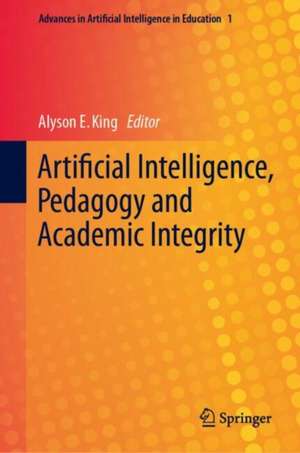
Artificial Intelligence, Pedagogy and Academic Integrity: Advances in Artificial Intelligence in Education, cartea 1
Editat de Alyson E. Kingen Limba Engleză Hardback – 3 iul 2025
Analizând bazele de date academice și noile apariții din cadrul Springer, remarcăm lansarea volumului Artificial Intelligence, Pedagogy and Academic Integrity, editat de Alyson E. King. Această lucrare marchează debutul seriei Advances in Artificial Intelligence in Education, propunând o examinare riguroasă a modului în care tehnologiile emergente redefinesc standardele de onestitate și metodă în mediul universitar. Considerăm că relevanța acestui text pentru curriculumul de formare a profesorilor rezidă în abordarea sa echilibrată: nu se limitează la posibilitățile tehnice, ci chestionează profund etica evaluării în era digitală. Structura de 184 de pagini oferă un cadru teoretic solid pentru instituțiile care caută să își actualizeze politicile interne. Subliniem că, spre deosebire de manualele pur tehnice, acest volum prioritizează dimensiunea pedagogică a integrării AI. Ca alternativă la GenAI in Higher Education de Upasana Gitanjali Singh pentru cursurile de politici educaționale, volumul de față aduce avantajul apartenenței la o serie nouă, specializată strict pe evoluția educației sub impactul inteligenței artificiale, oferind perspective proaspete asupra menținerii integrității academice fără a respinge inovația.

Preț: 980.76 lei
Preț vechi: 1196.05 lei
-18%
Carte disponibilă
Livrare economică 02-16 noiembrie
Specificații
ISBN-10: 3031925335
Pagini: 184
Dimensiuni: 160 x 241 x 16 mm
Greutate: 0.45 kg
Editura: Springer
Colecția Advances in Artificial Intelligence in Education
Seria Advances in Artificial Intelligence in Education
V-ar putea interesa
-
 Using Artificial Intelligence Absolute Beginner's GuideMichael Miller-20%Preț: 194.58 lei243.22 lei
 -
 Preț: 127.05 lei
 -
 AI in Social Studies EducationChristopher H ClarkPreț: 279.95 lei
 -
 Transforming Teaching with Generative AINick GasparPreț: 278.40 lei
 -
 Preț: 153.46 lei
 -
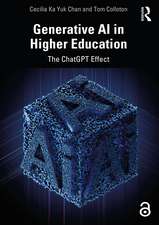 Generative AI in Higher Education: The ChatGPT EffectCecilia Ka Yuk ChanPreț: 339.90 lei
 -
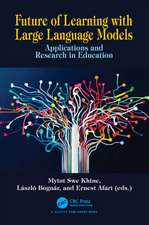 -20%Preț: 823.96 lei1029.96 lei
 -
 Preț: 380.56 lei
 -
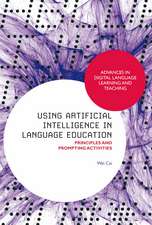 -33%Preț: 616.33 lei915.67 lei
 -
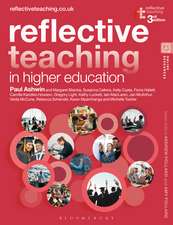 Reflective Teaching in Higher EducationCamille Kandiko Howson-14%Preț: 273.08 lei317.28 lei
 -
 -9%Preț: 113.03 lei124.79 lei
 -
 GenAI in Higher Education: Redefining Teaching and LearningDr Sam Illingworth-23%Preț: 190.69 lei246.55 lei
 -
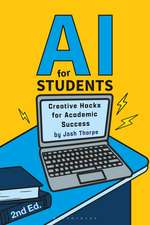 -10%Preț: 110.27 lei123.15 lei
 -
 -20%Preț: 188.02 lei235.03 lei
 -
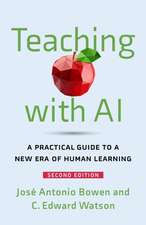 Teaching with AIJosé Antonio BowenPreț: 167.80 lei
 -
 Preț: 258.60 lei
 -
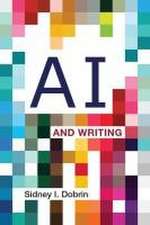 AI and WritingSidney I. Dobrin-23%Preț: 163.91 lei214.26 lei
 -
 Brave New WordsSalman KhanPreț: 92.67 lei
 -
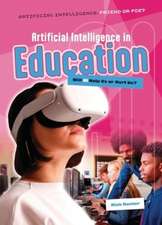 Preț: 77.59 lei
 -
 -17%Preț: 162.48 lei196.94 lei
De ce să citești această carte
Recomandăm această carte educatorilor și administratorilor universitari care doresc să înțeleagă riscurile și oportunitățile aduse de AI. Cititorul câștigă o bază teoretică pentru adaptarea metodelor de predare și evaluare, asigurându-se că standardele academice rămân intacte. Este un instrument esențial pentru elaborarea strategiilor instituționale de integritate în fața noilor tehnologii generative.