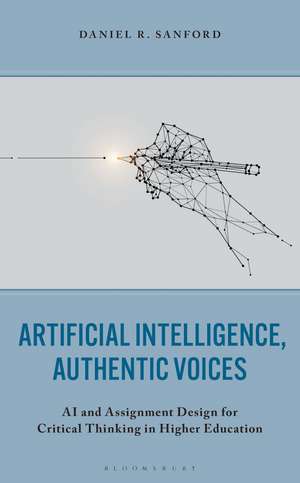
Artificial Intelligence, Authentic Voices: AI and Assignment Design for Critical Thinking in Higher Education
Autor Daniel R. Sanforden Limba Engleză Hardback – 3 apr 2027
Drawing on research in learning, assessment, and faculty development, Daniel R. Sanford argues that the central challenge posed by AI is not simply academic integrity, but the growing difficulty of using finished products as evidence of learning. When production can be automated, assignments must be designed to surface judgment, decision-making, revision, interpretation, and critical thinking.
Organized around durable cognitive practices such as reflection, analysis, argumentation, collaboration, ethics, and metacognition, this book offers practical strategies for redesigning assignments across disciplines and teaching modalities. It will help faculty make student thinking visible, cultivate authentic voice, and reconnect student work to the learning it is meant to represent.
Preț: 582.02 lei
Preț vechi: 676.77 lei
-14% Precomandă
Puncte Express: 873
Carte nepublicată încă
Livrare prin curier în România Precomanda se expediază când titlul devine disponibil.
Transport gratuit pentru acest produs Plată online sau ramburs, în funcție de opțiunile comenzii.
Retur gratuit în 14 zile Comandă securizată și suport în română.
Doresc să fiu notificat când acest titlu va fi disponibil:
Se trimite...
Specificații
ISBN-13: 9798216467021
Pagini: 224
Ilustrații: 22 textboxes
Dimensiuni: 152 x 229 mm
Editura: Bloomsbury Publishing
Colecția Bloomsbury Academic
Locul publicării:New York, United States
Pagini: 224
Ilustrații: 22 textboxes
Dimensiuni: 152 x 229 mm
Editura: Bloomsbury Publishing
Colecția Bloomsbury Academic
Locul publicării:New York, United States
Cuprins
Foreword
Introduction: The Stakes of Assignment Design in the Age of AI
Part I. Durable Skills for Individual Thinking
Chapter 1. Reflection
Chapter 2. Structure
Chapter 3. Analysis and Interpretation
Chapter 4. Argument and Evidence
Chapter 5. Revision and Iteration
Part II. Durable Skills for Social and Communal Thinking
Chapter 6. Conversation
Chapter 7. Collaboration
Chapter 8. Ethics
Chapter 9. Metacognition
Chapter 10. Futures
Conclusion: Preserving Human Thinking
Introduction: The Stakes of Assignment Design in the Age of AI
Part I. Durable Skills for Individual Thinking
Chapter 1. Reflection
Chapter 2. Structure
Chapter 3. Analysis and Interpretation
Chapter 4. Argument and Evidence
Chapter 5. Revision and Iteration
Part II. Durable Skills for Social and Communal Thinking
Chapter 6. Conversation
Chapter 7. Collaboration
Chapter 8. Ethics
Chapter 9. Metacognition
Chapter 10. Futures
Conclusion: Preserving Human Thinking
Recenzii
This is a wonderful and much-needed book on how to make learning visible again. Sanford carefully categorizes the things we really want to understand about student thinking (like reflection, analysis and argumentation) and then briefly diagnoses how we might redesign their assessment after AI has undermined so many of our old methods. He pushes past trying to detect if students did 'work' to present truly innovative new assignment designs that assess how students are considering decisions and making judgments. Clear examples of each new assignment design from a wide variety of disciplines increase in complexity as the book progresses. With clear insight and many practical solutions, this really is a book for everyone who cares about rebuilding real learning in the age of AI.
This book acknowledges the strain of teaching "under AI conditions" and unpacks some practical strategies for assessing the learning that matters: thinking process, not fluency. With examples from across the disciplines, this book will help you make student learning visible in the age of AI without surveiling them.
Sanford insightfully identifies a core challenge of AI's uptake in higher education: the inability of instructors to trust written products as evidence of student learning. Based on his experience as a writing program administrator and teacher, Sanford helpfully offers practical suggestions for how teachers can design assignments that work to redress this challenge. In his book, Sanford skillfully models deliberative contemplation of issues of AI and writing rather than rushing to easy answers. He rightly calls for responding to AI by taking it head on, engaging with it responsibly so we can demonstrate for and with students ways in which to use AI (or not) thoughtfully, productively, and ethically. The academic world needs this book right now.
This book acknowledges the strain of teaching "under AI conditions" and unpacks some practical strategies for assessing the learning that matters: thinking process, not fluency. With examples from across the disciplines, this book will help you make student learning visible in the age of AI without surveiling them.
Sanford insightfully identifies a core challenge of AI's uptake in higher education: the inability of instructors to trust written products as evidence of student learning. Based on his experience as a writing program administrator and teacher, Sanford helpfully offers practical suggestions for how teachers can design assignments that work to redress this challenge. In his book, Sanford skillfully models deliberative contemplation of issues of AI and writing rather than rushing to easy answers. He rightly calls for responding to AI by taking it head on, engaging with it responsibly so we can demonstrate for and with students ways in which to use AI (or not) thoughtfully, productively, and ethically. The academic world needs this book right now.