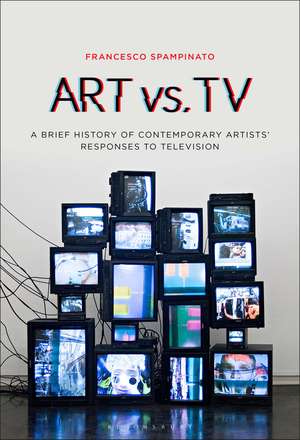
Art vs. TV: A Brief History of Contemporary Artists' Responses to Television
Autor Dr. Francesco Spampinatoen Limba Engleză Hardback – 30 dec 2021
The artists discussed belong to different generations: those that emerged in the 1960s in association with art movements such as Pop Art, Fluxus and Happening; and those appearing on the scene in the 1980s, whose work aimed at deconstructing media representation in line with postmodernist theories; to those arriving in the 2000s, an era in which, through reality shows and the Internet, anybody could potentially become a media personality; and finally those active in the 2010s, whose work reflects on how old media like television has definitively vaporized through the electronic highways of cyberspace.
These works and phenomena elicit a tension between art and television, exposing an incongruence; an impossibility not only to converge but at the very least to open up a dialogical exchange.
Preț: 649.46 lei
Preț vechi: 964.16 lei
-33%
Puncte Express: 974
Carte tipărită la comandă
Livrare economică 11-25 noiembrie
Livrare prin curier în România Termenul estimat este afișat lângă disponibilitate.
Transport gratuit pentru acest produs Plată online sau ramburs, în funcție de opțiunile comenzii.
Retur gratuit în 14 zile Comandă securizată și suport în română.
Specificații
ISBN-13: 9781501370571
ISBN-10: 150137057X
Pagini: 368
Ilustrații: 105 bw illus
Dimensiuni: 156 x 230 x 26 mm
Greutate: 0.68 kg
Editura: Bloomsbury Publishing
Colecția Bloomsbury Academic
Locul publicării:New York, United States
ISBN-10: 150137057X
Pagini: 368
Ilustrații: 105 bw illus
Dimensiuni: 156 x 230 x 26 mm
Greutate: 0.68 kg
Editura: Bloomsbury Publishing
Colecția Bloomsbury Academic
Locul publicării:New York, United States
V-ar putea interesa
-
 Making News in India: Star News and Star AnandaSomnath Batabyal-18%Preț: 1364.02 lei1663.45 lei
 -
 Building Communication Theories: A Socio/cultural ApproachFred L. CasmirPreț: 238.98 lei
 -
 Preț: 493.47 lei
 -
 Preț: 342.88 lei
 -
 Preț: 479.44 lei
 -
 Preț: 396.69 lei
 -
 -18%Preț: 1113.77 lei1358.26 lei
 -
 Race After the InternetLisa Nakamura-18%Preț: 1370.66 lei1671.54 lei
 -
 The Gender and Media ReaderMary Celeste Kearney-18%Preț: 1831.92 lei2234.05 lei
 -
 RingbearersTanya Krzywinska-23%Preț: 742.20 lei963.90 lei
 -
 Social MediaHana S Noor Al-Deen-18%Preț: 803.85 lei980.31 lei
 -
 Fear and LaughterJake ReederPreț: 104.54 lei
 -
 Responsible Drone JournalismAstrid Gynnild-15%Preț: 470.52 lei553.55 lei
 -
 Media Power in Hong Kong: Hyper-Marketized Media and Cultural ResistanceCharles Chi-wai Cheung-15%Preț: 422.92 lei497.56 lei
 -
 Prostitution Scandals in China: Policing, Media and SocietyElaine JeffreysPreț: 479.02 lei
 -
 Writing and Reporting News You Can UseTammy Trujillo-18%Preț: 1412.81 lei1722.93 lei
 -
 Trust in the World: A Philosophy of FilmJosef Früchtl-18%Preț: 1116.20 lei1361.23 lei
 -
 Preț: 300.52 lei
 -
 The World News Prism: Challenges of Digital CommunicationWilliam A. HachtenPreț: 375.18 lei
 -
 Public Participation in the Arts & the Role of TechnologyJennifer P Byrnes-26%Preț: 1165.88 lei1586.03 lei
 -
 -38%Preț: 771.37 lei1241.96 lei
 -
 Preț: 444.36 lei
 -
 Preț: 437.63 lei
 -
 Preț: 349.86 lei
Cuprins
Introduction
1. Historical and Theoretical Frameworks
2. TV as a Mirror: Manipulations, Interruptions, and Re-presentations
3. Breaking News: Television Between Art and Activism
4. Artists as Media Stars
5. Disentertainment: Music Videos, Kid Shows, Humor, and Soap Operas
6. Art in the Age of Prosumers: Reality TV and the Internet
Acknowledgements
Works Cited
Bibliography
Index
1. Historical and Theoretical Frameworks
2. TV as a Mirror: Manipulations, Interruptions, and Re-presentations
3. Breaking News: Television Between Art and Activism
4. Artists as Media Stars
5. Disentertainment: Music Videos, Kid Shows, Humor, and Soap Operas
6. Art in the Age of Prosumers: Reality TV and the Internet
Acknowledgements
Works Cited
Bibliography
Index
Recenzii
What is and does a work of art? Art can only work framed in a context where it can be seen. Traditionally, that is the museum, gallery, sometimes public space. The space, the curator, then the viewer, become co-makers. With the advent of television, art is set to work in the private sphere. This changes the work of art profoundly. This pioneering study of the relationship between art and television includes reflections on resistance, political tensions, and other ways in which art descends from its isolating pedestal and participates fully in the lives of people. Francesco Spampinato lucidly and patiently lays out what that cultural change entails for what we consider "art" to be and do.
In this exhaustive, scholarly yet entertaining book, Francesco Spampinato traces several decades of relations between art and television. Contemporary artworks dealing with the TV function as a space in which to break down the barriers between high and low culture, explore identity or question power structures. In our current times of on-demand platforms, remembering that age in which television was the center of any home appears, not as an exercise in nostalgia, but as a way to reflect on where we come from and where we are now. Contemporary art here becomes the guiding thread from which to look at ourselves in the mirror of that black screen that will give rise to many others.
In this exhaustive, scholarly yet entertaining book, Francesco Spampinato traces several decades of relations between art and television. Contemporary artworks dealing with the TV function as a space in which to break down the barriers between high and low culture, explore identity or question power structures. In our current times of on-demand platforms, remembering that age in which television was the center of any home appears, not as an exercise in nostalgia, but as a way to reflect on where we come from and where we are now. Contemporary art here becomes the guiding thread from which to look at ourselves in the mirror of that black screen that will give rise to many others.