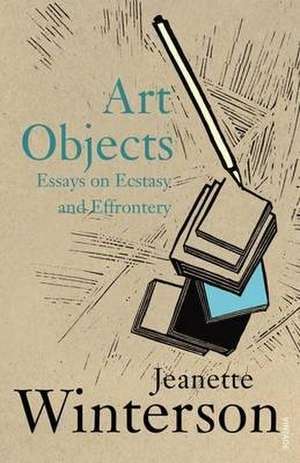
Art Objects
Autor Jeanette Wintersonen Limba Engleză Paperback – 2 mai 1996
Considerăm că volumul Art Objects reprezintă o incursiune senzorială rară în modul în care privim și interacționăm cu frumosul. Încă de la primele pagini, experimentăm o eliberare de straturile groase de prejudecăți academice; Jeanette Winterson nu se limitează la o analiză rece, ci ne invită să simțim șocul și puterea de transformare a unor opere iconice. Apreciem modul în care stilul său poetic, deja consacrat în beletristică, reușește să transforme critica de artă într-o experiență estetică în sine, unde cuvântul devine la fel de vibrant ca vopseaua pe pânză. Cele zece eseuri sunt interconectate printr-o voce urgentă și stilată, care ne provoacă să redescoperim Mona Lisa sau proza Virginiei Woolf dintr-o perspectivă surprinzătoare. Ca și volumul Essays on Art (Routledge Revivals) de A. Clutton-Brock, acest titlu pune în valoare relația dintre public și actul artistic, dar cu un accent pe nevoia viscerală, aproape fizică, de a fi mișcați de artă. În timp ce alte lucrări teoretice rămân în sfera analizei sociale, Winterson păstrează o abordare intimă. Merită menționat că această lucrare se integrează organic în opera autoarei; dacă în The Passion explora intensitatea dorinței, iar în Written on the Body descifra codurile secrete ale identității, în Art Objects ea aplică aceeași curiozitate neobosită asupra obiectului de artă ca oglindă a sufletului. Rezultatul este un ritm narativ alert, care transformă teoria artei într-o lectură provocatoare, menită să ne neliniștească și, în final, să ne exalte.
Preț: 73.68 lei
Preț vechi: 92.13 lei
-20%
Carte disponibilă
Livrare economică 05-11 noiembrie
Livrare express 16-22 octombrie pentru 35.47 lei
Specificații
ISBN-10: 0099590018
Pagini: 208
Dimensiuni: 129 x 197 x 19 mm
Greutate: 0.15 kg
Ediția:New
Editura: Vintage Publishing
Locul publicării:United Kingdom
V-ar putea interesa
-
 Ways of SeeingJohn BergerPreț: 78.02 lei
 -
 Against Interpretation and Other EssaysSusan Sontag-24%Preț: 70.57 lei93.46 lei
 -
 Selected EssaysVirginia Woolf-19%Preț: 58.54 lei72.03 lei
 -
 -27%Preț: 56.19 lei77.26 lei
 -
 Reclaiming Art in the Age of ArtificeJ. F. Martel-27%Preț: 97.88 lei133.93 lei
 -
 The Shock of the NewRobert Hughes-17%Preț: 238.67 lei286.84 lei
 -
 Art in Theory 1900 - 2000Charles HarrisonPreț: 315.11 lei
 -
 The Dehumanization of Art and Other Essays on Art, Culture, and LiteratureJosé Ortega Y. GassetPreț: 90.47 lei
 -
 Selected Essays of John BergerJohn Berger-24%Preț: 110.98 lei146.02 lei
 -
 Preț: 335.73 lei
 -
 Keeping an Eye OpenJulian BarnesPreț: 127.55 lei
 -
 -25%Preț: 85.53 lei114.64 lei
 -
 Funny WeatherOlivia Laing-39%Preț: 48.82 lei79.59 lei
 -
 How To Live An Artful LifeKaty HesselPreț: 126.12 lei
 -
 Like LoveMaggie NelsonPreț: 78.09 lei
 -
 More Joy of Art: Keys to Appreciating ArtCarolyn Schlam-17%Preț: 233.04 lei281.26 lei
 -
 Oh, to Be a Painter!Virginia Woolf-21%Preț: 66.73 lei84.29 lei
 -
 The Art of FictionVirginia WoolfPreț: 37.31 lei
 -
 Towards the Ethical Art MuseumGareth HarrisPreț: 161.52 lei
 -
 Theory & PracticeMichelle de Kretser-17%Preț: 78.02 lei94.15 lei
De ce să citești această carte
Recomandăm această carte cititorilor care doresc să privească dincolo de etichetele muzeale. Veți câștiga o nouă perspectivă asupra modului în care arta vă poate transforma viața cotidiană. Este un volum esențial pentru cei care apreciază scriitura de o frumusețe rară a lui Jeanette Winterson și care caută un ghid pasional în descifrarea marilor opere ale lumii, de la pictură la literatura modernistă.
Despre autor
Jeanette Winterson este o figură centrală a literaturii britanice contemporane, distinsă cu titlurile de Ofițer și Comandant al Ordinului Imperiului Britanic pentru contribuțiile sale remarcabile. A devenit celebră odată cu romanul semi-autobiografic „Portocalele nu sunt singurul fruct”, premiat cu Whitbread Prize, și a continuat să exploreze teme complexe legate de identitate, gen și relația dintre oameni și tehnologie. Stilul său, descris adesea ca fiind „nebun de poetic”, i-a adus numeroase distincții, inclusiv premiile BAFTA, John Llewellyn Rhys și Lambda. Winterson este recunoscută pentru capacitatea de a îmbina rigoarea intelectuală cu o sensibilitate emoțională profundă.
Descriere
Recenzii
"Thrilling, persuasive, challenging and written with a skill and beauty entirely shorn of artifice...Should be bought, read, re-read and read out loud as often as possible." —The Edmonton Journal
"Brilliant essays, the finest I=ve read in years, a wonderful, timely endorsement of what art is and what it isn't. In 10 separate ways, from 10 different angles, she takes clear, intelligent aim at the modern wish that art be less arty, and more entertaining; that art be easier for people to chew and quickly digest...Should be required reading." —The Ottawa Citizen
"It is invigorating to read these essays by a woman who believes in art, full stop." —The Globe and Mail
"A delight...I find Winterson an invigorating critic, as well as an exhilarating literary soul mate...At a time when literary commentary is bogged down by dense, impenetrable post-modern and post-structuralist twaddle, Art Objects...offers itself as a breath of fresh thought and fresh expression." —Kitchener-Waterloo Record
"Brilliant, challenging, funny, highly personal." —Family Practice
"A witty, reasoned look at the power of, and our powerful need for, all forms of art." —The Ottawa Citizen
"A book of essays to set your intellect on fire." Bruce Powe, The Financial Post
"Potent.... Part soulful meditation and part fiery manifesto.... Ms. Winterson is a passionate writer.... Hers is a book born of a restless, uncompromising intelligence and a life of practicing what she preaches, of taking the kind of artistic risks she so fiercely espouses." —The New York Times Book Review
"Winterson is in fine form in these essays about art, arguing, admonishing, infuriating, teasing...She fights solemnly, beguilingly, for ecstasy and silence and the revival of our ability to contemplate...She says much that is important about energy and passion. Her stalwart defence of the modern is a challenge to the barrenness and niggliness with which we live." —The Observer, U.K.
"There is no denying the beauty and precision of her writing, nor the clarity of her expression...On her heroines — Stein, Woolf, Eliot, books themselves — she is particularly strong and passionate. Through it all, a central theme occurs: that art, true art, is and will remain a vital force, without which life is scarcely worthy of the name." —Time Out, U.K.
Extras
Millions! The viewer does not see the colours on the canvas, he sees the colour of the money.
Is the painting famous? Yes! Think of all the people who have carefully spared one minute of their lives to stand in front of it.
Is the painting Authority? Does the guide-book tell us that it is part of The Canon? If Yes, then half of the viewers will admire it on principle, while the other half will dismiss it on principle.
Who painted it? What do we know about his/her sexual practices and have we seen anything about them on the television? If not, the museum will likely have a video full of schoolboy facts and tabloid gossip.
Where is the tea-room/toilet/gift shop?
Where is the painting in any of this?
Experiencing paintings as moving pictures, out of context, disconnected, jostled, over-literary, with their endless accompanying explanations, over-crowded, one against the other, room on room, does not make it easy to fall in love. Love takes time. It may be that if you have as much difficulty with museums as I do, that the only way into the strange life of pictures is to expose yourself to as much contemporary art as you can until you find something, anything, that you will go back and back to see again, and even make great sacrifices to buy. Inevitably, if you start to even make great sacrifices to buy. Inevitably, if you start to love pictures, you will start to buy pictures. The time, like the money, can be found, and those who call the whole business élitist, might be fair enough to reckon up the time they spend in front of the television, at the DIY store, and how much the latest satellite equipment and new PC has cost.
For myself, now that paintings matter, public galleries are much less dispiriting. I have learned to ignore everything about them, except for the one or two pieces with whom I have come to spend the afternoon.
Supposing we made a pact with a painting and agreed to sit down and look at it, on our own with no distractions, for one hour. The painting should be an original, not a reproduction, and we should start with the advantage of liking it, even if only a little. What would we find?
Increasing discomfort. When was the last time you looked at anything, solely, and concentratedly, and for its own sake? Ordinary life passes in a near blur. If we go to the theatre or the cinema, the images before us change constantly, and there is the distraction of language. Our loved ones are so well known to us that there is no need to look at them, and one of the gentle jokes of married life is that we do not. Nevertheless, here is a painting and we have agreed to look at it for one hour. We find we are not very good at looking.
Increasing distraction. Is my mind wandering to the day's work, to the football match, to what's for dinner, to sex, to whatever it is that will give me something to do other than to look at the painting?
Increasing invention. After some time spent daydreaming, the guilty or the dutiful might wrench back their attention to the picture.
What is it about? Is it a landscape? Is it figurative? More promisingly, is it a nude? If the picture seems to offer an escape route then this is the moment to take it. I can make up stories about the characters on the canvas much as art-historians like to identify the people in Rembrandt's The Night Watch. Now I am beginning to feel much more confident because I am truly engaging with the picture. A picture is its subject matter isn't it? Oh dear, mine's an abstract. Never mind, would that pink suit me?
Increasing irritation. Why doesn't the picture do something? Why is it hanging there staring at me? What is this picture for? Pictures should give pleasure but this picture is making me very cross. Why should I admire it? Quite clearly it doesn't admire me...
Admire me is the sub-text of so much of our looking; the demand put on art that it should reflect the reality of the viewer. The true painting, in its stubborn independence, cannot do this, except coincidentally. Its reality is imaginative not mundane.
When the thick curtain of protection is taken away; protection of prejudice, protection of authority, protection of trivia, even the most familiar of paintings can begin to work its power. There are very few people who could manage an hour alone with the Mona Lisa.
But our poor art-lover in his aesthetic laboratory has not succeeded in freeing himself from the protection of assumption. What he has found is that the painting objects to his lack of concentration; his failure to meet intensity with intensity. He still has not discovered anything about him. He is inadequate and the painting has told him so.
It is not as hopeless as it seems. If I can be persuaded to make the experiment again (and again and again), something very different might occur after the first shock of finding out that I do not know how to look at pictures, let alone how to like them.
A favourite writer of mine, an American, an animal trainer, a Yale philosopher, Vicki Hearne, has written of the acute awkwardness and embarrassment of those who work with magnificent animals, and find themselves at a moment of reckoning, summed up in those deep and difficult eyes and for many the gaze is too insistent. Better to pretend that art is dumb, or at least has nothing to say that makes sense to us. If art, all art, is concerned with truth, then a society in denial will not find much in use for it.
In the West, we avoid painful encounters with art by trivialising it, or by familiarising it. Our present obsession with the past has the double advantage of making new work seem raw and rough compared to the cosy patina of tradition, whilst refusing tradition its vital connection to what is happening now. By making islands of separation out of the unbreakable chain of human creativity, we are able to set up false comparisons, false expectations, all the while lamenting that the music, poetry, painting, prose, performance art of Now, fails to live up to the art of Then, which is why, we say, it does not affect us. In fact, we are no more moved by a past we are busy inventing, than by a present we are busy denying. If you love a Cézanne, you can love a Hockney, can love a Boyd, can love a Rao. If you love a Cézanne rather than lip-service it.