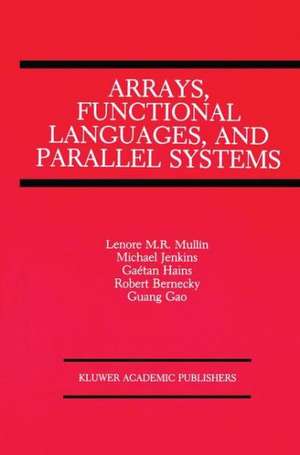
Arrays, Functional Languages, and Parallel Systems
Editat de Lenore M. Restifo Mullinen Limba Engleză Hardback – 31 oct 1991
Preț: 1026.08 lei
Preț vechi: 1282.61 lei
-20%
Puncte Express: 1539
Carte tipărită la comandă
Livrare economică 08-22 decembrie
Livrare prin curier în România Termenul estimat este afișat lângă disponibilitate.
Transport gratuit pentru acest produs Plată online sau ramburs, în funcție de opțiunile comenzii.
Retur gratuit în 14 zile Comandă securizată și suport în română.
Specificații
ISBN-13: 9780792392132
ISBN-10: 0792392132
Pagini: 336
Ilustrații: XI, 319 p.
Dimensiuni: 160 x 241 x 23 mm
Greutate: 0.62 kg
Ediția:1991
Editura: Springer
Locul publicării:New York, NY, United States
ISBN-10: 0792392132
Pagini: 336
Ilustrații: XI, 319 p.
Dimensiuni: 160 x 241 x 23 mm
Greutate: 0.62 kg
Ediția:1991
Editura: Springer
Locul publicării:New York, NY, United States
V-ar putea interesa
-
 -28%Preț: 429.77 lei597.47 lei
 -
 Programming for Hybrid Multi/Manycore MPP SystemsJohn Levesque-20%Preț: 404.16 lei505.21 lei
 -
 Essentials of Computer ArchitectureDouglas Comer-20%Preț: 370.93 lei463.66 lei
 -
 -20%Preț: 373.79 lei467.24 lei
 -
 Prisons After Woolf: Reform through RiotElaine Player-18%Preț: 1289.65 lei1572.75 lei
 -
 The ZX Spectrum UlaChristopher David Smith-20%Preț: 246.85 lei308.57 lei
 -
 Digital Logic DesignGuy Even-20%Preț: 448.30 lei560.37 lei
 -
 Comp Arch Security CWang-9%Preț: 806.13 lei885.86 lei
 -
 Vision Architectures CHong Jeong-20%Preț: 899.94 lei1124.93 lei
 -
 Enterprise Content and Search Management for Building Digital PlatformsShailesh Kumar Shivakumar-20%Preț: 528.34 lei660.43 lei
 -
 -20%Preț: 674.17 lei842.71 lei
 -
 Multiscalar ProcessorsManoj Franklin-20%Preț: 669.51 lei836.88 lei
 -
 High Performance Computing Systems and ApplicationsRobert D Kent-20%Preț: 1035.24 lei1294.05 lei
 -
 Parallel Programming and CompilersConstantine D. Polychronopoulos-20%Preț: 319.75 lei399.68 lei
 -
 -20%Preț: 949.76 lei1187.20 lei
 -
 Memory Storage Patterns in Parallel ProcessingMary E. Mace-20%Preț: 315.04 lei393.81 lei
 -
 Defect and Fault Tolerance in VLSI SystemsIsrael Koren-20%Preț: 658.80 lei823.50 lei
 -
 -20%Preț: 315.34 lei394.17 lei
 -
 CoCo: The Colorful History of Tandy’s Underdog ComputerBoisy G Pitre-20%Preț: 389.74 lei487.18 lei
 -
 High Performance Computing Systems and ApplicationsAndrew Pollard-20%Preț: 962.76 lei1203.45 lei
 -
 Reconfigurable Multipipeline Computing StructuresIgor A Kalyaev-35%Preț: 1171.03 lei1811.74 lei
 -
 Transformation of Collective IntelligencesJean-Max Noyer-20%Preț: 959.44 lei1199.30 lei
 -
 System ArchitectureWolfgang J. Paul-20%Preț: 362.83 lei453.53 lei
 -
 Network and Parallel ComputingGuang R. Gao-20%Preț: 330.98 lei413.72 lei
 -
 -20%Preț: 328.16 lei410.20 lei
 -
 Decision Theory with Imperfect InformationRafik A. Aliev-20%Preț: 992.33 lei1240.41 lei
Public țintă
ResearchDescriere
During a meeting in Toronto last winter, Mike Jenkins, Bob Bernecky and I were discussing how the two existing theories on arrays influenced or were in fluenced by programming languages and systems. More's Army Theory was the basis for NIAL and APL2 and Mullin's A Mathematics of A rmys(MOA) , is being used as an algebra of arrays in functional and A-calculus based pro gramming languages. MOA was influenced by Iverson's initial and extended algebra, the foundations for APL and J respectively. We discussed that there is a lot of interest in the Computer Science and Engineering communities concerning formal methods for languages that could support massively parallel operations in scientific computing, a back to-roots interest for both Mike and myself. Languages for this domain can no longer be informally developed since it is necessary to map languages easily to many multiprocessor architectures. Software systems intended for parallel computation require a formal basis so that modifications can be done with relative ease while ensuring integrity in design. List based lan guages are profiting from theoretical foundations such as the Bird-Meertens formalism. Their theory has been successfully used to describe list based parallel algorithms across many classes of architectures.
Cuprins
1 Arrays and the Lambda Calculus.- 2 Compiling APL.- 3 Acorn Run-Time System for the CM-2.- 4 Compiling Issues of Monolithic Arrays.- 5 Arrays in Sisal.- 6 Falafel: Arrays in a Functional Language.- 7 Arrays in Haskell.- 8 Array Theory and Knowledge Representation.- 9 A Parallel Intermediate Representation Based on Lambda Expressions.- 10 Arrays in Fidil.- 11 Structured Data-Types in the Reduction System ?-RED.- 12 Psi, The Indexing Function: A Basis for FFP with Arrays.- 13 Genotype-A Pure Functional Array Language.- 14 A Comparison of Array Theory and A Mathematics of Arrays.- 15 Alternative Evaluation of Array Expressions.- 16 Matrix Inverion in 3 Dimensions.- 17 Fuzzy Inference Using Array Theory and Nial.