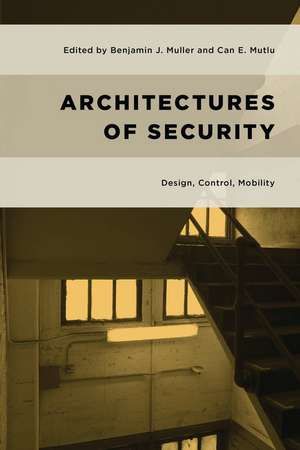
Architectures of Security: Design, Control, Mobility: Geopolitical Bodies, Material Worlds
Editat de Benjamin J. Muller, Can E. Mutluen Limba Engleză Hardback – 18 noi 2024

Preț: 597.68 lei
Preț vechi: 895.66 lei
-33%
Puncte Express: 897
Preț estimativ în valută:
105.71€ • 123.58$ • 91.90£
105.71€ • 123.58$ • 91.90£
Carte tipărită la comandă
Livrare economică 07-21 martie
Specificații
ISBN-13: 9781786612229
ISBN-10: 1786612224
Pagini: 184
Ilustrații: 1 BW Illustration
Dimensiuni: 148 x 152 x 18 mm
Greutate: 0.86 kg
Editura: Bloomsbury Publishing
Colecția Rowman & Littlefield Publishers
Seria Geopolitical Bodies, Material Worlds
Locul publicării:New York, United States
ISBN-10: 1786612224
Pagini: 184
Ilustrații: 1 BW Illustration
Dimensiuni: 148 x 152 x 18 mm
Greutate: 0.86 kg
Editura: Bloomsbury Publishing
Colecția Rowman & Littlefield Publishers
Seria Geopolitical Bodies, Material Worlds
Locul publicării:New York, United States
Cuprins
1. Benjamin Muller and Can E. Mutlu, Introduction: Architecture and Security
Part I: Design, and Security
2. Natalie Rowe, View as Narrative: The Built Environment as a Social Model for Individuals with Dementia
3. Can E. Mutlu, Aesthetics of Security: (Re)designing the Sandy Hook School Building
4. Mahdi Tourage, Curated Memory: Notes on Toronto's Agha Khan Museum
Part II: Control and Security
5. Adam Nowek, An Architecture of Control: Spatial and Digital Methods of Social Sorting in the Dutch Built Environment
6. Miguel de Larrinaga, The Spaces of Teargas and Contentious Politics
7. Leopold Lambert, The Politics of the Bulldozer
8. Thomas N. Cooke, Security, Circulation and Noise in Pearson International Airport
Part III: Border Security and Mobility
9. Jennifer Mustapha, Border security legislation and the construction of uncertain spaces: the case of Bill C-23
10. Benjamin Muller, iBorders: Beautiful and Ferocious Architecture at the Canada/US Border
11. Daniela Johannes, Transborder Immigrant Tool: Re-structuring U.S.-Mexico Border Assemblages
12. Afterword by Ronald Rael or Eyal Weizman - TBC
Contributors Notes
Glossary of terms
Part I: Design, and Security
2. Natalie Rowe, View as Narrative: The Built Environment as a Social Model for Individuals with Dementia
3. Can E. Mutlu, Aesthetics of Security: (Re)designing the Sandy Hook School Building
4. Mahdi Tourage, Curated Memory: Notes on Toronto's Agha Khan Museum
Part II: Control and Security
5. Adam Nowek, An Architecture of Control: Spatial and Digital Methods of Social Sorting in the Dutch Built Environment
6. Miguel de Larrinaga, The Spaces of Teargas and Contentious Politics
7. Leopold Lambert, The Politics of the Bulldozer
8. Thomas N. Cooke, Security, Circulation and Noise in Pearson International Airport
Part III: Border Security and Mobility
9. Jennifer Mustapha, Border security legislation and the construction of uncertain spaces: the case of Bill C-23
10. Benjamin Muller, iBorders: Beautiful and Ferocious Architecture at the Canada/US Border
11. Daniela Johannes, Transborder Immigrant Tool: Re-structuring U.S.-Mexico Border Assemblages
12. Afterword by Ronald Rael or Eyal Weizman - TBC
Contributors Notes
Glossary of terms
Recenzii
Pushing the boundaries of critical geopolitics, architecture, design, and international politics, Muller and Mutlu's inventive and diverse collection brings a sharp and necessary focus on the border between aesthetics and control to understand how spaces, structures, and systems make the strange dangerous and the familiar seem safe. Architectures of Security is an important contribution to a series debates in critical international relations, critical security studies, human and cultural geography about infrastructure, affect, and control.
Architectures of Security is a much-needed examination of how violence unfolds through seemingly banal formations - in buildings, machines, atmospheres, and databases. It does the very difficult - but very necessary - work of exposing how the material world often enables exclusion, dispossession, and brutality. What really makes Architectures of Security stand out is the scope of its analysis: it traces the pernicious reach of materialised security in explicit sites such as airports and borders, but also shows its less obvious manifestations in places like schools, dementia wards, and museums. This book is an important articulation of these connections and starts a number of significant conversations about the unexpected fusions between architecture and security.
Security. Violence. Exclusion. Oppression. Trauma. Death. How are these phenomena designed into the architecture of every aspect of our lives today? Architectures of Security answers this question through an exceptional boundary-pushing multidisciplinary foray into how security is materially, aesthetically, and technically built-in to the world. In doing so, it not only guides us to a profound novel understanding of the status quo of security politics, but equally opens crucial new avenues for understanding the future of that politics.
Architectures of Security is a much-needed examination of how violence unfolds through seemingly banal formations - in buildings, machines, atmospheres, and databases. It does the very difficult - but very necessary - work of exposing how the material world often enables exclusion, dispossession, and brutality. What really makes Architectures of Security stand out is the scope of its analysis: it traces the pernicious reach of materialised security in explicit sites such as airports and borders, but also shows its less obvious manifestations in places like schools, dementia wards, and museums. This book is an important articulation of these connections and starts a number of significant conversations about the unexpected fusions between architecture and security.
Security. Violence. Exclusion. Oppression. Trauma. Death. How are these phenomena designed into the architecture of every aspect of our lives today? Architectures of Security answers this question through an exceptional boundary-pushing multidisciplinary foray into how security is materially, aesthetically, and technically built-in to the world. In doing so, it not only guides us to a profound novel understanding of the status quo of security politics, but equally opens crucial new avenues for understanding the future of that politics.