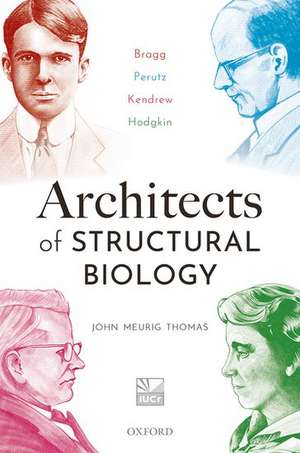
Architects of Structural Biology: Bragg, Perutz, Kendrew, Hodgkin
Autor John Meurig Thomasen Limba Engleză Hardback – 28 feb 2020
Evoluția biologiei moleculare în secolul XX a marcat trecerea de la observația descriptivă la înțelegerea mecanismelor vieții la nivel atomic. În volumul Architects of Structural Biology, autorul John Meurig Thomas documentează această transformare radicală prin prisma vieților și carierelor a patru figuri monumentale: Lawrence Bragg, Max Perutz, John Kendrew și Dorothy Hodgkin. Apreciem modul în care textul depășește formatul unei simple biografii colective, devenind o istorie intelectuală a modului în care chimia și fizica au fuzionat pentru a descifra structura proteinelor și a cristalografiei cu raze X.
Merită menționat că autorul utilizează experiența sa directă la conducerea unor instituții de elită pentru a ilustra atmosfera din Laboratorul de Biologie Moleculară (LMB) din Cambridge. Această ediție de la OUP OXFORD se distinge prin bogăția materialului vizual, oferind peste 130 de ilustrații care clarifică progresele științifice fără a recurge la un jargon impenetrabil. Lucrarea funcționează ca o alternativă la Designs for Life de Soraya de Chadarevian pentru cursurile de istoria științei sau biologie moleculară, având avantajul unei perspective interne, subiective, care pune accent pe „devotamentul neclintit” al cercetătorilor mai degrabă decât pe analiza instituțională pură.
În contextul operei sale, această carte completează preocupările autorului pentru istoria instituțiilor de cercetare, temă abordată și în Albemarle Street, dar se distanțează de lucrările sale strict tehnice, precum cele despre catalizatori, oferind o lectură accesibilă despre „epoca de aur” a descoperirilor care au revoluționat medicina modernă.
Preț: 367.99 lei
Preț vechi: 417.12 lei
-12%
Carte disponibilă
Livrare economică 15-20 mai
Specificații
ISBN-10: 0198854501
Pagini: 322
Ilustrații: 45 grayscale and 36 color line figures, and 38 grayscale and 19 color halftone figures
Dimensiuni: 162 x 241 x 21 mm
Greutate: 0.67 kg
Editura: OUP OXFORD
Colecția OUP Oxford
Locul publicării:Oxford, United Kingdom
V-ar putea interesa
-
 The Boundless DeepRichard HolmesPreț: 185.57 lei
 -
 Molecules: A Very Short IntroductionPhilip Ball-21%Preț: 53.51 lei67.81 lei
 -
 -13%Preț: 266.71 lei306.53 lei
 -
 -19%Preț: 509.35 lei628.83 lei
 -
 Crystallography: A Very Short IntroductionA. M. Glazer-22%Preț: 52.49 lei67.20 lei
 -
 -17%Preț: 145.78 lei175.40 lei
 -
 Molecular Biology: Principles of Genome FunctionNancy Craig-20%Preț: 487.22 lei607.56 lei
 -
 Preț: 89.20 lei
 -
 -27%Preț: 64.78 lei89.24 lei
 -
 Cambridge Scientific MindsPeter HarmanPreț: 305.22 lei
 -
 The Double HelixDr James Watson-28%Preț: 49.36 lei68.36 lei
 -
 HubrisJohannes KrausePreț: 160.43 lei
 -
 Breaking ThroughKatalin KarikóPreț: 89.00 lei
 -
 Crick: A Mind in Motion – from DNA to the BrainProfessor Matthew Cobb-19%Preț: 181.71 lei223.38 lei
 -
 The Scientist Who Wasn't ThereJoanne BriggsPreț: 138.34 lei
 -
 Against the OddsMary GribbinPreț: 103.01 lei
 -
 The Historic Heart of Oxford UniversityGeoffrey TyackPreț: 303.20 lei
 -
 -20%Preț: 71.74 lei89.47 lei
 -
 -16%Preț: 131.17 lei156.79 lei
 -
 A Short History of CambridgeRichard TamesPreț: 76.19 lei
De ce să citești această carte
Recomandăm această carte studenților și profesioniștilor din domeniul științelor vieții care doresc să înțeleagă rădăcinile disciplinei lor. Cititorul câștigă o perspectivă rară asupra modului în care colaborarea interdisciplinară și mediul academic de elită din Cambridge au facilitat descoperiri premiate cu Nobel. Este un omagiu adus rigoarei științifice, esențial pentru oricine este interesat de istoria ideilor care au dus la tratamentele medicale de astăzi.
Despre autor
Sir John Meurig Thomas a fost un distins chimist britanic și educator, recunoscut pentru contribuțiile sale fundamentale în chimia stării solide și cataliza eterogenă. A ocupat poziții academice de prestigiu, fiind Director al Royal Institution din Marea Britanie și Master al colegiului Peterhouse de la Universitatea din Cambridge. Experiența sa în fruntea acestor instituții istorice îi conferă autoritatea necesară pentru a scrie despre arhitecții biologiei structurale, îmbinând expertiza științifică cu o cunoaștere profundă a contextului universitar britanic, reflectată și în volumul său de lucrări selectate.
Descriere
Recenzii
a fascinating behind-the-scenes journey of the early years of structural biology . . . The real insight of this book is not so much the stories of the four cited pioneers, but their interactions with a wide cast of people who founded the field. The commentary on different leadership styles is very acute, as well as the respectful telling of some of the personality clashes and rivalries that developed. This would be an excellent read for those who are beginning to specialise in structural biology, and those with a love of the history of crystallography.
beautifully written and illustrated . . . The science is clearly explained, without too much complex jargon. [Architects of Structural Biology] is a superb chronicle of an extraordinary era of scientific and medical advances
[John Meurig Thomas'] insight due to the close connections to the main people in the book gives a valuable perspective on how it was possible for an activity that began in a shed at a parking lot to develop into a world-leading laboratory . . . [he] makes some remarkable observations
For historians and philosophers of science, this book renews the debate of whether the personalities, teaching styles, and institutional support are as significant as the ideas, experiments, and publications that result from the untidy, often contradictory, ways in which they are generated. As I read this volume, I delighted in the amount of sharing and enthusiasm even rivals had for each other's work...
A superb exposition of many inter-related topics. The author is very articulate with a great talent for explaining in an approachable, perceptive and jargon-free manner the insights, interactions and key milestones. The book will be a popular, accessible portal into the hidden depths of molecular and biological structure as revealed during the last century.
This is a landmark book on the lives and work of four brilliant Nobel Prize-winning scientists, and many of their colleagues, whose pioneering research on structural biology has transformed modern medicine. [...] It should be read by a wide range of scientists, from pre-university students to professors and directors of research institutes. If you can only read one scientific book this year, read this one.
Biomedical research -- elucidating the chemistry of life - is now a massive enterprise. This book focuses on some key pioneering stages, when a conjunction of individuals initiated huge advances, through insight, instrumental skill and determination. [...] This superbly-written celebration of some great scientists and their achievements deserves wide readership.
[John Meurig Thomas'] vivid profiles ... illumine the field of structural biology and help explain how the Laboratory of Molecular Biology became one of the most successful and influential scientific establishments ever.
Sir John has extraordinary aptitude for writing as well as for pursuing adventurous scientific studies. [...] The topic is indeed timely. Other books have bits and pieces but Sir John has brought together a saga of monumental discoveries. The book will inspire many young scientists and intrigue a wide readership.
The book is beautifully written and illustrated...This book is a history of the glory days of advances in molecular biology of the last century. The science is clearly explained, without too much complex jargon. It is a superb chronicle of an extraordinary era of scientific and medical advances made by scientists of outstanding talent, to whom we remain indebted.