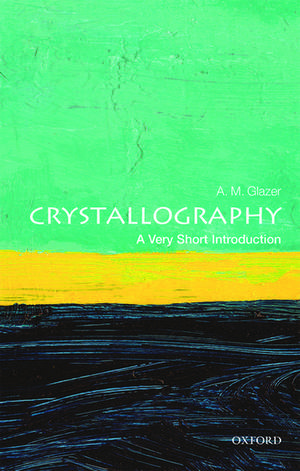
Crystallography: A Very Short Introduction: Very Short Introductions
Autor A. M. Glazeren Limba Engleză Paperback – 24 mar 2016
Apreciem în acest volum de tip introducere modul în care A. M. Glazer reușește să ancoreze o disciplină tehnică în aplicabilitatea sa cotidiană imediată, transformând cristalografia dintr-o curiozitate despre simetria mineralelor într-un pilon al industriei farmaceutice și al biologiei moleculare. Descoperim aici o perspectivă clară asupra modului în care difracția de raze X, metodă inițiată de familia Bragg acum mai bine de un secol, a devenit astăzi un instrument de rutină capabil să determine poziția a zeci de mii de atomi într-un singur cristal. Remarcăm structura echilibrată a cărții, care nu se rezumă la istorie, ci explică mecanismele prin care înțelegerea aranjamentelor atomice a facilitat progresele în genetică, studiul virusurilor și crearea de noi materiale performante.
Textul este remarcabil de fluid, beneficiind de un ton care îmbină rigoarea academică cu o notă discretă de umor, aspect susținut de cele 41 de diagrame și ilustrații care clarifică concepte spațiale complexe. Cartea este comparabilă cu Early Days of X-ray Crystallography de André Authier în ceea ce privește precizia istorică, dar este actualizată pentru a include tehnologii de ultimă oră, precum microscopia electronică avansată și utilizarea fluxurilor de neutroni. În contextul operei autorului, acest volum din seria Very Short Introductions servește drept punct de intrare accesibil către lucrările sale mai tehnice, precum A Journey into Reciprocal Space, unde A. M. Glazer aprofundează fizica stării solide. Rezultatul este un ghid esențial pentru oricine dorește să înțeleagă arhitectura invizibilă a lumii materiale.
Din seria Very Short Introductions
-
 Preț: 52.51 lei
 -
 Preț: 52.05 lei
 -
 Preț: 45.30 lei
 -
 Preț: 51.05 lei
 - 5%
 Preț: 64.72 lei
 -
 Preț: 51.23 lei
 -
 Preț: 64.74 lei
 -
 Preț: 51.74 lei
 - 20%
 Preț: 57.26 lei
 - 20%
 Preț: 56.92 lei
 - 20%
 Preț: 55.70 lei
 - 19%
 Preț: 57.35 lei
 - 19%
 Preț: 57.65 lei
 - 20%
 Preț: 57.15 lei
 - 20%
 Preț: 57.28 lei
 - 19%
 Preț: 57.62 lei
 - 20%
 Preț: 57.26 lei
 - 20%
 Preț: 56.97 lei
 - 19%
 Preț: 57.85 lei
 - 19%
 Preț: 57.46 lei
 - 20%
 Preț: 57.26 lei
 - 21%
 Preț: 54.82 lei
 - 20%
 Preț: 57.32 lei
 - 20%
 Preț: 56.65 lei
 - 20%
 Preț: 57.15 lei
 - 32%
 Preț: 48.58 lei
 - 20%
 Preț: 57.15 lei
 - 20%
 Preț: 57.15 lei
 - 20%
 Preț: 57.15 lei
 - 19%
 Preț: 57.46 lei
 - 20%
 Preț: 57.12 lei
 - 19%
 Preț: 57.35 lei
 - 20%
 Preț: 57.26 lei
 - 21%
 Preț: 55.39 lei
 - 20%
 Preț: 57.12 lei
 - 20%
 Preț: 57.15 lei
 - 19%
 Preț: 57.73 lei
 - 20%
 Preț: 56.73 lei
 - 20%
 Preț: 56.42 lei
 - 19%
 Preț: 57.65 lei
 - 20%
 Preț: 56.47 lei
 - 19%
 Preț: 57.73 lei
 - 20%
 Preț: 56.97 lei
 -
 Preț: 68.81 lei
 - 19%
 Preț: 57.70 lei
 - 19%
 Preț: 57.46 lei
 - 20%
 Preț: 57.26 lei
 - 19%
 Preț: 57.82 lei
 - 19%
 Preț: 57.85 lei
 - 20%
 Preț: 57.12 lei
Preț: 56.15 lei
Preț vechi: 70.53 lei
-20%
Carte disponibilă
Livrare economică 06-11 noiembrie
Livrare express 22-28 octombrie pentru 28.63 lei
Specificații
ISBN-10: 0198717598
Pagini: 176
Ilustrații: 41 black and white halftones and diagrams
Dimensiuni: 111 x 174 x 9 mm
Greutate: 0.09 kg
Editura: OUP OXFORD
Colecția OUP Oxford
Seria Very Short Introductions
Locul publicării:Oxford, United Kingdom
V-ar putea interesa
-
 Molecules: A Very Short IntroductionPhilip Ball-19%Preț: 57.62 lei71.42 lei
 -
 Human PhysiologyGillian Pocock-14%Preț: 632.30 lei737.32 lei
 -
 Early Days of X-ray CrystallographyAndré Authier-11%Preț: 313.06 lei352.31 lei
 -
 -16%Preț: 159.13 lei189.44 lei
 -
 Architects of Structural Biology: Bragg, Perutz, Kendrew, HodgkinJohn Meurig Thomas-21%Preț: 364.54 lei459.43 lei
 -
 -31%Preț: 390.55 lei567.01 lei
 -
 -28%Preț: 425.51 lei588.69 lei
 -
 -10%Preț: 142.35 lei158.92 lei
 -
 -14%Preț: 135.69 lei158.70 lei
 -
 -12%Preț: 136.03 lei155.16 leiRecomandat
 -
 -16%Preț: 80.13 lei95.94 lei
 -
 Introduction to CrystallographyDonald E. Sands-21%Preț: 115.27 lei145.64 lei
 -
 -9%Preț: 1170.57 lei1286.35 lei
 -
 From Atoms to PatternsLesley JacksonPreț: 165.95 lei
 -
 X-rayNicole Lobdell-33%Preț: 50.70 lei75.20 lei
 -
 CrystallographyChristian BokPreț: 99.44 lei
 -
 CrystalsRebecca Pettiford-12%Preț: 60.08 lei67.92 lei
 -
 -26%Preț: 1222.01 lei1662.48 lei
 -
 -19%Preț: 75.97 lei93.44 lei
 -
 Science of Crystal StructuresIstvan Hargittai-15%Preț: 691.02 lei812.96 lei
De ce să citești această carte
Recomandăm această carte studenților la chimie, biologie sau fizică, dar și curioșilor care vor să înțeleagă cum se „văd” moleculele. Cititorul câștigă o viziune de ansamblu asupra unei științe care stă la baza dezvoltării noilor medicamente. Este un motiv concret de a o cumpăra dacă doriți o introducere rapidă, de buzunar, care explică legătura dintre structura microscopică a cristalelor și marile descoperiri din genetica modernă.
Despre autor
A. M. Glazer este profesor emerit în cadrul Clarendon Laboratory și Fellow al Jesus College la Universitatea din Oxford. Expertiza sa se concentrează pe fizica stării solide și cristalografie, fiind recunoscut pentru capacitatea de a explica fenomene complexe precum spațiul reciproc sau difracția. Activitatea sa academică de decenii la Oxford și implicarea în cercetarea materialelor îi conferă o autoritate deosebită, reușind în această lucrare să sintetizeze un secol de progrese științifice pentru un public larg, fără a sacrifica acuratețea datelor.
Descriere
Recenzii
The merits of this book are that it is extremely concise and compact, yet precise and complete; it is written in a very pleasant and clear way; and it mixes history, anecdotes, theory and examples in a well-blended recipe. It is easy to read and the concepts flow naturally, and you arrive to the end with the impression of a birds eye view on all what you need to know about crystallography.
This book is an excellent account of the science behind the study and understanding of crystals.
Explaining in 144 pages just what crystallography is, how it originated and developed, and in what fields it has been put to use, this new VSI volume superbly embodies the purpose of the Very Short Introductions series.
for anyone layperson or technicianwho would like to know what crystallography is all about, this is the book to read.
The author of this book should write so many more books, what a good read! The illustrations were informative and clear and the writing was not only informative, but there was also a distinct sense of humor. I would highly recommend this to anyone working with or interested in crystallography or XRD.
Notă biografică
Cuprins
- Preface
- A long history!
- Symmetry
- Crystal structures
- Diffraction
- Seeing atoms
- Sources of radiation
- Further Reading
- Index