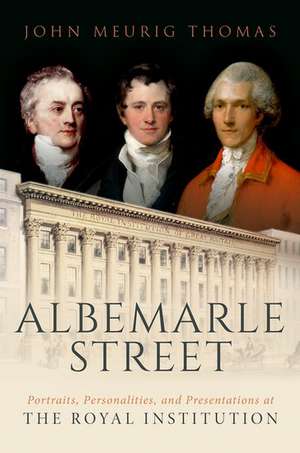
Albemarle Street: Portraits, Personalities and Presentations at The Royal Institution
Autor John Meurig Thomasen Limba Engleză Hardback – 5 oct 2021
Preț: 293.17 lei
Preț vechi: 334.02 lei
-12%
Puncte Express: 440
Carte disponibilă
Livrare economică 06-11 noiembrie
Livrare prin curier în România Termenul estimat este afișat lângă disponibilitate.
Transport gratuit de la 400.00 lei Plată online sau ramburs, în funcție de opțiunile comenzii.
Retur gratuit în 14 zile Comandă securizată și suport în română.
Specificații
ISBN-13: 9780192898005
ISBN-10: 0192898000
Pagini: 284
Ilustrații: 155 half tones and colour images
Dimensiuni: 164 x 240 x 20 mm
Greutate: 0.63 kg
Editura: OUP OXFORD
Colecția OUP Oxford
Locul publicării:Oxford, United Kingdom
ISBN-10: 0192898000
Pagini: 284
Ilustrații: 155 half tones and colour images
Dimensiuni: 164 x 240 x 20 mm
Greutate: 0.63 kg
Editura: OUP OXFORD
Colecția OUP Oxford
Locul publicării:Oxford, United Kingdom
V-ar putea interesa
-
 Preț: 109.79 lei
 -
 The Boundless DeepRichard HolmesPreț: 194.51 lei
 -
 Architects of Structural Biology: Bragg, Perutz, Kendrew, HodgkinJohn Meurig Thomas-21%Preț: 364.54 lei459.43 lei
 -
 -16%Preț: 93.83 lei111.52 lei
 -
 Preț: 92.12 lei
 -
 The ScientistsAndrew Robinson-19%Preț: 76.29 lei93.85 lei
 -
 Cambridge Scientific MindsPeter HarmanPreț: 311.06 lei
 -
 The 50 Greatest ScientistsJon BalchinPreț: 153.78 lei
 -
 -25%Preț: 109.06 lei144.49 lei
 -
 Preț: 138.32 lei
 -
 DianaramaAndy WebbPreț: 124.70 lei
 -
 The Royal InstitutionKatherine Mathieson-13%Preț: 62.05 lei70.94 lei
 -
 Versailles: Science & SplendourAnna FerrariPreț: 232.84 lei
 -
 Michael Faraday and the Electrical Century (Icon Science)Iwan Rhys MorusPreț: 65.02 lei
 -
 Crick: A Mind in Motion – from DNA to the BrainProfessor Matthew Cobb-17%Preț: 194.13 lei234.30 lei
 -
 Preț: 406.70 lei
 -
 Against the OddsMary GribbinPreț: 106.24 lei
 -
 -19%Preț: 75.97 lei93.44 lei
 -
 Royal Observatory GreenwichLouise DevoyPreț: 280.55 lei
 -
 Science in LondonIstvan HargittaiPreț: 345.77 lei
Recenzii
The publisher spared no expense in obtaining high--quality color reproductions of portraits and photos relating to TRI. Thomas intended the book as a popular treatment rather than a scholarly history. Although the text is annotated by footnotes, most of the material is drawn from secondary sources such as obituaries, and historians will find it more entertaining than illuminating. That said, for conveying what TRI is all about and documenting the scope and variety of famous people who passed through its doors over the years, this book has no peer.
It is a delight to read, beautifully written, and is both a historical and personal chronicle of an institution that was and still remains a mecca of science communication in Britain.
The Royal Institution is a national treasure, a jewel in Britain's scientific crown. Nobody is better qualified to tell its historic story than its former Director, Sir John Meurig Thomas. His book will delight all who care about science and its history.
John Meurig Thomas's writing style is lively and accessible - portraying a range of distinguished and idiosyncratic characters. It would be hard to think of any author who could do a better job of portraying these people's lives and achievements for a wide readership - conveying what it was like to be a scientist, and what their role in society was.
There is no place in London which has housed such talent and adventurous exploration of the world as The Royal Institution. The retelling in context of unusual and pivotal RI discourses, such as that of Grove on the fuel cell, Andrew on MRI, is a very strong feature of the book. The excursions on potentially the most famous experiments and Egyptomania are really fun.
Reading it is effortless and compelling. The author has a style that is absent in many writers today and he keeps the reader interested.
This is a high-quality book, written by a master craftsman in words. The chapters are packed full of useful and interesting information that I have not come across before. It is a fascinating book to read.
A wonderful book - The Royal Institution has been a very special place, with a remarkable cast of characters: Count Rumford, Humphry Davy, Michael Faraday, Thomas Young… Sir John is the perfect person to write about it.
A gem akin to his Architects of Structural Biology book, and very likely to draw a wide potential readership.
Many of the anecdotes are indeed interesting, informative, and illuminating â and from time to time amusing...every scientist should get something really interesting and enjoyable from reading what must have been one of the last things John Meurig Thomas wrote.
The book is illustrated with both black-and-white and color photos. It is a delight to read, beautifully written, and is both a historical and personal chronicle of an institution that was and still remains a mecca of science communication in Britain.
It is a delight to read, beautifully written, and is both a historical and personal chronicle of an institution that was and still remains a mecca of science communication in Britain.
The Royal Institution is a national treasure, a jewel in Britain's scientific crown. Nobody is better qualified to tell its historic story than its former Director, Sir John Meurig Thomas. His book will delight all who care about science and its history.
John Meurig Thomas's writing style is lively and accessible - portraying a range of distinguished and idiosyncratic characters. It would be hard to think of any author who could do a better job of portraying these people's lives and achievements for a wide readership - conveying what it was like to be a scientist, and what their role in society was.
There is no place in London which has housed such talent and adventurous exploration of the world as The Royal Institution. The retelling in context of unusual and pivotal RI discourses, such as that of Grove on the fuel cell, Andrew on MRI, is a very strong feature of the book. The excursions on potentially the most famous experiments and Egyptomania are really fun.
Reading it is effortless and compelling. The author has a style that is absent in many writers today and he keeps the reader interested.
This is a high-quality book, written by a master craftsman in words. The chapters are packed full of useful and interesting information that I have not come across before. It is a fascinating book to read.
A wonderful book - The Royal Institution has been a very special place, with a remarkable cast of characters: Count Rumford, Humphry Davy, Michael Faraday, Thomas Young… Sir John is the perfect person to write about it.
A gem akin to his Architects of Structural Biology book, and very likely to draw a wide potential readership.
Many of the anecdotes are indeed interesting, informative, and illuminating â and from time to time amusing...every scientist should get something really interesting and enjoyable from reading what must have been one of the last things John Meurig Thomas wrote.
The book is illustrated with both black-and-white and color photos. It is a delight to read, beautifully written, and is both a historical and personal chronicle of an institution that was and still remains a mecca of science communication in Britain.
Notă biografică
Sir John Meurig Thomas is Former Director of the Royal Institution of Great Britain and the Davy-Faraday Research Laboratory, London, and former Master of Peterhouse, Cambridge. He was Head of the Department of Physical Chemistry and Professorial Fellow of King's College, University of Cambridge. John Meurig Thomas was knighted for services to chemistry and the popularisation of science. His biography of Michael Faraday has been translated into Japanese, Chinese and Italian. He has received numerous international and national awards for his work, including the Royal Medal of the Royal Society for his contributions to green chemistry and clean technology. He is a member of the American Academy of Arts and Science, and of the Swedish and Russian Academies of Sciences.
Cuprins
- 1: Setting the Scene
- 2: Count Rumford's Remarkable Creation in Albemarle Street
- 3: Sir Humphry Davy: Natural Philosopher, Discourser, Inventor, Poet and Man of Action
- 4: Michael Faraday: Paragon
- 5: The Incredible Lord Rayleigh
- 6: The Fuel Cell: W. R. Grove's Discourse in 1843 and Francis Bacon's in 1960
- 7: Molecular Biology, and the Crucial Role Played by the Davy Faraday Research Laboratory in its Birth
- 8: Modern Diagnostic Medicine: Memorable Discourse in 1986 by Andrew on Magnetic Resonance Imaging (MRI)
- 9: Egyptomania at the Royal Institution: Howard Carter's Discourse on "The Tomb of Tut-Ank-Amun from Ante-room to Burial Chamber" (1925)
- 10: Peter Mark Roget: Facilitator of the Writing of Good English and two of his Distinguished Successors as the Fullerian Professor of Physiology (T. H. Huxley and Peter Medawar)
- 11: The Most Beautiful Experiment in Physics: Candidates from the Royal Institution and Elsewhere
- 12: The Uniqueness of the RI: George Porter, my Predecessor, as its Director
- Afterword