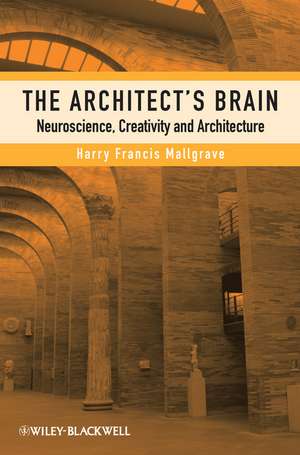
Architects Brain
Autor Harry Francis Mallgraveen Limba Engleză Hardback – 21 dec 2009
Preț: 908.40 lei
Preț vechi: 998.25 lei
-9%
Puncte Express: 1363
Carte tipărită la comandă
Livrare economică 25 august-08 septembrie
Livrare prin curier în România Termenul estimat este afișat lângă disponibilitate.
Transport gratuit pentru acest produs Plată online sau ramburs, în funcție de opțiunile comenzii.
Retur gratuit în 14 zile Comandă securizată și suport în română.
Specificații
ISBN-13: 9781405195850
ISBN-10: 1405195851
Pagini: 288
Dimensiuni: 161 x 240 x 20 mm
Greutate: 0.59 kg
Ediția:New.
Editura: Wiley
Locul publicării:Chichester, United Kingdom
ISBN-10: 1405195851
Pagini: 288
Dimensiuni: 161 x 240 x 20 mm
Greutate: 0.59 kg
Ediția:New.
Editura: Wiley
Locul publicării:Chichester, United Kingdom
V-ar putea interesa
-
 Moonwalking with EinsteinJoshua Foer-19%Preț: 62.95 lei78.14 lei
 -
 The Future of the MindMichio KakuPreț: 78.80 lei
 -
 -34%Preț: 61.12 lei92.95 lei
 -
 Consciousness and the BrainStanislas DehaenePreț: 103.36 lei
 -
 Atlas of Human Brain ConnectionsMarco Catani-33%Preț: 812.90 lei1209.30 lei
 -
 -32%Preț: 62.04 lei91.25 lei
 -
 Brain and MusicStefan KoelschPreț: 349.61 lei
 -
 Modern Architectural TheoryHarry Francis MallgravePreț: 330.78 lei
 -
 Can Neuroscience Change Our MindsHilary Rose-5%Preț: 439.79 lei462.94 lei
 -
 The CerebellumDianne M Broussard-9%Preț: 844.53 lei928.06 lei
 -
 History of Cognitive NeuroscienceM BennettPreț: 293.10 lei
 -
 -9%Preț: 1199.78 lei1318.44 lei
 -
 Architectural Theory V2Mallgrave-23%Preț: 511.45 lei664.22 lei
 -
 Preț: 356.92 lei
 -
 -28%Preț: 1254.74 lei1730.99 lei
 -
 The Power of HabitCharles DuhiggPreț: 85.49 lei
 -
 Naked ArchitectureValerio Paolo Mosco-24%Preț: 170.10 lei223.00 lei
Public țintă
Architects, students and researchers of architecture, those involved with the cognitive and neurosciences.Notă biografică
Harry Francis Mallgrave is a professor of architecture at Illinois Institute of Technology and has enjoyed a distinguished career as an award-winning scholar, translator, and architect. His most recent publications include Modern Architectural Theory: A Historical Survey, 1673-1968, and the two-volume Architectural Theory: An Anthology from Vitruvius to 2005 (Wiley-Blackwell 2008). His forthcoming Introduction to Architectural Theory: 1968 to the Present. A Critical History will be published by Wiley-Blackwell in 2010.
Descriere
This richly detailed study explores the issue of how architects view the phenomenal world. Mallgrave sketches various moments of architectural thought as a cognitive manifestation of philosophical, psychological, and physiological theory. He later repositions this question from the perspective of contemporary neuroscience.