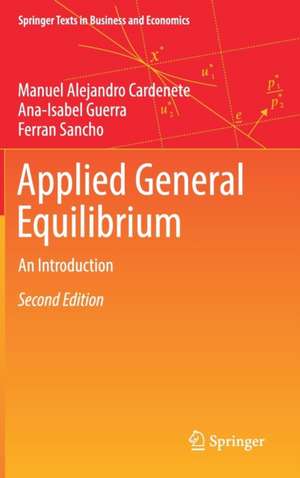
Applied General Equilibrium: An Introduction: Springer Texts in Business and Economics
Autor Manuel Alejandro Cardenete, Ana-Isabel Guerra, Ferran Sanchoen Limba Engleză Hardback – 14 aug 2017
This advanced textbook provides a straightforward but comprehensive introduction to applied general equilibrium modeling. General equilibrium is the backbone of modern economic analysis, which is why generation after generation of economics students have been introduced to it. As an analytical tool, general equilibrium can provide one of the most complete views of a given economy, as it incorporates all economic agents (households, firms, government and the foreign sector) in an integrated way that explicitly reveals the interplay of economic forces—supply and demand—and the balancing role of prices.
Applied general equilibrium goes one step further in modeling, since it entails the integration of microeconomic theory, data handling and computing. This integration is essential for successful empirical modeling, but also involves various abilities that are not found in standard books. This book fills the gap, providing advanced students with the required tools,
from the construction of consistent and applicable general equilibrium models to the interpretation of the results that ensue from the adoption of policies. This second edition expands the range of topics covered, including: indispensable general equilibrium theory, step-by-step model design, incremental model extensions, a wealth of sample computer code, procedures for constructing economic databases, database adjustments and database updating algorithms, numerical model calibration, policy strategies and their trade-offs and welfare effects, and a discussion of empirical policy examples.Applied general equilibrium goes one step further in modeling, since it entails the integration of microeconomic theory, data handling and computing. This integration is essential for successful empirical modeling, but also involves various abilities that are not found in standard books. This book fills the gap, providing advanced students with the required tools,
| Toate formatele și edițiile | Preț | Express |
|---|---|---|
| Paperback (2) | 413.92 lei 38-44 zile | |
| Springer – 21 feb 2014 | 413.92 lei 38-44 zile | |
| Springer Berlin, Heidelberg – 15 aug 2018 | 446.39 lei 38-44 zile | |
| Hardback (1) | 562.55 lei 6-8 săpt. | |
| Springer Berlin, Heidelberg – 14 aug 2017 | 562.55 lei 6-8 săpt. |
Din seria Springer Texts in Business and Economics
- 18%
 Preț: 611.42 lei
 -
 Preț: 200.06 lei
 -
 Preț: 601.10 lei
 - 17%
 Preț: 497.05 lei
 - 18%
 Preț: 612.19 lei
 - 18%
 Preț: 703.30 lei
 - 17%
 Preț: 396.01 lei
 - 20%
 Preț: 750.29 lei
 -
 Preț: 376.10 lei
 - 15%
 Preț: 465.00 lei
 - 15%
 Preț: 448.21 lei
 - 15%
 Preț: 625.44 lei
 -
 Preț: 360.97 lei
 - 18%
 Preț: 722.71 lei
 - 15%
 Preț: 635.80 lei
 - 15%
 Preț: 646.77 lei
 - 15%
 Preț: 672.38 lei
 -
 Preț: 379.89 lei
 - 23%
 Preț: 660.99 lei
 -
 Preț: 373.24 lei
 - 15%
 Preț: 572.59 lei
 - 15%
 Preț: 502.59 lei
 -
 Preț: 510.27 lei
 -
 Preț: 471.15 lei
 -
 Preț: 383.38 lei
 - 15%
 Preț: 573.07 lei
 - 18%
 Preț: 1026.55 lei
 - 15%
 Preț: 527.95 lei
 -
 Preț: 375.07 lei
 -
 Preț: 383.03 lei
 - 45%
 Preț: 320.32 lei
 -
 Preț: 406.24 lei
 - 15%
 Preț: 510.36 lei
 -
 Preț: 332.49 lei
 - 15%
 Preț: 487.32 lei
 -
 Preț: 377.68 lei
 - 15%
 Preț: 482.43 lei
 - 19%
 Preț: 538.82 lei
 - 18%
 Preț: 720.73 lei
 - 15%
 Preț: 508.94 lei
 -
 Preț: 356.30 lei
 -
 Preț: 439.45 lei
 -
 Preț: 373.24 lei
 - 15%
 Preț: 572.76 lei
Preț: 562.55 lei
Preț vechi: 661.82 lei
-15%
Puncte Express: 844
Preț estimativ în valută:
99.49€ • 114.98$ • 85.87£
99.49€ • 114.98$ • 85.87£
Carte tipărită la comandă
Livrare economică 25 aprilie-09 mai
Specificații
ISBN-13: 9783662548929
ISBN-10: 3662548925
Pagini: 176
Ilustrații: XVI, 176 p. 9 illus., 7 illus. in color.
Dimensiuni: 155 x 235 x 18 mm
Greutate: 0.45 kg
Ediția:2nd ed. 2017
Editura: Springer Berlin, Heidelberg
Colecția Springer
Seria Springer Texts in Business and Economics
Locul publicării:Berlin, Heidelberg, Germany
ISBN-10: 3662548925
Pagini: 176
Ilustrații: XVI, 176 p. 9 illus., 7 illus. in color.
Dimensiuni: 155 x 235 x 18 mm
Greutate: 0.45 kg
Ediția:2nd ed. 2017
Editura: Springer Berlin, Heidelberg
Colecția Springer
Seria Springer Texts in Business and Economics
Locul publicării:Berlin, Heidelberg, Germany
V-ar putea interesa
-
 The Wealth of Nations: Books I-IIIAdam SmithPreț: 90.60 lei
 -
 Knowledge and Coordination: A Liberal InterpretationDaniel B. KleinPreț: 252.27 lei
 -
 Keynes: A Very Short IntroductionRobert Skidelsky-20%Preț: 54.43 lei68.32 lei
 -
 Institutional Diversity and Political Economy: The Ostroms and BeyondPaul Dragos Aligica-14%Preț: 660.13 lei767.59 lei
 -
 -29%Preț: 1011.78 lei1425.08 lei
 -
 How Much is Enough?Edward Skidelsky-21%Preț: 59.50 lei75.15 lei
 -
 Optimization in Economics and FinanceBruce D Craven-15%Preț: 613.85 lei722.18 lei
 -
 The Economics of InequalityThomas PikettyPreț: 266.70 lei
 -
 Wolf, M: Shifts and the ShocksMartin Wolf-19%Preț: 72.76 lei90.23 lei
 -
 For a New WestKarl PolanyiPreț: 183.42 lei
 -
 Austrian Economics: Tensions and New DirectionsBruce J. Caldwell-18%Preț: 914.06 lei1114.71 lei
 -
 -18%Preț: 1182.77 lei1442.40 lei
 -
 G.L.S. ShackleP. Earl-15%Preț: 615.48 lei724.10 lei
 -
 Business AdventuresJohn BrooksPreț: 108.34 lei
 -
 Frontiers in EconomicsKlaus F. Zimmermann-15%Preț: 631.40 lei742.82 lei
 -
 -15%Preț: 623.84 lei733.93 lei
 -
 Game Equilibrium Models III: Strategic BargainingReinhard Selten-15%Preț: 621.80 lei731.52 lei
 -
 Mainstream Mathematical Economics in the 20th CenturyPierCarlo Nicola-18%Preț: 925.28 lei1128.39 lei
Cuprins
Introduction.- An Overview of General Equilibrium Theory.- A Simple General Equilibrium Model.- A General Equilibrium Model with a Government Sector.- Further Extensions of the Model: External Sector, Labor Market, Consumption Technology and Welfare Evaluation.- Data Base and Model Calibration.- Real-World Examples of Applied General Equilibrium Analysis.
Notă biografică
Manuel Alejandro Cardenete is Professor of Economics and Vice-rector of Postgraduate Studies at the Universidad Loyola Andalucía (ULA). He is an Associated Researcher at the Universidad Autonóma de Chile and Principal Researcher of HISPAREAL (Hispalis Regional Economics Applications Laboratory). He has co-authored several books including Designing Public Policies, Springer, 2010. He has also published articles in scholarly journals such as Economic Modelling, European Planning Studies, Journal of Forecasting, Environment and Planning A, Regional Studies, Journal of Industrial Ecology and Economic Systems Research. He was Chair of the Department of Economics at ULA (2013-2016), Senior Economist in the European Commission (2011-2013), Professor at the Universidad Pablo de Olavide (2000-2013) and Visiting Researcher at the Regional Economics Applications Laboratory (REAL), University of Illinois at Urbana-Champaign (2002).
Ana-Isabel Guerra
Energy Economics, Economic Modeling, Economic Systems Research and Energy Efficiency. She has visited other research centers and universities: the Fraser of Allander Institute, Strathclyde University, in Scotland in 2008, the Universidad Pablo de Olavide of Seville in 2010, the Edward J. Bloustein School of Planning and Public Policy, at Rutgers University, in 2011 and the University of Gröningen in 2014. She is currently collaborating with the supervision of end-of-master projects in the Official Master in Economics of the University of Granada in topics related to applied general equilibrium models and analysis.Ferran Sancho is Professor in the Department of Economics at the Universitat A
utònoma de Barcelona since 1992. His articles have appeared in the International Economic Review, the European Economic Review, the Review of Economics and Statistics, Economic Theory, Economic Modelling, and the Journal of Forecasting, among others. He has visited the University of California at Berkeley in 1992 and 2003, the Federal Reserve Bank of Minneapolis in 1992, the Universidad Pablo de Olavide in 2010, the Universidad Loyola Andalucía in 2016, and the Universitat de Barcelona in 2017. He has also been Chair of the Department of Economics, Vice-chancellor, and President of the Universitat Autònoma de Barcelona.
Ana-Isabel Guerra
Energy Economics, Economic Modeling, Economic Systems Research and Energy Efficiency. She has visited other research centers and universities: the Fraser of Allander Institute, Strathclyde University, in Scotland in 2008, the Universidad Pablo de Olavide of Seville in 2010, the Edward J. Bloustein School of Planning and Public Policy, at Rutgers University, in 2011 and the University of Gröningen in 2014. She is currently collaborating with the supervision of end-of-master projects in the Official Master in Economics of the University of Granada in topics related to applied general equilibrium models and analysis.Ferran Sancho is Professor in the Department of Economics at the Universitat A
utònoma de Barcelona since 1992. His articles have appeared in the International Economic Review, the European Economic Review, the Review of Economics and Statistics, Economic Theory, Economic Modelling, and the Journal of Forecasting, among others. He has visited the University of California at Berkeley in 1992 and 2003, the Federal Reserve Bank of Minneapolis in 1992, the Universidad Pablo de Olavide in 2010, the Universidad Loyola Andalucía in 2016, and the Universitat de Barcelona in 2017. He has also been Chair of the Department of Economics, Vice-chancellor, and President of the Universitat Autònoma de Barcelona.
Textul de pe ultima copertă
This advanced textbook provides a straightforward but comprehensive introduction to applied general equilibrium modeling. General equilibrium is the backbone of modern economic analysis, which is why generation after generation of economics students have been introduced to it. As an analytical tool, general equilibrium can provide one of the most complete views of a given economy, as it incorporates all economic agents (households, firms, government and the foreign sector) in an integrated way that explicitly reveals the interplay of economic forces—supply and demand—and the balancing role of prices.
Applied general equilibrium goes one step further in modeling, since it entails the integration of microeconomic theory, data handling and computing. This integration is essential for successful empirical modeling, but also involves various abilities that are not found in standard books. This book fills the gap, providing advanced students with the required tools, from the
construction of consistent and applicable general equilibrium models to the interpretation of the results that ensue from the adoption of policies. This second edition expands the range of topics covered, including: indispensable general equilibrium theory, step-by-step model design, incremental model extensions, a wealth of sample computer code, procedures for constructing economic databases, database adjustments and database updating algorithms, numerical model calibration, policy strategies and their trade-offs and welfare effects, and a discussion of empirical policy examples.
Applied general equilibrium goes one step further in modeling, since it entails the integration of microeconomic theory, data handling and computing. This integration is essential for successful empirical modeling, but also involves various abilities that are not found in standard books. This book fills the gap, providing advanced students with the required tools, from the
construction of consistent and applicable general equilibrium models to the interpretation of the results that ensue from the adoption of policies. This second edition expands the range of topics covered, including: indispensable general equilibrium theory, step-by-step model design, incremental model extensions, a wealth of sample computer code, procedures for constructing economic databases, database adjustments and database updating algorithms, numerical model calibration, policy strategies and their trade-offs and welfare effects, and a discussion of empirical policy examples.
Caracteristici
Provides the minimal analytical background for successful model implementation Includes step-by-step procedures for building empirically oriented large-scale economic models Facilitates quick learning by isolating problems and providing solutions in an incremental manner Integrates basic modeling tips with data handling to provide an empirical background to economic models Includes software code in a transparent text format to accompany the chapters (required GAMS software is available free of charge)
Recenzii
From the reviews:
“The authors’ aim is to provide readers with the tools needed to construct their own models. I applaud them for their success. After reading the book, students should be able to build an AGE model because they will have gained an understanding of its internal logic. … this is a very useful book that should be on the shelf of any student of AGE modeling. … Even the most complicated issues are tackled in an easy-to-understand way, which makes the book quite accessible.” (María Teresa Álvarez-Martínez, The Review of Regional Studies, Vol. 42 (1), 2012)
“The authors’ aim is to provide readers with the tools needed to construct their own models. I applaud them for their success. After reading the book, students should be able to build an AGE model because they will have gained an understanding of its internal logic. … this is a very useful book that should be on the shelf of any student of AGE modeling. … Even the most complicated issues are tackled in an easy-to-understand way, which makes the book quite accessible.” (María Teresa Álvarez-Martínez, The Review of Regional Studies, Vol. 42 (1), 2012)
Descriere
Descriere de la o altă ediție sau format:
This book offers a simple, fully operational introduction to applied general equilibrium as an analytical tool in economics. Coverage includes model design, model development, computer code examples, calibration and data adjustments, practical policy examples.
This book offers a simple, fully operational introduction to applied general equilibrium as an analytical tool in economics. Coverage includes model design, model development, computer code examples, calibration and data adjustments, practical policy examples.