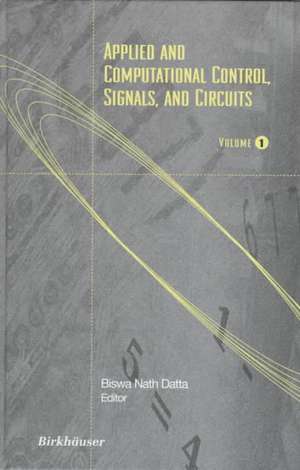
Applied and Computational Control, Signals, and Circuits
Editat de Biswa N. Dattaen Limba Engleză Hardback – 28 iul 1999
Preț: 680.80 lei
Preț vechi: 800.94 lei
-15%
Puncte Express: 1021
Carte tipărită la comandă
Livrare economică 07-21 decembrie
Livrare prin curier în România Termenul estimat este afișat lângă disponibilitate.
Transport gratuit pentru acest produs Plată online sau ramburs, în funcție de opțiunile comenzii.
Retur gratuit în 14 zile Comandă securizată și suport în română.
Specificații
ISBN-13: 9780817639549
ISBN-10: 0817639543
Pagini: 564
Ilustrații: XXI, 539 p.
Dimensiuni: 160 x 241 x 35 mm
Greutate: 0.95 kg
Ediția:1999
Editura: Birkhäuser Boston
Locul publicării:Boston, MA, United States
ISBN-10: 0817639543
Pagini: 564
Ilustrații: XXI, 539 p.
Dimensiuni: 160 x 241 x 35 mm
Greutate: 0.95 kg
Ediția:1999
Editura: Birkhäuser Boston
Locul publicării:Boston, MA, United States
V-ar putea interesa
-
 Signals and Systems Using MATLAB®Aydin Akan-31%Preț: 676.23 lei981.55 lei
 -
 -39%Preț: 622.57 lei1028.93 lei
 -
 Numerical RecipesWilliam H. Press-14%Preț: 872.22 lei1014.21 lei
 -
 Data-Driven Science and EngineeringSteven L. Brunton-22%Preț: 386.74 lei496.40 lei
 -
 -11%Preț: 674.61 lei758.00 lei
 -
 Matrix ComputationsGene H. Golub-15%Preț: 494.62 lei581.91 lei
 -
 Signals and SystemsChi-Tsong ChenPreț: 156.42 lei
 -
 Foundations of Analog and Digital Electronic CircuitsAnant Agarwal-28%Preț: 546.19 lei754.30 lei
 -
 Robust and Adaptive ControlEugene LavretskyPreț: 542.07 lei
 -
 Signals and Systems with MATLAB® and Simulink®Farzin AsadiPreț: 431.01 lei
 -
 Advanced Topics in Electric CircuitsZdzislaw Trzaska-18%Preț: 999.63 lei1219.06 lei
 -
 Statistics for ScientistsUmberto Michelucci-20%Preț: 279.62 lei349.53 lei
 -
 Advanced Control Methods for Industrial ProcessesPablo A. López-Pérez-23%Preț: 701.54 lei911.09 lei
 -
 -20%Preț: 323.23 lei404.04 lei
 -
 Distributed Coordination Control SystemYongnan Jia-18%Preț: 812.36 lei990.69 lei
 -
 Control and Information SciencesI. Thirunavukkarasu-18%Preț: 1461.00 lei1781.72 lei
 -
 -24%Preț: 2041.25 lei2685.84 lei
Public țintă
ResearchCuprins
1 Discrete Event Systems: The State of the Art and New Directions.- 1.1 Introduction.- 1.2 DES Modeling Framework.- 1.3 Review of the State of the Art in DES Theory.- 1.4 New Directions in DES Theory.- 1.5 Decentralized Control and Optimization.- 1.6 Failure Diagnosis.- 1.7 Nondeterministic Supervisory Control.- 1.8 Hybrid Systems and Optimal Control.- References.- 2 Array Algorithms forH2andH?Estimation.- 2.1 Introduction.- 2.2H2Square Root Array Algorithms.- 2.3HO?Square Root Array Algorithms.- 2.4H2Fast Array Algorithms.- 2.5HO?Fast Array Algorithms.- References.- 2.A Unitary and Hyperbolic Rotations.- 2.B Krein Spaces.- 3 Nonuniqueness, Uncertainty, and Complexity in Modeling.- 3.1 Introduction.- 3.2 Issues of Models and Modeling.- 3.3 Nonuniqueness.- 3.4 Uncertainty.- 3.5 Complexity.- 3.6 Formulation of Model Set Identification.- 3.7 Learning or Optimization?.- 3.8 Conclusion.- References.- 4 Iterative Learning Control: An Expository Overview.- 4.1 Introduction.- 4.2 Generic Description of ILC.- 4.3 Two Illustrative Examples of ILC Algorithms.- 4.4 The Literature, Context, and Terminology of ILC.- 4.5 ILC Algorithms and Results.- 4.6 Example: Combining Some New ILC Approaches.- 4.7 Conclusion: The Past, Present, and Future of ILC.- References.- 5 FIR Filter Design via Spectral Factorization and Convex Optimization.- 5.1 Introduction.- 5.2 Spectral Factorization.- 5.3 Convex Semi-infinite Optimization.- 5.4 Lowpass Filter Design.- 5.5 Log-Chebychev Approximation.- 5.6 Magnitude Equalizer Design.- 5.7 Linear Antenna Array Weight Design.- 5.8 Conclusions.- References.- 5.A Appendix: Spectral Factorization.- 6 Algorithms for Subspace State-Space System Identification: An Overview.- 6.1 System Identification: To Measure Is To Know’.- 6.2 Linear SubspaceIdentification: An Overview.- 6.3 Comparing PEM with Subspace Methods.- 6.4 Statistical Consistency Results.- 6.5 Extensions.- 6.6 Software and DAISY.- 6.7 Conclusions and Open Research Problems.- References.- 7 Iterative Solution Methods for Large Linear Discrete Ill-Posed Problems.- 7.1 Introduction.- 7.2 Krylov Subspace Iterative Methods.- 7.3 Tikhonov Regularization.- 7.4 An Exponential Filter Function.- 7.5 Iterative Methods Based on Implicitly Defined Filter Functions.- 7.6 Toward a Black Box.- 7.7 Computed Examples.- References.- 8 Wavelet-Based Image Coding: An Overview.- 8.1 Introduction.- 8.2 Quantization.- 8.3 Transform Coding.- 8.4 Wavelets: A Different Perspective.- 8.5 A Basic Wavelet Image Coder.- 8.6 Extending the Transform Coder Paradigm.- 8.7 Zerotree Coding.- 8.8 Frequency and Space-Frequency Adaptive Coders.- 8.9 Utilizing Intra-band Dependencies.- 8.10 Future Trends.- 8.11 Summary and Conclusion.- References.- 9 Reduced-Order Modeling Techniques Based on Krylov Subspaces and Their Use in Circuit Simulation.- 9.1 Introduction.- 9.2 Reduced-Order Modeling of Linear Dynamical Systems.- 9.3 Linear Systems in Circuit Simulation.- 9.4 Krylov Subspaces and Moment Matching.- 9.5 The Lanczos Process.- 9.6 Lanczos-Based Reduced-Order Modeling.- 9.7 The Arnoldi Process.- 9.8 Arnoldi-Based Reduced-Order Modeling.- 9.9 Circuit-Noise Computations.- 9.10 Concluding Remarks.- References.- 10 SLICOT—A Subroutine Library in Systems and Control Theory.- 10.1 Introduction.- 10.2 Why Do We Need More Than MATLAB Numerics?.- 10.3 Retrospect.- 10.4 The Design of SLICOT.- 10.5 Contents of SLICOT.- 10.6 Performance Results.- 10.8 Concluding Remarks.- References.- 10.A Contents of SLICOT Release 3.0.- 10.B Electronic Access to the Library and Related Literature.