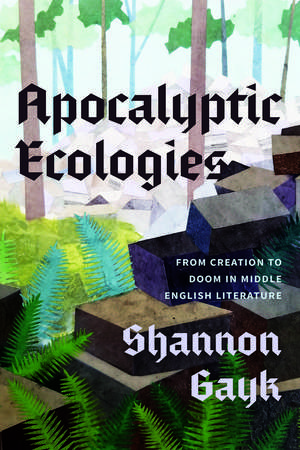
Apocalyptic Ecologies: From Creation to Doom in Middle English Literature
Autor Professor Shannon Gayken Limba Engleză Paperback – 6 dec 2024
When a series of ecological disasters swept medieval England, writers turned to religious storytelling for precedents. Their depictions of biblical floods, fires, storms, droughts, and plagues reveal an unsettled relationship to the natural world, at once unchanging and bafflingly unpredictable. In Apocalyptic Ecologies, Shannon Gayk traces representations of environmental calamities through medieval plays, sermons, and poetry such as Cleanness and Piers Plowman. In premodern disaster writing, she recovers a vision of environmental flourishing that could inspire new forms of ecological care today: a truly apocalyptic sensibility capable of seeing in every ending, every emergency a new beginning waiting to emerge.
| Toate formatele și edițiile | Preț | Express |
|---|---|---|
| Paperback (1) | 254.23 lei 6-8 săpt. | |
| University of Chicago Press – 6 dec 2024 | 254.23 lei 6-8 săpt. | |
| Hardback (1) | 649.82 lei 6-8 săpt. | |
| University of Chicago Press – 6 dec 2024 | 649.82 lei 6-8 săpt. |
Preț: 254.23 lei
Nou
Puncte Express: 381
Preț estimativ în valută:
44.98€ • 52.82$ • 39.49£
44.98€ • 52.82$ • 39.49£
Carte tipărită la comandă
Livrare economică 27 ianuarie-10 februarie 26
Preluare comenzi: 021 569.72.76
Specificații
ISBN-13: 9780226837611
ISBN-10: 0226837610
Pagini: 304
Ilustrații: 4 halftones
Dimensiuni: 152 x 229 x 20 mm
Greutate: 0.45 kg
Ediția:First Edition
Editura: University of Chicago Press
Colecția University of Chicago Press
ISBN-10: 0226837610
Pagini: 304
Ilustrații: 4 halftones
Dimensiuni: 152 x 229 x 20 mm
Greutate: 0.45 kg
Ediția:First Edition
Editura: University of Chicago Press
Colecția University of Chicago Press
Notă biografică
Shannon Gayk is professor of English at Indiana University, Bloomington. She is the author of Image, Text, and Religious Reform in Fifteenth Century England.
Cuprins
Introduction: Learning to Die
Excursus: A Brief History of Medieval Climate Change
Part I. Edenic Ecologies
1. Being Earth: Performing the “Fayre Processe” of Creation
2. “This Deadly Life”: Elegy and Ecological Care after Eden
Part II. Everyday Apocalypse
Excursus: On Plague, Precedent, and the Punishment Paradigm
3. Becoming Beholden: Floods, Fires, and Acts of Attention
4. Ordinary Apocalypses: Wondrous Weather in Early England
Part III. Apocalyptic Ecologies
5. Fifteen Ways of Looking: Signs at the End of the World
Epilogue: Learning to Love: Ecological Attention and the Work of Care
Acknowledgments
Notes
Abbreviations
Bibliography
Index
Excursus: A Brief History of Medieval Climate Change
Part I. Edenic Ecologies
1. Being Earth: Performing the “Fayre Processe” of Creation
2. “This Deadly Life”: Elegy and Ecological Care after Eden
Part II. Everyday Apocalypse
Excursus: On Plague, Precedent, and the Punishment Paradigm
3. Becoming Beholden: Floods, Fires, and Acts of Attention
4. Ordinary Apocalypses: Wondrous Weather in Early England
Part III. Apocalyptic Ecologies
5. Fifteen Ways of Looking: Signs at the End of the World
Epilogue: Learning to Love: Ecological Attention and the Work of Care
Acknowledgments
Notes
Abbreviations
Bibliography
Index
Recenzii
"There is a deep beauty in the way Gayk unwraps . . . the tensions and imperfections of our engagement with the environment, both then and now."
"Throughout its careful studies of how writers reshaped biblical narratives, Apocalyptic Ecologies challenges the received idea of medieval Christianity as overwhelmingly anthropocentric . . . Apocalyptic Ecologies is fundamentally a work of medieval literary
criticism, emerging from its author’s deep knowledge of premodern Christian thought. However, it offers several points of access for the general reader, including summaries of historical events and literary conventions."
criticism, emerging from its author’s deep knowledge of premodern Christian thought. However, it offers several points of access for the general reader, including summaries of historical events and literary conventions."
"Gayk stages an encounter between the endangered landscapes of the present and the disasters of Middle English literature to consider how impending doom can open new possibilities for relating to the world. The result is a uniquely affecting and persuasive methodological experiment, which brings together attentive formalism, historicist accounts of the medieval environment, and personal essays to seek new ways to cope with catastrophe across multiple scales, from the local to the cosmic. . . . Apocalyptic Ecologies is a haunting book, in the best sense of the word. It calls us to rethink what it means to read, write, and teach at a time of catastrophe and casts the love of language and love of creation as twinned aspects of committing to a dying world."
"The author's enterprise and originality are praiseworthy . . . [Apocalyptic Ecologies] has something to say and enables others to say more, and for that reason alone deserves special notice."
"In this sensitive and searching new book, Shannon Gayk examines medieval English poems, plays, and sermons that draw on sacred history to understand the causes and consequences of such disasters, reimagining biblical stories in response to environmental catastrophes real and imagined. . . . Gayk combines research and analysis with reflections on the environments that have shaped her life, to produce a work of nuanced scholarship that is also a timely personal meditation on how we can think through apocalypses past, present, and future."
"A study that is both deeply personal and also a master class in the close reading of a wide swath of late medieval English literature. As such, this volume occupies that rare place where few scholarly studies ever reach: a valuable contribution to the field that can also be read with profit and enjoyment by a general audience."
“At once intimate and historically far-ranging, Apocalyptic Ecologies is a lyrical meditation on how societies grapple with the effects of natural disaster. Beautifully written, it makes the compelling case that medieval writers offer us not just a pageant of weather disasters drawn from the Old and New Testaments but instead provide modern readers with urgently needed models of ecological connection and environmental stewardship.”
“Apocalyptic Ecologies will be a transformative book in premodern studies and across the environmental humanities. With eloquence and great erudition, Gayk traces the apocalyptic edges of medieval ecological imaginings, revealing vital new perspectives on a world that thought about its own end times in ways that haunt us still. A moving and powerful book.”
“Apocalyptic Ecologies offers an illuminating account of environmental thinking in premodern vernacular literature. Through beautiful readings of medieval plays and poetry, punctuated with moving reflections on her own experiences of flux in the twenty-first century, Gayk opens up medieval literature as a source of both comfort and challenge to contemporary readers living through what often seem to be the end days.”