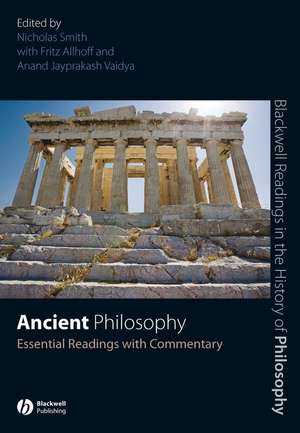
Ancient Philosophy
Autor Nick Smithen Limba Engleză Paperback – 29 feb 2008
- Focuses on the key philosophers and their texts, from Pre-Socratic thinkers through to the Neo-Platonists
- Brings together the key primary writings of Thales, Xenophanes, Parmenides, Anaxagoras, Gorgias, Plato, Aristotle, Epicurus, Lucretius, Seneca, Sextus Empiricus, Plotinus, and many others
- Is broken down into eight chronological sections for easy comprehension and comparison
- The readings are accompanied by expert commentary from the editors
Preț: 387.02 lei
Puncte Express: 581
Carte tipărită la comandă
Livrare economică 09-23 noiembrie
Livrare prin curier în România Termenul estimat este afișat lângă disponibilitate.
Transport gratuit de la 400.00 lei Plată online sau ramburs, în funcție de opțiunile comenzii.
Retur gratuit în 14 zile Comandă securizată și suport în română.
Specificații
ISBN-13: 9781405135634
ISBN-10: 1405135638
Pagini: 468
Dimensiuni: 170 x 244 x 25 mm
Greutate: 0.8 kg
Editura: Wiley
Locul publicării:Chichester, United Kingdom
ISBN-10: 1405135638
Pagini: 468
Dimensiuni: 170 x 244 x 25 mm
Greutate: 0.8 kg
Editura: Wiley
Locul publicării:Chichester, United Kingdom
V-ar putea interesa
-
 Binary Bullets: The Ethics of CyberwarfareFritz Allhoff-19%Preț: 337.78 lei417.70 lei
 -
 Whiskey and PhilosophyFritz AllhoffPreț: 139.23 lei
 -
 The Betty Ford Center Book of AnswersJames W. West-38%Preț: 73.97 lei118.73 lei
 -
 -48%Preț: 58.04 lei112.14 lei
 -
 Human Excellence: Dialogues on Virtue TheoryDaniel A. Putman-34%Preț: 348.60 lei528.58 lei
 -
 Michael and the Two-Horned BeastBernard Nesfield-CooksonPreț: 153.30 lei
 -
 Preț: 470.92 lei
 -
 -11%Preț: 477.49 lei536.51 lei
 -
 Physicians at WarFritz Allhoff-18%Preț: 900.93 lei1098.70 lei
 -
 Nanotechnology & SocietyFritz AllhoffPreț: 391.82 lei
 -
 Medieval PhilosophyGyula KlimaPreț: 321.22 lei
 -
 Immortality DefendedLesliePreț: 189.67 lei
 -
 Central Issues of PhilosophyJ ShandPreț: 339.28 lei
 -
 Writing to ReasonMogckPreț: 246.62 lei
 -
 Preț: 444.37 lei
 -
 War Torture TerrorRodinPreț: 263.97 lei
 -
 What Is NanotechnologyAllhoffPreț: 385.19 lei
 -
 Ethics Psychotherapists CounseMitchell M. Handelsman-5%Preț: 261.55 lei275.31 lei
 -
 Postmodernism and Social TheorySeidmanPreț: 421.29 lei
 -
 PROBLEMS IN PHILOSOPHYMcginnPreț: 386.16 lei
 -
 The Philosophy of Religious LanguageDan R. StiverPreț: 540.31 lei
 -
 Amicus Plato magis amica veritasRainer Enskat-23%Preț: 1391.29 lei1806.87 lei
 -
 Aristoteles' Transzendentaler RealismusBurkhard Hafemann-23%Preț: 1315.64 lei1708.62 lei
 -
 Formale LogikPaul Hoyningen-HuenePreț: 77.98 lei
Public țintă
undergraduates taking courses in ancient philosophyCuprins
Acknowledgments. List of Sources.
Chronology.
Map 1 The Greek World (6th-5th centuries BCE).
Map 2 The Hellenistic Period (323-31 BCE).
Map 3 The Late Roman Empire.
General Introduction.
I: The Presocratics and Sophists:.
1. The Milesians: Thales, Anaximander, and Anaximenes.
2. Xenophanes of Colophon, Heracleitus of Ephesus, and Pythagoras of Samos.
3. The Eleatics: Parmenides, and Zeno of Elea and Melissus of Samos.
4. The Pluralists: Empedocles of Acragas and Anaxagoras of Clazomenae.
5. The Atomists: Leucippus of Elea (or Miletus) and Democritus of Abdera.
6. The Sophists: Protagoras of Abdera, Gorgias of Leontini, and Antiphon.
II: Xenophon:.
Introduction.
7. Memorabilia.
III: Plato:.
Introduction.
8. Euthyphro.
9. Apology.
10. Crito.
11. Meno.
12. Phaedo.
13. Symposium.
14. Republic.
15. Parmenides.
16. Timaeus.
IV: Aristotle:.
Introduction.
17. Categories.
18. On Interpretation.
19. Physics.
20. On the Soul.
21. Metaphysics.
22. Nicomachean Ethics.
23. Politics.
V: Diogenes the Cynic:.
Introduction.
24. Diogenes Laertius, Life of Diogenes.
VI: Epicurus and Epicureanism:.
Introduction.
25. Epicurus, Letter to Herodotus; Letter to Menoeceus; Principle Doctrines.
26. Lucretius, On the Nature of Things.
VII: Stoics and Stoicism:.
Introduction.
27. Diogenes Laertius on Stoicism.
28. Epictetus, Manual.
VIII: Skeptics and Skepticism:.
Introduction.
29. Diogenes Laertius, Life of Pyrrho.
30. Sextus Empiricus, Outlines of Pyrrhonism.
31. Sextus Empiricus, Against the Professors.
IX: Neoplatonism:.
Introduction.
32. Plotinus, Enneads.
33. Proclus, On Evil.
Bibliography.
Recommended Further Reading (English-Language Sources).
Index.
Chronology.
Map 1 The Greek World (6th-5th centuries BCE).
Map 2 The Hellenistic Period (323-31 BCE).
Map 3 The Late Roman Empire.
General Introduction.
I: The Presocratics and Sophists:.
1. The Milesians: Thales, Anaximander, and Anaximenes.
2. Xenophanes of Colophon, Heracleitus of Ephesus, and Pythagoras of Samos.
3. The Eleatics: Parmenides, and Zeno of Elea and Melissus of Samos.
4. The Pluralists: Empedocles of Acragas and Anaxagoras of Clazomenae.
5. The Atomists: Leucippus of Elea (or Miletus) and Democritus of Abdera.
6. The Sophists: Protagoras of Abdera, Gorgias of Leontini, and Antiphon.
II: Xenophon:.
Introduction.
7. Memorabilia.
III: Plato:.
Introduction.
8. Euthyphro.
9. Apology.
10. Crito.
11. Meno.
12. Phaedo.
13. Symposium.
14. Republic.
15. Parmenides.
16. Timaeus.
IV: Aristotle:.
Introduction.
17. Categories.
18. On Interpretation.
19. Physics.
20. On the Soul.
21. Metaphysics.
22. Nicomachean Ethics.
23. Politics.
V: Diogenes the Cynic:.
Introduction.
24. Diogenes Laertius, Life of Diogenes.
VI: Epicurus and Epicureanism:.
Introduction.
25. Epicurus, Letter to Herodotus; Letter to Menoeceus; Principle Doctrines.
26. Lucretius, On the Nature of Things.
VII: Stoics and Stoicism:.
Introduction.
27. Diogenes Laertius on Stoicism.
28. Epictetus, Manual.
VIII: Skeptics and Skepticism:.
Introduction.
29. Diogenes Laertius, Life of Pyrrho.
30. Sextus Empiricus, Outlines of Pyrrhonism.
31. Sextus Empiricus, Against the Professors.
IX: Neoplatonism:.
Introduction.
32. Plotinus, Enneads.
33. Proclus, On Evil.
Bibliography.
Recommended Further Reading (English-Language Sources).
Index.
Notă biografică
Nicholas Smith is James F. Miller Professor of Humanities in the Department of Philosophy at Lewis & Clark College. He has been involved in the writing of several distinguished essays and over fifteen books, including Plato's Socrates with T. C. Brickhouse, which won the Outstanding Academic Book for 1995 award from Choice. Fritz Allhoff is Assistant Professor of Philosophy at Western Michigan University.
Anand Jayprakash Vaidya is Assistant Professor of Philosophy at San José State University.
Anand Jayprakash Vaidya is Assistant Professor of Philosophy at San José State University.
Descriere
Part of The Blackwell Readings in Philosophy Series, this survey of ancient philosophy explores the scope of ancient philosophy, focusing on the key philosophers and their texts, examining how the foundations of philosophy as we know it were laid.